BPO Service Level Agreements: What to Include
A strong BPO service level agreement turns a vague promise into measurable commitments. Here are the metrics, reporting rules and remedies every outsourcing SLA should contain.
In this article
A service level agreement is the part of an outsourcing contract that says, in numbers, what good service looks like. Without one, "good" means whatever each side remembers it meaning. With one, both parties can see whether the work is on track.
This guide covers what a strong service level agreement (SLA) contains for BPO and staffing work.
Why the SLA matters
Outsourcing moves work to people you do not manage day to day. The SLA is how you keep visibility and control. It also protects the provider, because clear targets stop disputes about expectations.
A good SLA does three things:
- Defines the work in measurable terms.
- Creates a shared scoreboard both sides trust.
- Sets out the remedy when results fall short.
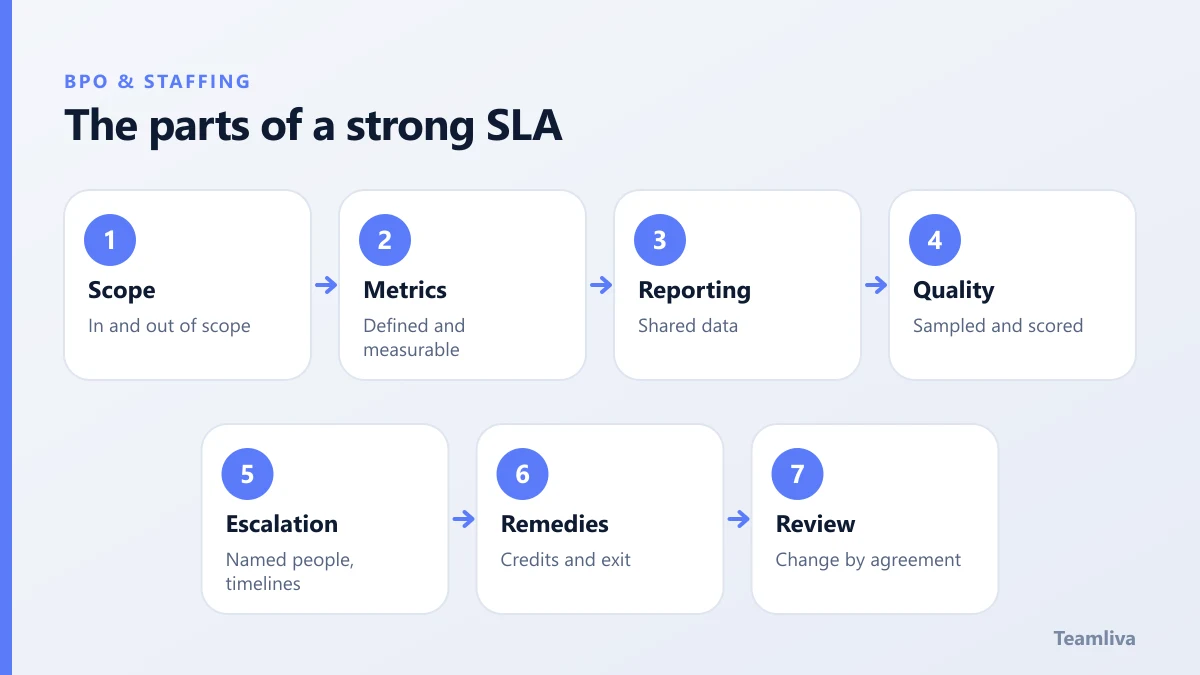
The core elements of a service level agreement
Scope of service
Describe the tasks, channels, hours and volume ranges covered. State what is out of scope. Ambiguity here causes most later disagreements.
Metrics and targets
Choose measures that reflect real outcomes. Typical examples include:
- Response time, such as first response within a set number of minutes or hours.
- Resolution time for each request category.
- Accuracy or quality score, based on reviewed samples.
- Availability, meaning the hours the team is staffed.
- Turnaround time for back-office batches, such as document processing.
- Customer satisfaction where you survey end customers.
Define each metric precisely. State how it is calculated, over what period and from which data source.
Measurement and reporting
Agree who measures, how often and in what format. Weekly operational reports and a monthly review are common. Both sides should be able to check the underlying data.
Quality assurance
Describe how quality is sampled and scored. For example, "twenty reviewed items per agent per month, scored against an agreed checklist." Share the checklist with the team.
Security and confidentiality
Set requirements for data handling, access controls, device security and confidentiality. If regulated data is involved, reference the applicable rules and required agreements.
Escalation path
Name the people and the timelines. Who is contacted first, and when does a problem move up a level? A simple three-step ladder is enough for most engagements.
Remedies
Spell out what happens if targets are missed:
- A root-cause review and written corrective plan.
- Service credits for defined shortfalls.
- Termination rights for repeated or severe failures.
Review and change process
Business needs change. Build in a regular review, such as quarterly, where targets and scope can be revised by agreement.
Practical tips for writing SLAs
- Start with outcomes. Ask what the business needs, then choose metrics that show it.
- Keep the list short. Four to six well-chosen metrics beat fifteen vague ones.
- Balance speed and quality. A team measured only on speed will cut corners.
- Be realistic during ramp-up. Allow a launch period with relaxed targets.
- Use ranges where volume varies. Targets should hold across an agreed volume band.
Example: a support SLA in outline
- Email first response: within four business hours.
- Chat first response: within two minutes.
- Quality score: at least 90 percent on reviewed tickets.
- Customer satisfaction: reviewed monthly against an agreed baseline.
- Reporting: weekly summary and monthly review.
These numbers are illustrations only. Set your own from real data, not from a template.
How this fits your outsourcing plan
The SLA is one step in a broader plan. If you are still deciding what to outsource, read BPO versus in-house teams. If you are ready to launch, our customer support outsourcing setup guide shows the whole sequence. For a wider framework on managing services, see ITIL guidance, which many providers follow.
Teamliva agrees the SLA during scoping, before a pod launches. You can see how that works on our BPO solutions page.
Common SLA mistakes
Even careful teams make the same errors.
- Measuring what is easy instead of what matters. Speed is simple to count. Accuracy needs sampling, but it protects your customers.
- Vague definitions. "Timely response" means different things to different people. Say how many hours, and count from when.
- No baseline. Targets set without reference to current performance are guesses.
- Penalties without partnership. Credits are a safety net, not a strategy. The best agreements focus on shared improvement.
Questions to ask before you sign
- How is each metric calculated, and who owns the data?
- What happens during ramp-up while the team learns your work?
- How are changes in volume handled?
- What is the process for updating the SLA?
- How quickly will you tell us about a problem, not just report it later?
Good partners welcome these questions, because they make the relationship easier to run.
The takeaway
A service level agreement turns outsourcing from trust into evidence. Define the scope, choose a few meaningful metrics, agree how they are measured and set out remedies. Then review it regularly, because the best SLAs change with the business. To talk through targets for your own operation, contact us.
Frequently asked questions
What is a BPO service level agreement?
It is the part of an outsourcing contract that defines the measurable standards the provider must meet, such as response time, accuracy and availability, plus how they are reported and what happens if they are missed.
How many SLA metrics should we track?
Fewer is better. Most engagements do well with four to six metrics that map directly to what the business cares about. Too many metrics dilute attention.
What should happen if the provider misses an SLA?
The agreement should define a review process, a corrective action plan and, where appropriate, service credits. Repeated or serious misses should allow escalation or termination.
- #sla
- #bpo
- #outsourcing
- #service levels