BPO vs In-House Teams: How to Decide What to Outsource
Not every function belongs outside the company. A practical framework for deciding which work to outsource to a BPO partner and which to keep in-house.
In this article
Business process outsourcing (BPO) means handing a defined business function to an external team that runs it for you. Done well, it adds capacity quickly and lets your core team focus on the work only they can do. Done badly, it creates a quality gap and a management burden. The difference is usually decided before the contract is signed — in choosing what to outsource.
Start with the nature of the work
A useful first filter is to sort functions by two questions: how repeatable is the work, and how much company-specific judgement does it need?
- Repeatable, well-defined, measurable — strong candidates for BPO. Examples: customer support queues, order management, data processing, billing operations, appointment scheduling, outbound calling.
- Judgement-heavy, strategic or relationship-critical — usually better kept in-house. Examples: product decisions, key-account management, pricing strategy.
- In between — often outsourced in part, with your team owning escalations and exceptions.
Weigh the real trade-offs
Reasons to outsource
- Capacity on demand, without a long hiring cycle.
- Coverage across time zones, including extended or overnight hours.
- Lower fully loaded cost for the right kind of work.
- A managed team with its own supervision and quality process.
Reasons to keep it in-house
- The work is core to how you differentiate.
- Volume is too low or too irregular to justify a dedicated team.
- You are still figuring out the process — outsourcing a process you have not stabilised tends to outsource the confusion too.
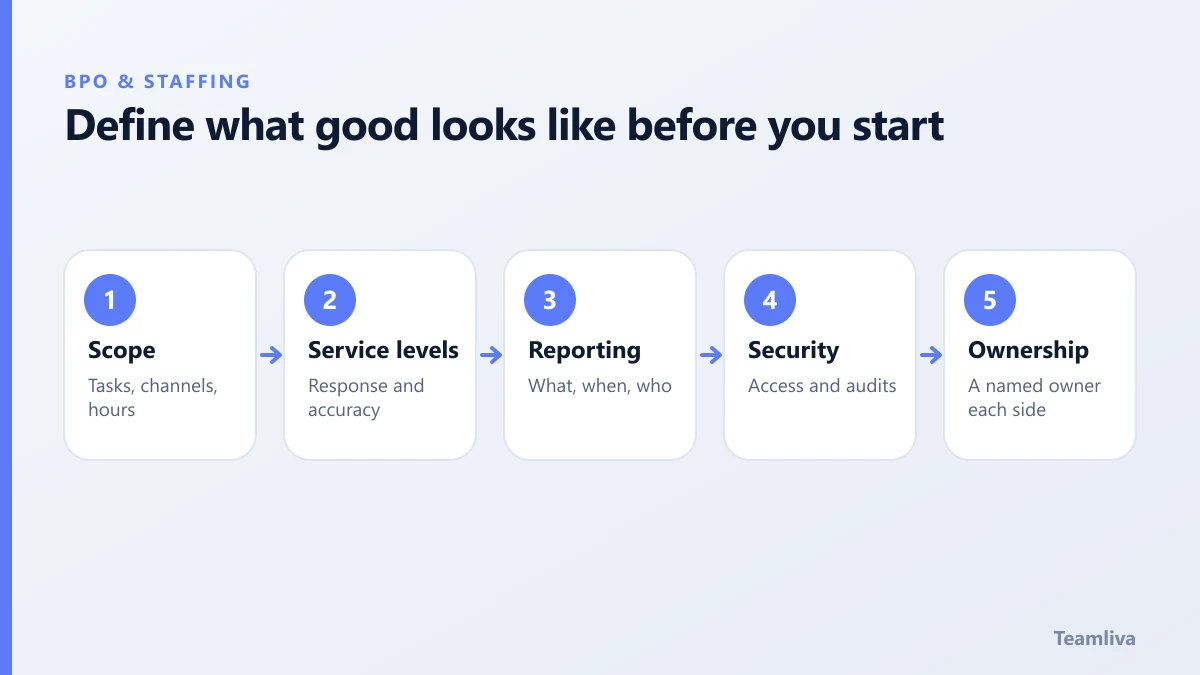
Define what "good" looks like before you start
Outsourcing succeeds on clarity. Before launch, agree:
- Scope — the exact tasks, channels and hours covered.
- Service levels — response times, accuracy targets, escalation paths.
- Reporting — what you will see, how often, and who reviews it.
- Security — how data is handled, who has access and how it is audited.
- Ownership — a named team lead on their side and a named owner on yours.
Start small and structured
Rather than moving an entire function at once, many companies begin with a single pod sized to the work — from one dedicated specialist up to a managed team of ten or more — and expand once the process is proven. Our BPO and staffing solutions are organised this way, with pods scoped, secured and launched under an agreed SLA.
A quick decision checklist
- Is the work repeatable and documented (or documentable)?
- Can quality be measured objectively?
- Is there enough steady volume to keep a team busy?
- Do we have someone who will own the relationship?
- Are the security and compliance requirements clear?
If most answers are yes, the function is a good candidate. If several are no, fix the process first.
To see how this maps onto your own operations, talk to our operations desk or read more about customer support and back-office outsourcing.
Frequently asked questions
What kinds of work are usually a good fit for BPO outsourcing?
Repeatable, process-driven work with clear quality measures: customer support, order and back-office processing, data entry, billing operations and outbound calling. Work that depends on deep company-specific judgement is usually better kept in-house.
How do I keep quality high with an outsourced team?
Agree measurable service levels up front, review them on a fixed cadence, and make sure the partner has a named team lead who is accountable for the results.
- #bpo
- #outsourcing
- #staffing