Customer Support Outsourcing: A Step-by-Step Setup Guide
Customer support outsourcing can extend your coverage and cut costs, but only if you set it up well. Follow this step-by-step guide to scope, launch and manage an outsourced support team.
In this article
Customer support outsourcing means handing part or all of your customer service work to an external team. Done well, it gives you longer coverage, faster responses and a more predictable cost. Done badly, it produces confused customers and lost trust.
The difference is preparation. This guide walks through a practical setup, step by step.
Why companies choose customer support outsourcing
The usual reasons are simple:
- Coverage. Customers expect answers outside a single time zone's office hours.
- Scale. Volume rises and falls, and hiring cannot always keep up.
- Focus. Internal teams can spend time on complex issues and product improvement.
- Cost. A managed team can be cheaper than the equivalent local headcount.
Before you commit, read our comparison of BPO versus in-house teams. It helps you test whether the work is a good fit at all.
Step 1: Define the scope
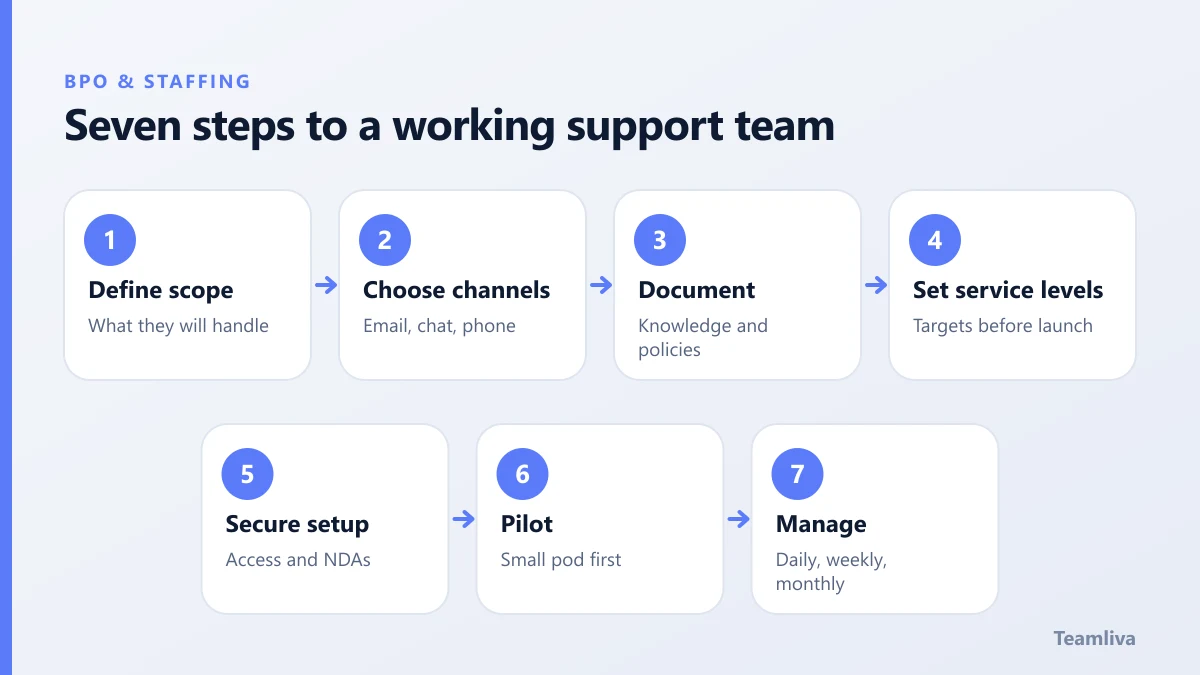
Decide exactly what the outsourced team will handle. List the request types, the channels and the hours. Be explicit about what they will not handle, and where those cases should go.
A useful exercise is to pull three months of tickets and group them by type. The high-volume, low-complexity groups are your first candidates.
Step 2: Choose your channels
Support can run over phone, email, chat and social channels. Start with the channels where you already have clear processes. Add more once the first are stable.
- Email and tickets are easiest to document and audit.
- Chat needs fast response and good macros.
- Phone needs strong voice quality and careful call scripts.
Step 3: Document the knowledge
The team can only be as good as the material you give them. Prepare:
- A product or service overview.
- Answers to the top 50 questions.
- Step-by-step troubleshooting flows.
- Refund, escalation and exception policies.
- Tone-of-voice guidance with examples.
Keep the documents in a shared, versioned location. When something changes, update the document first and then tell the team.
Step 4: Set service levels and quality targets
Agree numbers before launch. Common measures are:
- First response time for each channel.
- Resolution time for each ticket type.
- Accuracy or quality score from reviewed conversations.
- Customer satisfaction from post-contact surveys.
Write them into a service level agreement. Our guide to BPO service level agreements shows what to include.
Step 5: Secure the setup
Support agents often see personal data. Make sure access is limited to what each role needs, workstations are secured and any confidentiality agreements are signed before day one.
Step 6: Start with a pilot
Launch with a small pod on a limited scope. Review conversations daily during the first weeks. Fix documentation gaps quickly and expand only when quality holds.
Step 7: Run a steady management rhythm
- Daily: a short check-in on volume and issues.
- Weekly: review a sample of tickets and share feedback.
- Monthly: review results against targets and plan improvements.
Name one owner on your side and one team lead on theirs. Problems are solved quickly when two people are accountable.
Common mistakes
- Launching without written documentation.
- Measuring only speed and ignoring quality.
- Keeping the outsourced team out of product updates.
- Treating the partner as a black box instead of part of the team.
How Teamliva approaches it
Teamliva builds support pods sized to the work, from one specialist to a managed team, with the scope, security and service levels agreed before launch. See the details on our BPO and staffing solutions page.
Measuring success after launch
Once the team is live, watch a few numbers to see whether the arrangement is working.
- First response and resolution times against the targets in your agreement.
- Quality scores from reviewed conversations.
- Customer satisfaction trends by channel.
- Escalation rate, which shows whether the team has the knowledge and authority to solve problems.
- Repeat contacts, a sign that first answers are not fixing the issue.
Look at the trend, not a single week. A dip after a product launch is normal. A steady decline is a signal to adjust training or documentation.
Standards worth knowing
If you are comparing providers, ask whether they follow a recognised standard for contact centres. The international standard ISO 18295 sets out requirements for customer contact centres and is a useful reference for what good looks like. It does not replace your own targets, but it gives a common language for the conversation.
Choosing the right partner
Look beyond price. A good partner will ask detailed questions about your customers, offer a small pilot instead of pushing a long contract and be open about how they hire, train and supervise agents. Ask for a sample quality report, meet the team lead who would run your account and check how they handle a change in volume. If they promise everything without asking about your processes, be cautious. The best partners behave like an extension of your own team.
The takeaway
Customer support outsourcing succeeds through clear scope, good documentation, measurable targets and steady management. Start small, prove quality and grow from there. When you are ready to plan your own team, talk to our operations desk.
Frequently asked questions
What customer support work is best to outsource?
Repeatable, well-documented work suits outsourcing best: order status, account questions, ticket triage, basic troubleshooting and follow-up. Highly sensitive or novel issues usually stay with an in-house team.
How do I keep quality high with an outsourced team?
Set measurable targets, review a sample of conversations every week, share product updates quickly and hold regular reviews with the team lead on the partner side.
Will customers notice that support is outsourced?
Not if the team is trained on your product, uses your tone and works inside your tools. Quality and consistency matter far more than where the agent sits.
- #customer support
- #outsourcing
- #bpo
- #call center