Back Office Outsourcing: What to Hand Over and What to Keep
Back office outsourcing moves routine, process-driven work to a specialist team. Learn which functions suit it, how to prepare and how to avoid the common pitfalls.
In this article
Every business has work that keeps operations running but does not set it apart. Data entry, order handling, billing tasks and record keeping are good examples. Back office outsourcing gives that work to a specialist team, so your own people can focus on customers and growth.
Here is how to decide what to hand over and how to do it well.
What counts as back office work
Back office functions are the behind-the-scenes activities that support the front line. Typical examples are:
- Data entry and processing. Forms, invoices, records and updates.
- Order management. Processing, tracking and exception handling.
- Finance operations. Invoicing support, payment posting and reconciliation help.
- HR and administration support. Scheduling, document handling and onboarding paperwork.
- Report preparation. Compiling and formatting routine reports.
- Document and email management. Sorting, filing and responding to routine requests.
Which work suits outsourcing
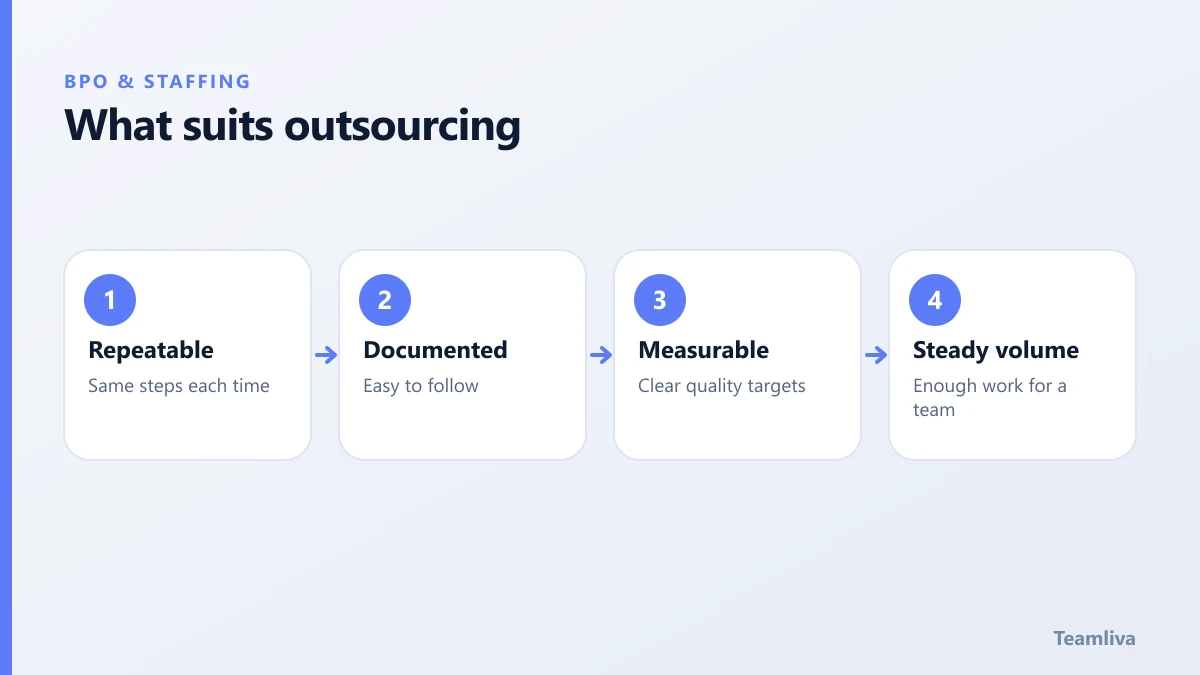
Use a simple filter. The best candidates are:
- Repeatable. The steps are the same each time.
- Documented, or easy to document. Someone new could follow the instructions.
- Measurable. You can define accuracy and turnaround.
- Steady in volume. There is enough work to keep a team useful.
Work that needs constant judgement or holds your competitive edge often stays in-house. Our article on BPO vs in-house teams gives a fuller framework.

The benefits
- Capacity on demand. Add people without a long hiring process.
- Predictable costs. Pay for defined work rather than idle time.
- Extended coverage. Teams in other time zones can process work overnight.
- Focus. Your staff spend more time on tasks that grow the business.
- Consistency. Documented processes produce steadier quality.
How to prepare
Document the process
Write the steps, the rules and the exceptions. Screen recordings help. If it cannot be explained, it cannot be outsourced well.
Define what good looks like
Set targets for accuracy, turnaround and volume. Decide how errors are handled.
Agree the security rules
Decide who can access which systems and data. Use unique logins and multi-factor authentication. Sensitive data needs particular care, as covered in virtual assistant data security.
Start with a pilot
Move one process first. Learn from it, refine the instructions and then expand. A small managed team is a sensible first step.
What to put in the agreement
- The exact scope and hours.
- Service levels and how they are measured.
- Reporting content and frequency.
- Escalation contacts and timelines.
- Data protection, confidentiality and audit rights.
- Notice and exit terms.
Our guide to BPO service level agreements covers these in detail.
Common mistakes
- Outsourcing a process you have not stabilised.
- Handing over everything at once.
- No named owner on your side.
- Focusing on price and ignoring quality.
- Skipping regular reviews.
Signs your business is ready for back office outsourcing
The right time is usually earlier than owners expect. Look for these signals:
- Staff spend a large share of their week on routine processing.
- Backlogs appear whenever volume rises.
- Errors and rework are increasing.
- You are turning down growth because operations cannot keep up.
- Hiring and training take longer than the peaks last.

Building the business case
Compare the full cost of the current approach with an outsourced model. Include salaries, benefits, equipment, management time, training and the cost of errors. Then add the value of what your staff could do with the recovered time. The US Small Business Administration offers general planning resources in its business guide, which can help you shape the numbers.
Governance after launch
Outsourcing does not end the moment the contract is signed. Keep control with a few habits.
- Hold a weekly operational call for the first two months.
- Review the service level report at each meeting.
- Sample the work yourself every week.
- Keep the documentation current, so the process stays clear as things change.
- Meet quarterly to review the scope, volume and priorities.
Good governance keeps the partnership healthy and prevents small issues from becoming disputes.
How Teamliva helps
Teamliva runs managed back-office teams for global brands and healthcare organisations, from one dedicated specialist to a pod of ten or more. Each team works under agreed service levels with a named team lead, and delivery runs from our Dhaka operations centre. Explore our BPO and staffing solutions or contact us.
Quick checklist before you start
- The process is written down, including exceptions.
- Success is defined in numbers: accuracy, turnaround and volume.
- Access is limited, with unique logins and multi-factor authentication.
- A named owner exists on both sides.
- The pilot is small, with a review date in the calendar.
- Exit terms and data return are agreed in writing.
If every item is ticked, you are ready to begin. If not, fix the gap first. It takes far less effort before launch than after.

The takeaway
Back office outsourcing works best for repeatable, documented, measurable work. Prepare the process, agree the standards in writing and start with a pilot. You gain capacity and focus without losing control.
Frequently asked questions
What is back office outsourcing?
It means giving internal support functions, such as data processing, order management, billing operations or record keeping, to an external team that runs them under agreed standards.
Which functions should stay in-house?
Work that needs deep company judgement, defines your strategy or depends on sensitive relationships usually stays in-house. Routine, repeatable work is a better fit for outsourcing.
How do I keep control of outsourced work?
Agree service levels, reporting and escalation rules in writing, name an owner on both sides and review results on a fixed schedule.
- #Teamliva
- #TeamLiva
- #BPO
- #Outsourcing
- #RemoteStaffing
- #BackOfficeOutsourcing
- #Operations
- #CostControl