Data Entry Outsourcing: Costs, Accuracy and How to Start
Data entry outsourcing explained: what work to send, how accuracy is checked, how pricing works, how data is kept secure and how to run a pilot.
In this article
Data entry outsourcing means sending repetitive data work, such as invoices, orders, forms and records, to a trained external team that enters it into your systems to an agreed accuracy and turnaround. Done well, it frees skilled staff and clears backlogs quickly.
What work suits outsourcing
The best candidates are high volume, rule-based and easy to check:
- Invoices, purchase orders and receipts.
- Customer, product and CRM records.
- Forms, applications and surveys.
- Insurance, legal and healthcare documents.
- Catalogue and e-commerce listings.
- Cleaning and de-duplicating existing databases.
Work that needs judgement, negotiation or deep context is usually better kept in-house. Our guide to what back-office work to outsource helps you draw the line.
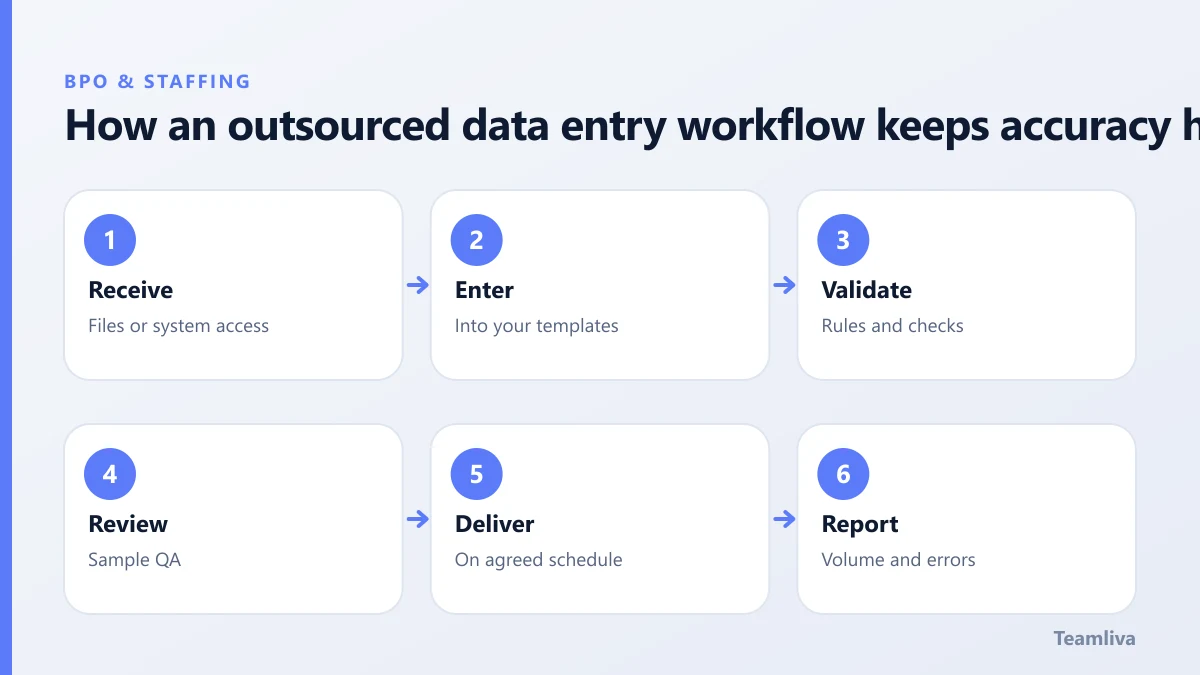
How accuracy is kept high
Accuracy is a process, not a promise. Ask for:
- Clear templates and examples for every document type.
- Validation rules, such as required fields, formats and totals that must match.
- Sample review, where a second person checks a share of entries each day.
- An agreed error-rate target, reported every week.
- A feedback loop, so every error becomes an update to the instructions.

How pricing works
There are three common models: per record or per document, per hour, and a dedicated full-time person. Per-record pricing suits uneven, project-based work. A dedicated person suits steady daily volume and usually gives the lowest cost per entry once they know your work. Our article on BPO pricing models compares each in detail.
Keeping your data secure
Data entry often touches personal or financial information. Require confidentiality agreements, company-managed devices, role-based access to your systems and no local copies of files. If the data includes health information, add a business associate agreement and HIPAA-aligned controls.
Running a pilot
Pick one document type and send two weeks of real volume. Measure accuracy, turnaround and how many questions the team needs to ask. Compare the result against your in-house cost per entry before scaling up.
Data entry outsourcing to Bangladesh
Bangladesh has a large, English-speaking workforce experienced in back-office and data work, at a lower cost than many markets. Our outsourcing to Bangladesh guide covers time zones, communication and how to choose a provider.
Choosing between per-record and dedicated pricing
Per-record pricing is attractive when volume is uneven or when you have a one-off backlog to clear. You pay only for what is entered, and the provider absorbs the idle time. The downside is that every new document type needs a new quote, and rush jobs can cost extra.
A dedicated team member makes more sense once volume is steady. After a few weeks they know your documents, systems and exceptions, so speed and accuracy improve and the cost per entry falls. They can also take on related tasks, such as checking supplier details or updating records, which per-record pricing rarely covers.
Many businesses start with a per-record pilot to test quality, then move to a dedicated person when they are confident in the volume.

Writing instructions that prevent errors
Most data entry errors come from unclear instructions rather than careless work. For every document type, write a one-page guide with an annotated example, the exact field each value belongs in, the formats to use for dates, names and amounts, and what to do when information is missing or unreadable. Keep a running list of questions the team asks, and add the answers to the guide. After a month, the guide becomes the reason quality stays high even when people change.
Signs a provider is the right fit
A good provider asks for samples before quoting, explains its quality checks without being prompted, reports errors openly rather than hiding them, and suggests improvements to your templates. A provider that promises perfect accuracy without asking a single question about your documents is guessing.
Planning for growth
Agree in advance how quickly the team can scale for seasonal peaks, such as year-end invoices or open enrolment forms, and how much notice they need. A provider with trained backup staff can absorb spikes without a drop in accuracy. Ask how many people already know your work, how long it takes to train someone new and whether peak pricing differs from the normal rate.
Key takeaways: data entry outsourcing
- Data entry outsourcing suits high-volume, rule-based work that is easy to check, such as invoices, orders and records.
- Accuracy comes from templates, validation rules, daily sample reviews and an agreed error-rate target.
- Per-record pricing suits uneven or one-off work; a dedicated person suits steady volume and lowers cost per entry.
- Protect data with confidentiality agreements, managed devices, role-based access and no local copies.
- Run a two-week pilot on one document type before scaling up.

How Teamliva helps
Teamliva (Team Liva) provides managed data entry and back-office teams for US and UK businesses, with daily quality checks and weekly reporting. See our back-office outsourcing services or contact us for a pilot.
For a general overview of the term, see data entry on Wikipedia.
Frequently asked questions
What kind of data entry can be outsourced?
Invoices, orders, CRM and product records, forms and surveys, insurance and healthcare documents, catalogues and any repetitive entry into spreadsheets or business systems.
How is accuracy guaranteed?
Through clear templates, validation rules, a second-person review of a sample and an agreed error-rate target that is reported every week.
Is outsourced data entry secure?
It can be, with confidentiality agreements, managed devices, role-based access to your systems and no local copies of sensitive files.
- #Teamliva
- #TeamLiva
- #BPO
- #Outsourcing
- #RemoteStaffing
- #DataEntryOutsourcing
- #OutsourceDataEntry
- #BackOfficeOutsourcing
- #DataProcessing