Freight Dispatch Outsourcing: A Guide for Brokers and Fleets
Freight dispatch outsourcing for brokers, 3PLs and fleets: check calls, load tracking, customer updates, paperwork and how to set up 24/7 coverage.
In this article
Freight dispatch outsourcing gives brokers, 3PLs and fleets a trained remote team for check calls, load tracking, customer updates and paperwork, often around the clock. Your in-house staff stay focused on selling, carrier relationships and solving problems.
Why logistics companies outsource dispatch support
Freight never sleeps, but in-house teams do. Loads move overnight and on weekends, customers expect updates at any hour and paperwork piles up. Hiring local staff for every shift is expensive and hard to staff. An offshore team in a different time zone can cover those hours at a lower cost.
Tasks an outsourced dispatch team can handle
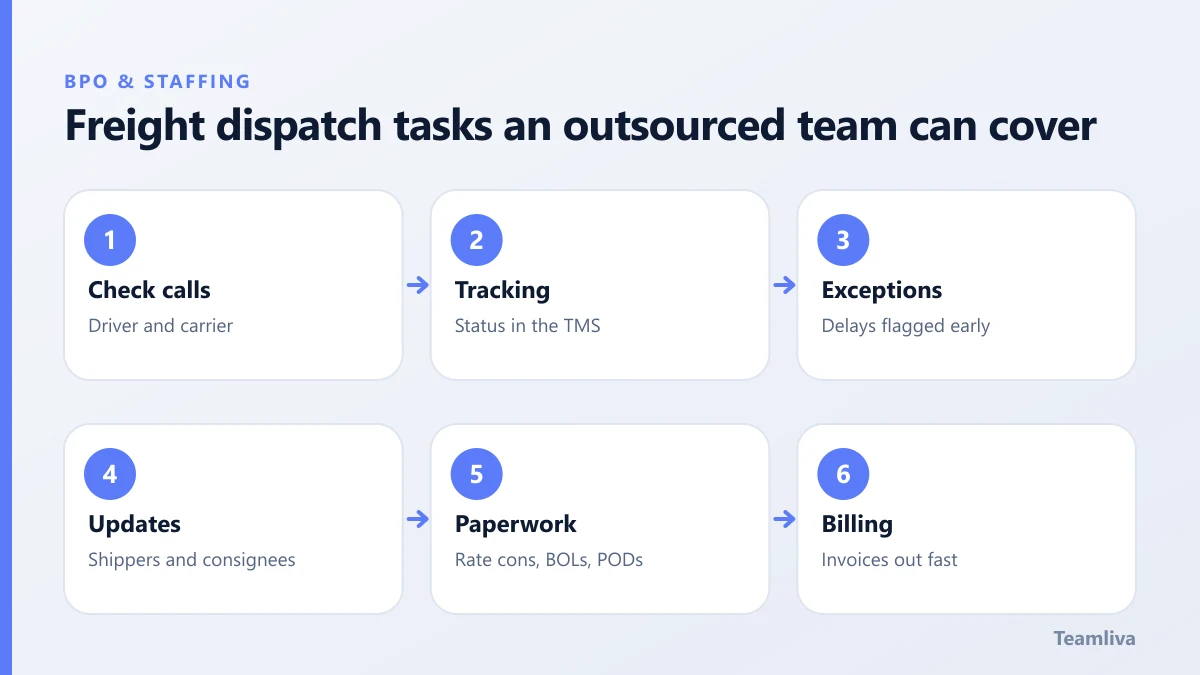
- Check calls with drivers and carriers at agreed intervals.
- Load tracking and status updates in your TMS.
- Exception management: flagging delays, breakdowns and missed appointments early.
- Customer updates to shippers and consignees by email, phone or portal.
- Paperwork: rate confirmations, bills of lading and proof of delivery.
- Carrier onboarding packets and compliance documents.
- Billing support: matching PODs and sending invoices quickly.

What to keep in-house
Rate negotiation, new customer sales, carrier relationship decisions and major claims usually stay with your senior team. Clear rules about what the remote team can decide on their own, and when to escalate, are essential.
Setting up 24/7 coverage
- Map your load volume by hour to see where cover is thin.
- Write exception playbooks: what to do for each common problem and who to call.
- Give TMS access with the right permissions and individual logins.
- Shadow your team for one to two weeks, then take over one shift.
- Hand over at every shift change with a written summary of open issues.
Our article on how to manage an offshore team covers shift handovers and daily routines in more depth.
Metrics to track
Track check-call completion, on-time status updates, exception response time, POD turnaround, invoice turnaround and customer complaints. Faster PODs and invoices also improve cash flow, which is often the biggest win.
Communication and quality
Customer-facing updates must be clear and professional. Ask for writing samples, test calls and a review of the first week's messages. Our guide to omnichannel customer support explains how to keep tone consistent across email, phone and chat.
Writing exception playbooks
Most of the value of a remote dispatch team comes from how it handles problems. Write a short playbook for each common exception: a driver running late for pickup, a missed delivery appointment, a breakdown, a refused load, a temperature alarm and a carrier that stops answering. For each one, set out who to call first, what to tell the customer, what to record in the TMS and when to wake up a manager.
Keep the playbooks to one page each and update them after every serious incident. Over time they become the reason the night shift handles problems as well as your most experienced day staff.

Shift handover routines
Handover is where loads get lost. At the end of every shift, the outgoing team should send a written summary of open exceptions, loads at risk, customers waiting for updates and anything promised that has not happened yet. The incoming team confirms they have read it before the outgoing team logs off. A short overlap of fifteen to thirty minutes makes this far more reliable.
Protecting customer relationships
Customers judge you by how quickly and clearly they hear about problems. Agree a standard for updates, such as notifying the shipper within thirty minutes of a known delay, and use message templates so tone is consistent. Review a sample of customer emails weekly in the first month.
Starting with paperwork
If you are not ready to hand over live tracking, start with paperwork: rate confirmations, bills of lading, proof of delivery collection and invoicing. It is lower risk, frees your dispatchers immediately and often speeds up cash flow, which builds the case for expanding the team. Once paperwork runs smoothly, add overnight check calls on a small group of lanes, then widen coverage as your customers see the difference in response times.
Key takeaways: freight dispatch outsourcing
- Freight dispatch outsourcing covers check calls, load tracking, exception alerts, customer updates and paperwork.
- Offshore teams are well suited to covering nights and weekends so loads are tracked around the clock.
- Keep rate negotiation, sales and major claims in-house, with clear rules for what the remote team decides.
- Exception playbooks and written shift handovers are what keep service consistent across shifts.
- Starting with PODs and invoicing is a low-risk first step that often improves cash flow quickly.

How Teamliva helps
Teamliva (Team Liva) provides dispatch, track-and-trace and customer care teams for US logistics companies. Our logistics dispatch blueprint shows a typical team, and our dedicated offshore teams page explains how we staff it. Contact us to discuss your lanes and volume.
For official US carrier safety and registration information, see the Federal Motor Carrier Safety Administration.
Frequently asked questions
What does an outsourced dispatch team do?
Check calls, load tracking and status updates in your TMS, exception alerts, shipper and consignee communication, rate confirmations, bills of lading, proof of delivery and invoicing support.
Can freight dispatch be outsourced 24/7?
Yes. Offshore teams are commonly used to cover nights and weekends so loads are tracked around the clock.
Which systems do outsourced dispatchers use?
Your transportation management system, such as McLeod or a broker TMS, load boards like DAT, telematics such as Samsara, plus email, phone and chat.
- #Teamliva
- #TeamLiva
- #BPO
- #Outsourcing
- #RemoteStaffing
- #FreightDispatchOutsourcing
- #LogisticsOutsourcing
- #TrackAndTrace
- #FreightBrokerBackOffice