What Is BPO? Business Process Outsourcing Explained Simply
BPO means hiring an outside provider to run a business function. Learn what BPO is, the main types, the benefits and risks, and when it makes sense for your company.
In this article
What is BPO? Business process outsourcing (BPO) is hiring an external provider to run a business function such as customer support, billing or data processing, with the provider responsible for the people, training and day-to-day management. You keep the goals and standards.
Business process outsourcing, or BPO, is the practice of hiring an outside company to run a specific business function. Instead of building the team, the systems and the management yourself, you agree what needs to be done and to what standard, and the provider delivers it. This guide explains what that means in practice.
A simple definition
BPO means contracting a specialist provider to perform a process, such as customer support, billing or data entry, on your behalf. The provider owns the people, the training and the day-to-day management. You own the goals, the standards and the relationship. Wikipedia has a good general overview of business process outsourcing.
The main types of BPO
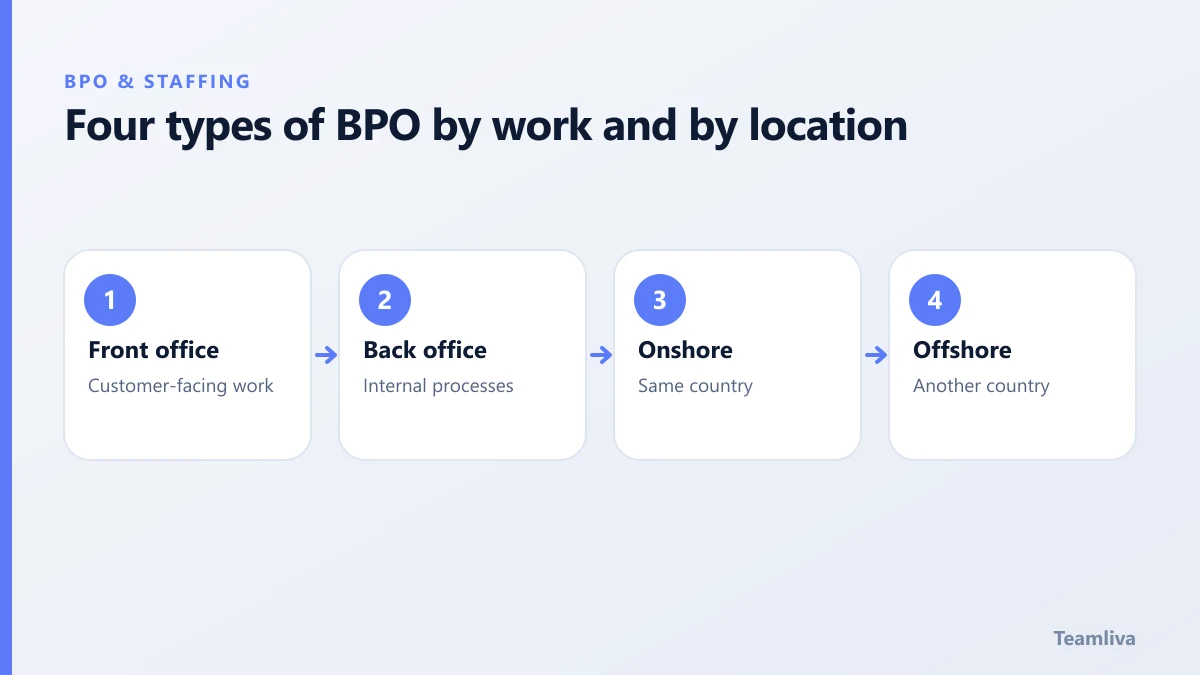
By type of work
- Front-office BPO: customer-facing work such as support, sales support and appointment setting.
- Back-office BPO: internal work such as data entry, billing, payroll administration, records and reporting.
By location
- Onshore: the provider is in your own country.
- Nearshore: the provider is in a nearby country or time zone.
- Offshore: the provider is in a distant country, often for cost or talent reasons.
We compare these models in offshore vs nearshore vs onshore outsourcing.

Common examples
- Customer support by email, chat and phone.
- Medical billing, coding and insurance follow-up.
- Data entry and document processing.
- Virtual assistants for administration.
- Recruitment logistics and HR administration.
- IT support and web maintenance.
Benefits
- Cost control: avoid recruitment, equipment, office space and management overhead.
- Speed: teams can be set up much faster than a hiring cycle.
- Focus: your people spend time on core work.
- Flexibility: scale up and down with demand.
- Expertise: providers run the process every day and know its pitfalls.
Risks to manage
- Loss of control if the scope and reporting are vague.
- Quality gaps without measures and reviews.
- Data and security concerns, especially for regulated data.
- Dependency on one provider without an exit plan.
- Hidden costs if pricing is not itemised.
Each of these is manageable with a clear agreement; see BPO service level agreements.
BPO, staffing and virtual assistants: how they differ
- BPO: the provider delivers a process and its outcomes.
- Staffing: the provider supplies people; you manage them.
- Virtual assistants: individual remote helpers, often managed by a provider. See virtual assistant vs BPO: which do you need.
When BPO makes sense
Outsourcing tends to work when the work is repeatable, measurable, has steady volume and has an owner on your side. Our guide to what to outsource: BPO vs in-house provides a checklist. It works less well for work that defines your competitive edge or is still being figured out.

How to start
- List the process, volumes and quality measures.
- Shortlist providers using our BPO checklist.
- Run a paid pilot.
- Agree service levels and reporting.
- Expand gradually.
What is BPO used for in practice?
Some examples, by function:
- Customer service: answering email, chat and phone questions, and managing tickets.
- Finance and accounting: invoicing, accounts payable and receivable, and reconciliation.
- Human resources: recruitment logistics, payroll administration and records.
- Healthcare: billing, coding, credentialing and patient scheduling.
- Sales and marketing support: lead research, data enrichment and campaign administration.
- IT support: help desk, monitoring and routine maintenance.
How a BPO engagement is usually structured
- Scope: the process, volumes, hours and tools.
- Service levels: measurable targets for quality and speed.
- Governance: named leads, meetings and reporting.
- Pricing: hourly, per person, per transaction or fixed fee.
- Term and exit: length, notice and what happens to data.
Signs BPO is not the right fit
- The work changes daily and cannot be documented.
- The volume is very small and irregular.
- The work is central to what makes your business different.
- You cannot spare anyone to oversee the relationship.
In those cases, a single virtual assistant, or fixing the process first, may be better. See virtual assistant vs BPO.
Key takeaways: what is BPO
- What is BPO in one line: paying a specialist provider to run a business function while you keep the goals and the standards.
- BPO splits into front-office and back-office work, and into onshore, nearshore and offshore locations.
- It works best for repeatable, measurable work with steady volume and a named owner on your side.
- Risks such as quality drift, data exposure and dependency are manageable with service levels, security rules and an exit plan.
- A paid pilot is the safest way to test a provider before you commit.

Where Teamliva fits
Teamliva (Team Liva) is a BPO, staffing and business solutions company in Dhaka serving US clients. Explore our BPO and staffing solutions or contact us to discuss a process.
Frequently asked questions
What does BPO stand for?
BPO stands for business process outsourcing: contracting an external provider to run a business function such as customer support, billing or data processing.
What is the difference between BPO and staffing?
In BPO, the provider is responsible for delivering a process and its results. In staffing, the provider supplies people whom you manage. Many providers offer both.
Is BPO only for large companies?
No. Small and mid-sized businesses often use BPO for functions they cannot justify hiring in-house, starting with a single specialist or a small team.
- #Teamliva
- #TeamLiva
- #BPO
- #Outsourcing
- #RemoteStaffing
- #WhatIsBpo
- #BusinessProcessOutsourcing
- #BpoServices