Virtual Assistant vs BPO: Which Do You Actually Need?
Virtual assistant or BPO provider? Compare scope, management, scale, cost and risk to decide whether you need one helper or a managed team.
In this article
Virtual assistant vs BPO: a virtual assistant is typically one remote person who supports you with tasks, while a BPO provider takes responsibility for a whole process with a managed team, quality controls and reporting. Choose a virtual assistant for tasks and a BPO for functions with volume and service levels.
"Should I hire a virtual assistant or use a BPO?" is a common question, and the two are often confused. They overlap, but they solve different problems. Knowing which fits your situation saves money and frustration.
The core difference
A virtual assistant (VA) is typically an individual remote worker who supports you or your team with tasks. You direct the work.
A BPO provider takes responsibility for a process, with a managed team, quality controls, reporting and service levels. They own the outcome.
Many providers, including Teamliva (Team Liva), offer managed virtual assistants that sit between the two: an individual assistant supported by a managed team.
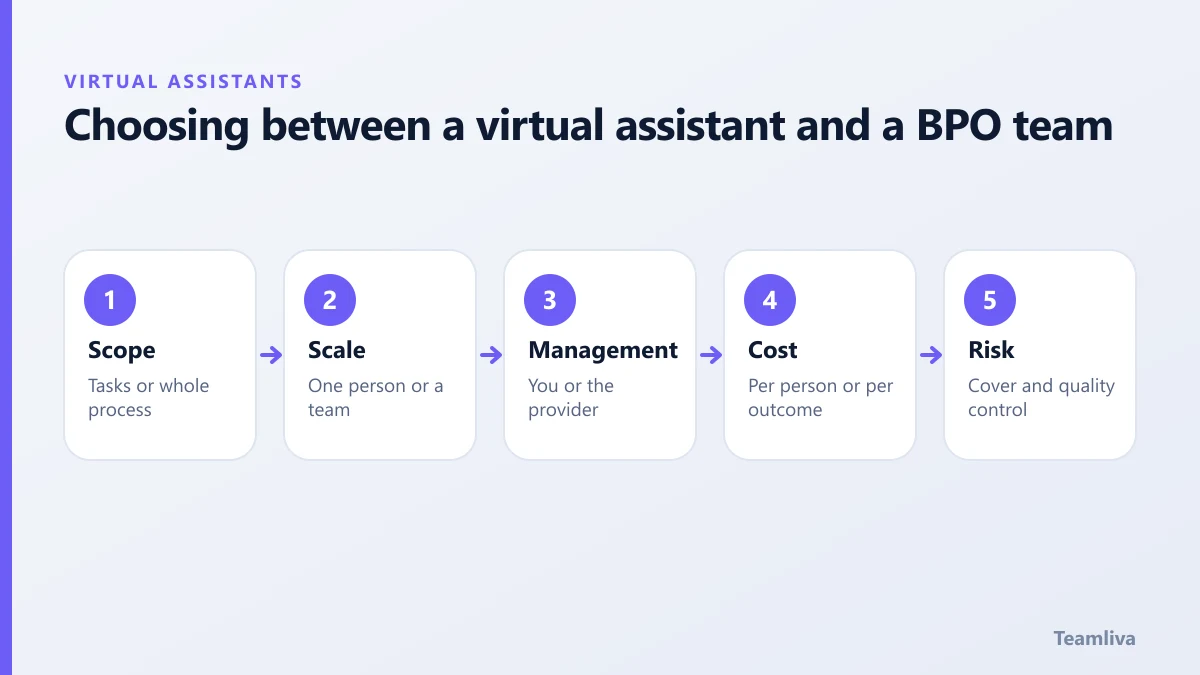
Five factors
1. Scope
A VA suits a defined set of tasks: inbox, scheduling, data entry, replies. A BPO suits a whole function: a support desk, a billing process, a back office.
2. Scale
One or two assistants are enough for personal or small-team support. Once you need five, ten or more people, or round-the-clock coverage, a managed team is more practical.
3. Management
With a VA, you manage the day-to-day, unless you use a managed provider. With BPO, a team lead manages the team and you manage the relationship and results. See how to manage a virtual assistant remotely.
4. Cost structure
A VA is priced per hour or per month. BPO may be per FTE, per transaction or fixed fee. See virtual assistant cost and BPO pricing models.
5. Risk
A single assistant can be absent or leave, and quality depends on one person. A BPO team gives cover, training, sampling and reporting.

When a virtual assistant is the right call
- You have a handful of repeatable tasks and want them off your plate.
- You have the time to direct and review the work, or you use a managed provider.
- Your budget suits part-time support.
- You are testing delegation for the first time. See virtual assistant for small business.
When BPO is the right call
- You want to outsource a full process, not just tasks.
- Volume is significant or growing.
- You need cover, reporting and service levels.
- The work involves compliance, such as healthcare billing. See medical billing outsourcing.
The middle path: managed virtual assistants
A managed assistant gives you a dedicated person, plus a provider who assesses, supervises and covers absences. It suits businesses that want a dedicated helper without doing all the management. Compare providers with best virtual assistant companies: how to compare.
A simple decision tree
- Is it a process with volume and quality targets? Choose BPO.
- Is it a set of tasks for you or a small team? Choose a virtual assistant.
- Do you want a dedicated person with supervision? Choose a managed virtual assistant.
- Unsure? Start with one assistant, document the work and expand later.
Growing from one to many
Documenting your assistant’s work creates the foundation for a BPO team later. Read remote staffing: how to scale your team and BPO vs in-house teams.

Virtual assistant vs BPO: examples
- Founder with an overloaded inbox and calendar: a virtual assistant.
- Clinic needing full billing and follow-up: a BPO or medical billing service.
- Online store with 30 support tickets a day: an assistant at first, a support pod as volume grows.
- Company wanting 24-hour support in several channels: a BPO team.
Cost comparison approach
Calculate the cost of the work you want done in three ways: doing it yourself (your hourly value times hours), using an assistant (monthly fee plus your management time) and using a BPO (fees plus a small amount of oversight). The cheapest option is not always the one with the lowest fee; it is the one with the lowest total cost for the quality you need.
Moving from one model to the other
Start with an assistant, document the work and track volume. When the work outgrows one person, or you need cover and reporting, move it to a managed team, using the same documentation. The transition plan shows how. If you begin with BPO and find a small set of tasks you want handled personally, add an assistant on top.
Key takeaways: virtual assistant vs BPO
- Virtual assistant vs BPO: choose an assistant for tasks and a BPO team for functions with volume, cover and service levels.
- A managed virtual assistant sits in the middle, giving you a dedicated person plus supervision and replacement cover.
- Compare total cost, including your own management time, not just the monthly fee.
- Start with one assistant, document the work and move to a team when volume outgrows one person.
- Regulated work, such as healthcare billing, usually belongs with a specialist team.
Further reading: Virtual assistant (occupation) on Wikipedia.

Ask us
Teamliva (Team Liva) offers both: virtual assistant services and BPO and staffing solutions. Contact us and we will suggest the simplest starting point.
Frequently asked questions
Is a virtual assistant the same as a BPO?
No. A virtual assistant is typically one remote person supporting you with tasks. A BPO provider delivers a whole process with a managed team, quality controls and reporting.
Can I start with a virtual assistant and move to BPO later?
Yes. Many businesses start with one assistant, document the work, and then expand to a managed team as volume grows.
- #Teamliva
- #TeamLiva
- #VirtualAssistant
- #VirtualAssistantServices
- #HireAVirtualAssistant
- #VirtualAssistantVsBpo
- #Bpo
- #OutsourcingDecision