Remote Staffing: How to Scale Your Team Without the Overhead
Remote staffing lets you add skilled people without offices, long searches or fixed overheads. Learn how it works, where it fits and how to make it succeed.
In this article
Growth creates a staffing puzzle. You need more people, but hiring is slow, offices are costly and demand may change. Remote staffing offers a flexible answer. You add skilled people who work from their own location, and you can grow or reduce the team as the workload changes.
This guide explains how to make that work.
What remote staffing looks like
Remote staffing takes a few common forms:
- Individual hires. You recruit and manage a remote employee or contractor directly.
- Dedicated staff through a provider. A company assesses and places a person, and supports them with supervision and backup.
- Managed teams (pods). A group handles a whole function, such as support or billing, under agreed service levels.
Each has its place. Our comparison of virtual assistant vs employee vs freelancer explains the trade-offs.
Where remote staffing fits best
- Customer support across time zones.
- Back-office operations, as described in back office outsourcing.
- Healthcare operations, such as scheduling, verification and billing support.
- Technology and design work that does not need to be done on site.
- Sales and marketing support.

Benefits
- Speed. Add capacity in weeks rather than months.
- Flexibility. Scale up for busy periods and down afterwards.
- Lower overheads. No office space or equipment on your side.
- Wider talent pool. You are not limited to people near your location.
- Extended coverage. Time zone differences can work in your favour.
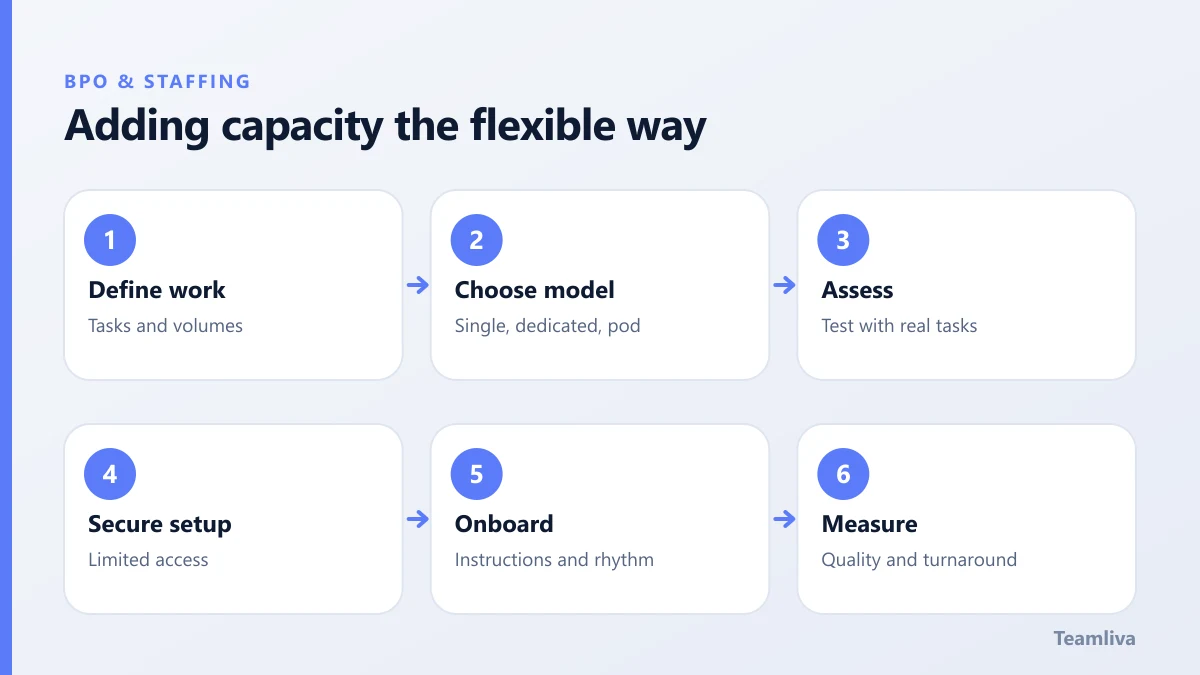
A step-by-step approach
1. Define the work
List the tasks, volumes and systems. Decide the hours and the overlap you need.
2. Choose the model
Pick a single person, a dedicated assistant or a managed pod depending on the workload and how much management you want to do.
3. Assess before you commit
Test candidates with realistic tasks. Check written communication, reliability and process discipline.
4. Secure the setup
Agree confidentiality terms, give minimum access and use multi-factor authentication. Regulated data needs additional safeguards, for example the HIPAA controls outlined by the US Department of Health and Human Services.
5. Onboard properly
Prepare written instructions, tools and a review rhythm. Our guide to onboarding a virtual assistant provides a 30-day plan.
6. Measure and adjust
Track quality, turnaround and customer impact. Hold regular reviews and update the instructions as you learn.
Keeping quality high
- Named accountability. Someone owns results on both sides.
- Documented processes. Everyone follows the same steps.
- Regular feedback. Short, specific and frequent.
- Quality sampling. Review a slice of the work every week.
More on this is in how to manage a virtual assistant remotely.
Culture and communication
Remote teams thrive on clarity. Use one main channel, share priorities openly and celebrate good work. Include the remote team in updates so they understand the goals, not only the tasks.
Common mistakes
- Hiring before defining the work.
- Ignoring time zone overlap.
- Sharing broad system access on day one.
- Treating remote staff as outsiders.

Matching the model to the stage of your business
The right remote staffing arrangement changes as you grow.
- Early stage. One or two dedicated people covering the most urgent workflow.
- Growth stage. A small pod with a team lead, covering support or operations across more hours.
- Established stage. Several pods across functions, with reporting and quarterly reviews.
Start small, prove the value and add capacity when the results justify it.
Retention and continuity
Turnover disrupts any team. Reduce it with steady habits.
- Give clear goals, feedback and a path to more responsibility.
- Recognise good work in front of the wider team.
- Keep documentation current so knowledge does not live in one head.
- Cross-train at least two people on every critical task.
- Agree a handover process before it is needed.
A managed provider can also supply backup, so an absence does not stop your workflow.
Budgeting for remote staffing
Plan for the total cost, not just the hourly rate. Include onboarding time, tools, management effort, the cost of any out-of-hours cover and a small allowance for adjustments in the first months. Then compare that with the value of the work delivered and the growth it makes possible. Where a cost is unclear, ask the provider to put it in writing before you sign.
How Teamliva helps
Teamliva provides pre-vetted remote professionals and managed pods for healthcare, BPO, technology and design roles. Each person clears a skills assessment before going live and works with a named team lead. You can see our approach in how to scale your business with a remote team, explore BPO and staffing solutions or contact us.
Quick checklist before you add people
- The work is defined, with volumes and hours.
- Instructions are written and easy to follow.
- Security rules and access levels are agreed.
- A manager or team lead is named.
- Targets and reporting are set before day one.
- A review date is booked for the end of the first month.
When these are in place, adding capacity is straightforward, and you can scale up or down with confidence.

The takeaway
Remote staffing lets you scale on your terms. Define the work, choose the right model, secure access and invest in onboarding. Do that and you gain flexible capacity without the overhead.
Frequently asked questions
What is remote staffing?
It is adding people to your operation who work from their own location, either as individuals or as a managed team supplied by a provider, instead of hiring on site.
How quickly can a remote team start?
Speed depends on the role and the provider. Managed providers with an assessed talent pool can usually propose candidates much faster than a typical open recruitment.
Is remote staffing suitable for regulated industries?
It can be, if the right controls are in place, such as agreements, limited access, secure devices and training. Healthcare, for example, requires HIPAA safeguards.
- #Teamliva
- #TeamLiva
- #BPO
- #Outsourcing
- #RemoteStaffing
- #Scaling
- #Workforce