How to Build a Remote Team: A Practical Guide for Growing Businesses
How to build a remote team that performs: hire for remote work, set clear communication rules, choose tools, protect data and build culture without an office.
In this article
How to build a remote team that works: define clear roles, hire for remote skills, agree communication rules, use a small set of tools, protect your data and invest in culture. Location becomes a detail when these foundations are strong. When they are weak, no tool can fix it.
Six building blocks
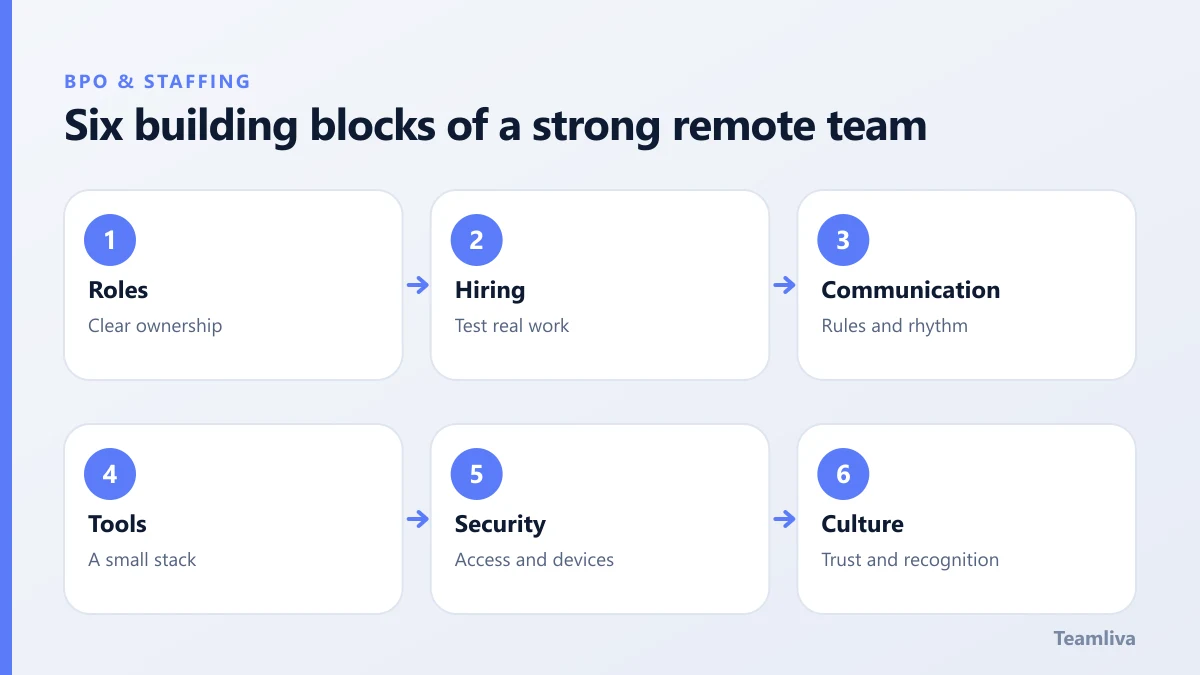
1. Clear roles
Write what each person owns and how you will measure it. Remote teams cannot rely on overheard context, so ownership must be explicit.
2. Hire for remote skills
Look for written clarity, self-direction, reliability and comfort with tools. A paid task test reveals these better than an interview. See interview questions for virtual assistants for a method that works for most remote roles.
3. Communication rules
Agree which channel is used for what: chat for quick questions, email for records, video for reviews. Set response expectations and overlap hours. Keep a short daily written update and a weekly review.
4. A small set of tools
You need email and calendar, chat, a task board, a shared drive and video calls. Add more only when a real problem justifies it. Our list of virtual assistant tools applies to any remote team.
5. Security
Use named accounts, least-privilege access, a password manager and multi-factor authentication. Sign confidentiality agreements. See data security for remote assistants.
6. Culture
Introduce people, explain how their work affects customers, recognise good work and hold occasional non-work conversations. Belonging improves retention and quality.
Local, offshore or both
A remote team can be entirely local, entirely offshore or a mix. Offshore members can add cost efficiency and extended hours. Read what offshore staffing is and how to build an offshore team if you plan to include them.

Benefits and challenges
Benefits: a wider talent pool, lower overheads, flexibility and extended hours.
Challenges: communication gaps, time zones, isolation and security. The benefits of offshore staffing and managing an offshore team address the offshore-specific issues.
A 30-day launch plan
- Week 1: write roles, guides and communication rules.
- Week 2: hire or onboard the first members and set up tools and access.
- Week 3: run live work with close review.
- Week 4: review results and adjust processes.
Common mistakes
- Hiring several people before processes are written.
- Relying on hours online as a measure of work.
- No named owner for onboarding.
- Too many tools.
- Ignoring time zones until problems appear.

The first-week checklist for every new team member
The first week sets habits. Use this list for each new team member:
- Before day one: accounts created, tools tested, guides shared, confidentiality agreement signed.
- Day one: a video welcome, a walkthrough of priorities and an introduction to colleagues.
- Days two to three: shadow a live process with a named buddy, asking questions freely.
- Day four: do a small task independently and get feedback.
- Day five: a short review of what went well, what was confusing and what to improve in the guides.
Keeping the team connected
Remote teams thrive on small rituals: a weekly all-hands call, a channel for non-work chat, public recognition of good work and an occasional virtual coffee. These do not need to be elaborate. Consistency matters more than novelty, and leaders who take part set the tone.
Key takeaways: how to build a remote team
- Define roles, hire for remote skills, set communication rules, use few tools, protect data and invest in culture.
- Test candidates on real work; written clarity and self-direction predict remote success.
- Agree what each channel is for and set response and overlap expectations.
- Use least-privilege access, multi-factor authentication and confidentiality agreements.
- Follow a first-week checklist and a 30-day launch plan for every new team member.

Let a provider help
Remote staffing services such as Teamliva's dedicated offshore and remote teams recruit, equip and supervise the team so that you can focus on direction and results. The Wikipedia page on remote work offers helpful background. Contact us to plan your first role.
Frequently asked questions
What makes a remote team successful?
Clear roles, written processes, a steady communication rhythm, results-based measures and trust. Tools help, but habits matter more.
Can a remote team be built across countries?
Yes. Many businesses combine local and offshore remote staff, agreeing overlap hours and using written handoffs to bridge time zones.
- #Teamliva
- #TeamLiva
- #BPO
- #Outsourcing
- #RemoteStaffing
- #HowToBuildARemoteTeam
- #RemoteTeam
- #RemoteWorkforce