Offshore Staff Augmentation: How It Works and When to Use It
Offshore staff augmentation adds skilled remote people to your existing team. How it works, when it beats hiring or outsourcing, what it costs and how to get started.

In this article
Offshore staff augmentation means adding skilled people from another country to your existing team, on a flexible basis, while a partner handles their hiring, employment and equipment. You manage their daily work as you would your own staff.
It is a fast way to fill a skills gap or add capacity without a long local hiring process or a permanent headcount commitment.
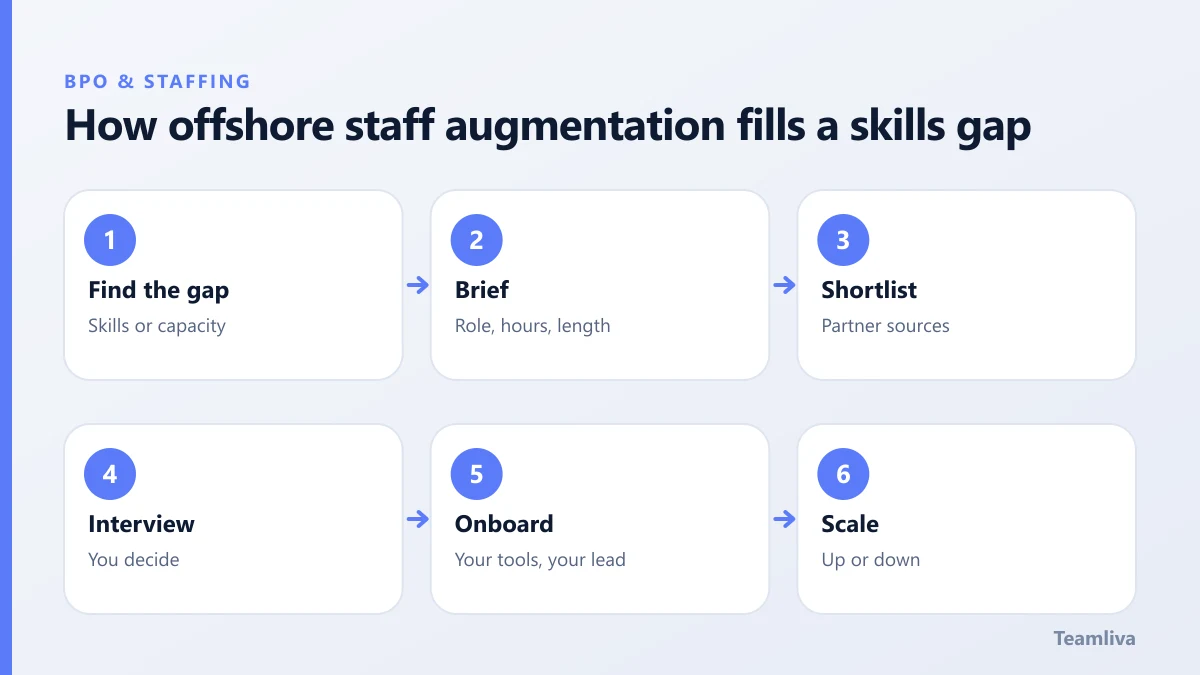
How offshore staff augmentation works
- You identify the gap, such as two React developers or a senior bookkeeper.
- You brief the partner on skills, hours, tools and contract length.
- The partner shortlists candidates from its network or recruits new ones.
- You interview and choose.
- The person joins your team, works in your tools and reports to your manager.
- You scale up or down as projects change, with agreed notice.
When staff augmentation makes sense
- You have a short-term spike in work, such as a product launch or tax season.
- You need a specific skill your team lacks.
- Local hiring is slow or expensive in your area.
- You want to test an offshore model before building a larger team.
It suits less well when you have no one to manage the extra people, or when you want a vendor to own the outcome. In that case, look at BPO outsourcing instead.

Staff augmentation vs other offshore models
| Model | Who manages daily work | Typical length | Best for |
|---|---|---|---|
| Staff augmentation | You | Months | Filling skill gaps |
| Dedicated team / ODC | You, with a partner lead | Years | Long-term product work |
| Project outsourcing | Vendor | Project | Fixed-scope delivery |
| BPO | Vendor | Ongoing | Whole processes |
Our guide to offshore development centers covers the dedicated team model in depth.
What augmentation costs
Most partners charge a monthly or hourly rate per person. It includes salary, benefits, equipment, office and margin. Senior and specialist roles cost more. Always ask what is included, such as replacements, holiday cover and notice terms. Our offshore staffing cost guide shows typical ranges.
Risks and how to manage them
- Weak onboarding: give augmented staff the same training and documentation as local hires.
- Isolation: include them in stand-ups, chats and team rituals.
- Security: individual accounts, least-privilege access and managed devices.
- Knowledge loss at exit: keep work documented in shared tools, not in one person's head.
Roles that suit augmentation
Developers and QA engineers are the most common, but many other roles work well: bookkeepers during tax season, support agents for a product launch, medical billers for a backlog, designers for a rebrand and data analysts for a reporting project. The common thread is a clear brief and a manager on your side who can direct the work each day.
Getting started
Begin with one or two roles and a 90-day review. If the fit is good, extend contracts or convert the group into a dedicated team. Our article on how to manage an offshore team covers daily routines.

How to onboard augmented staff in the first two weeks
- Day 1: accounts, devices, introductions and a written overview of the product or process.
- Days 2–3: shadow a team member and read the key documentation.
- Days 4–5: complete small, low-risk tasks with close review.
- Week 2: take ownership of real tickets or files, with daily check-ins.
- End of week 2: a short review of what is clear, what is not and what to change.
Contract terms to check
- Minimum commitment and notice period.
- Replacement policy if a person leaves or is not a fit.
- Holiday and sick-leave cover.
- Rate changes over the contract term.
- IP assignment and confidentiality.
- The option to convert people into a long-term dedicated team.
Measuring whether augmentation is paying off
Set a few simple measures before the first person starts. For developers, track tickets completed, review comments and bugs found after release. For finance or support roles, track volume, accuracy and turnaround time. Compare each measure with your local team after three months. Also ask your managers how much time they spend directing the extra people. If that time is too high, the brief or the documentation needs work.
When to move from augmentation to a dedicated team
If you keep extending the same people and adding more roles, you have outgrown short-term augmentation. A dedicated team gives you a local lead, shared processes and longer-term planning. It often costs about the same per person, but with better stability and less management load on your side.
Key takeaways: offshore staff augmentation
- Offshore staff augmentation adds remote specialists to your team while a partner employs and equips them.
- You manage the daily work, so it fits teams that already have leads with time to direct extra people.
- It suits short-term spikes, missing skills and testing an offshore model before a larger commitment.
- Onboard augmented staff exactly as you would local hires, with documentation and daily review at first.
- Check replacement, notice and IP terms before you sign.

Offshore staff augmentation with Teamliva
Teamliva (Team Liva) provides offshore professionals from Dhaka who join your team on your hours and in your tools. See our offshore staffing services or contact us to brief a role.
For a general definition, see staff augmentation on Wikipedia.
Frequently asked questions
What is the difference between staff augmentation and outsourcing?
With staff augmentation, you add people to your team and manage their work. With outsourcing, a vendor takes responsibility for a whole function or project and manages the people.
How fast can offshore staff augmentation start?
Often within two to four weeks, depending on how specialised the role is and how quickly you can interview.
Is staff augmentation only for IT roles?
No. It is common for developers and QA, but also for accounting, customer support, healthcare admin, design and marketing roles.
- #Teamliva
- #TeamLiva
- #BPO
- #Outsourcing
- #RemoteStaffing
- #OffshoreStaffAugmentation
- #StaffAugmentation
- #ItStaffAugmentation