Employer of Record vs Offshore Staffing: Which Do You Need?
An employer of record handles legal employment; an offshore staffing partner also recruits, equips and supports the team. How the two compare on cost, control and risk.
In this article
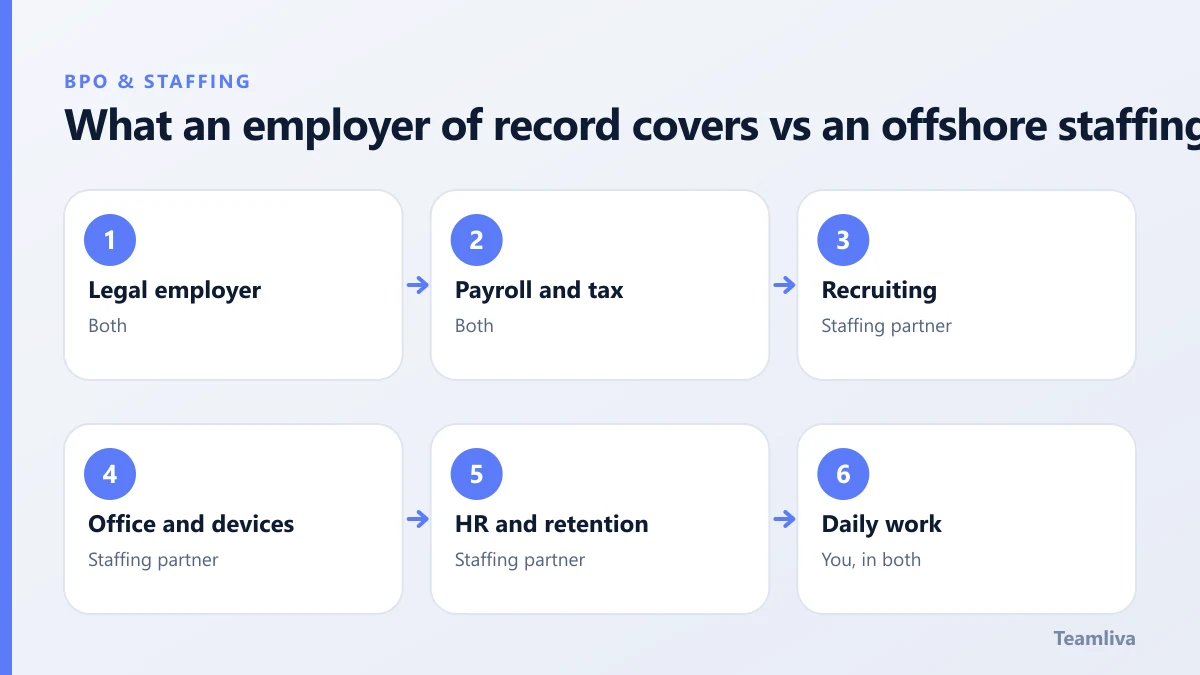
An employer of record (EOR) legally employs a worker in another country for you, handling contracts, payroll, tax and benefits, while you recruit and manage them. An offshore staffing partner does the same, plus recruiting, office space, equipment, IT and day-to-day HR support.
Both let you hire abroad without opening a foreign company. The right choice depends on how much work you want to do yourself.
What an employer of record covers
- Local employment contracts.
- Payroll, tax withholding and statutory benefits.
- Compliance with local labour law.
- Onboarding and termination paperwork.
What an EOR usually does not cover: finding candidates, providing an office or laptop, IT security, performance support or replacing someone who leaves.
What an offshore staffing partner covers
Everything an EOR covers, plus:
- Recruiting and screening candidates for your approval.
- A secure office seat, computer and internet.
- IT setup, access controls and data security.
- HR support, engagement and retention.
- Replacement hires if someone leaves.
Our guide to what offshore staffing is explains the model in full.

Employer of record vs staffing: side by side
| EOR | Offshore staffing partner | |
|---|---|---|
| Legal employment | Yes | Yes |
| Payroll and benefits | Yes | Yes |
| Recruiting | You | Partner |
| Office and equipment | You or the worker | Partner |
| Security controls | You | Partner, with your rules |
| Retention and HR support | Limited | Yes |
| Typical fee | Lower | Higher, more included |
When an EOR makes sense
- You already found the person you want to hire.
- You hire in many countries, one or two people in each.
- The role suits working from home.
- You have internal HR and IT capacity to support remote staff.
When an offshore staffing partner makes sense
- You want to build a team of several people in one location.
- You need help finding and screening candidates.
- The work involves sensitive data and needs a secure office.
- You want someone on the ground to handle HR, attendance and retention.
Remote work vs a secure office
Most EOR hires work from home on their own internet and power. That is fine for many roles, but not for work with health, financial or payment data, where clients and regulators expect controlled devices and premises. A staffing partner can place your team in a secure office with access cards, monitored networks and backup power.
Compare the true cost
Do not compare the EOR fee with the staffing fee alone. Add your recruiting time, equipment, software, security tools, management time and the cost of a bad hire. Our offshore staffing cost guide lists the items to include.
Questions to ask either provider
- Who is the legal employer, and in which country?
- What exactly is in the monthly fee?
- How are IP and confidentiality assigned to us?
- What happens if the person resigns?
- What are the notice and exit terms?
Our checklist on choosing an offshore staffing company has more questions.

A worked example: one hire vs a team of five
One hire: a company finds a strong developer through LinkedIn who already works from home. An EOR is a simple, low-cost way to employ them compliantly.
A team of five: the same company wants five support agents in one city, working US hours from a secure office. An EOR would leave it to recruit five people, find an office, buy equipment and manage attendance from abroad. An offshore staffing partner handles all of that as one service.
Red flags with either model
- No clear answer on who the legal employer is.
- Fees that change without notice.
- Contracts with no IP assignment to your company.
- No plan for replacing someone who resigns.
- Vague answers about data security.
What you still own in both models
Neither model takes away your role as the manager of the work. In both cases you set priorities, review output and give feedback. You also decide on pay rises and promotions, within local rules. Make sure you have a named person who owns the relationship with each offshore employee, holds regular one-to-ones and is the first point of contact for questions. Without that, even the best provider cannot make the arrangement succeed.
Moving between models as you grow
Many companies start with an EOR for one or two people, then move to a staffing partner once they plan a team in one city. Others start with a partner and later set up their own entity. Plan each move with notice, keep pay and benefits steady, and talk to staff early so they feel secure.
Key takeaways: employer of record
- An employer of record legally employs your worker abroad and runs payroll, tax and benefits.
- An offshore staffing partner also recruits, provides an office and equipment, and supports HR and retention.
- An EOR suits single hires you have already found, especially across many countries.
- A staffing partner suits teams in one location and work that needs a secure office.
- Compare the true cost, including your recruiting, equipment and management time, not just the fee.

Hiring in Bangladesh with Teamliva
Teamliva (Team Liva) is the employer, recruiter and office for offshore teams in Dhaka. You choose the people and direct their work. See our offshore staffing services or contact us.
For a general definition, see professional employer organization on Wikipedia.
Frequently asked questions
What does an employer of record do?
An employer of record becomes the legal employer of a worker in another country. It runs payroll, withholds taxes, provides required benefits and keeps employment compliant with local law.
Is an employer of record cheaper than offshore staffing?
The EOR fee is usually lower, but you must recruit, equip and support the person yourself. Once those costs and your time are counted, the gap often narrows.
Can I switch from an EOR to a staffing partner later?
Yes, but plan the transfer of employment carefully with notice and local rules, so the employee does not lose benefits or tenure.
- #Teamliva
- #TeamLiva
- #BPO
- #Outsourcing
- #RemoteStaffing
- #EmployerOfRecord
- #Eor
- #OffshoreStaffing
- #GlobalHiring