Offshoring Risks: 9 Common Problems and How to Avoid Them
The real offshoring risks, from poor communication and quality drift to data security, attrition and hidden costs, with a practical way to prevent each one.
In this article
The main offshoring risks are poor communication, quality drift, data security gaps, staff turnover, hidden costs and over-dependence on one vendor. Each can be managed with clear processes, the right partner and a small pilot before you scale.
Offshoring works for thousands of companies, but it fails often enough that caution is wise. Here are nine common problems and how to avoid them.
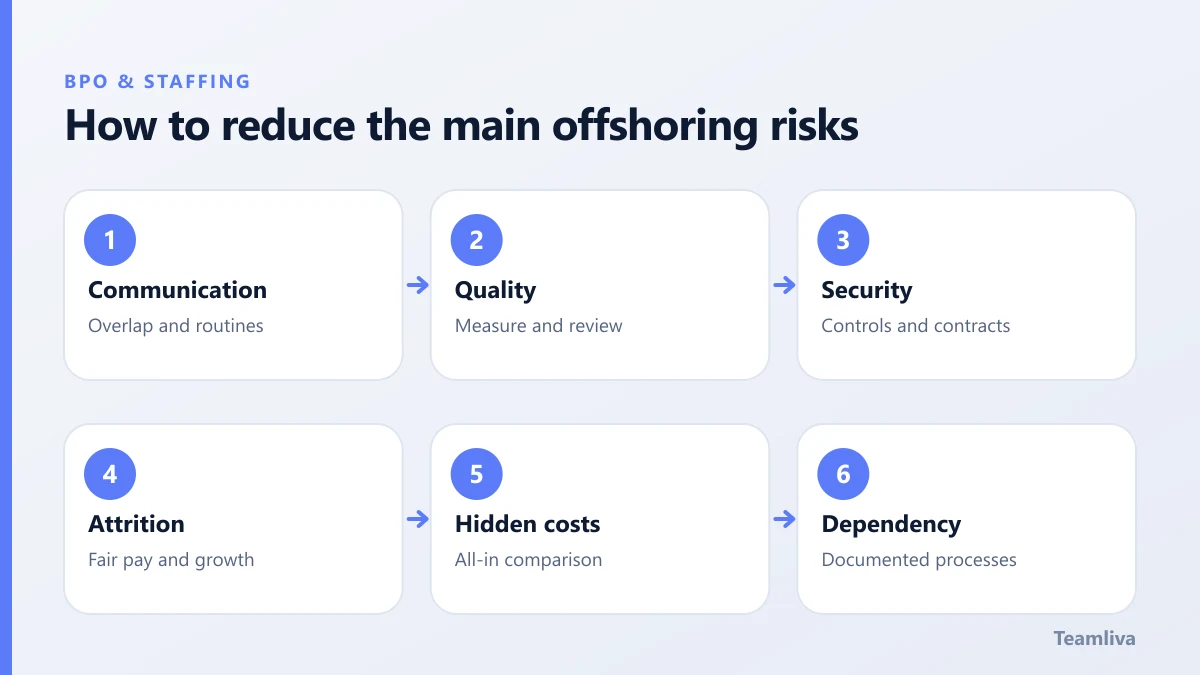
1. Communication gaps
Misunderstood instructions cause rework and missed deadlines. Prevent it: write clear procedures, agree a few overlap hours, hold short daily check-ins and confirm understanding in writing.
2. Quality drift
Quality is often good in week one and slips by month three. Prevent it: set measurable targets, review a sample of work every week and turn every error into an updated instruction.

3. Data security and privacy
Remote staff may handle customer, financial or health data. Prevent it: managed devices, secure office seats, multi-factor authentication, least-privilege access, confidentiality agreements and, for health data, a business associate agreement. Our guide to HIPAA for remote teams covers the health side.
4. Staff attrition
Losing trained people resets the learning curve. Prevent it: fair local pay, career growth, recognition and treating offshore staff as part of the team, not a separate group.
5. Hidden costs
The headline rate rarely includes management time, tools, rework and setup. Prevent it: compare an all-in monthly cost and ask exactly what the fee covers. See our offshore staffing cost guide.
6. Time zone friction
Waiting a day for every answer slows everything. Prevent it: choose shifts with some overlap, or use the time difference deliberately for overnight work with a written handover.
7. Legal and compliance exposure
Employment, tax and IP rules differ by country. Prevent it: use a partner or employer of record that employs staff compliantly, and make sure contracts assign IP to you.
8. Vendor dependency
If all knowledge sits with the vendor, leaving becomes painful. Prevent it: keep processes documented in your own systems, own your accounts and data, and agree exit terms at the start.
9. Cultural and management mismatch
Different norms around feedback and escalation can hide problems. Prevent it: say clearly that raising issues early is expected, and reward people who do.

Business continuity
Power cuts, internet outages, floods or political events can interrupt work in any country. Prevent it: choose a partner with backup power, two internet providers and a plan for staff to work from a second site or from home. Ask how they kept clients running during past disruptions, and keep critical knowledge documented so another team member can step in.
A simple offshoring risks checklist
- Is the work documented and measurable?
- Have we agreed targets, reporting and a review rhythm?
- Are security controls in writing and verified?
- Do we know the all-in cost?
- Can we exit cleanly with our data and processes?
- Are we starting with a pilot?
Our checklist on choosing an offshore staffing company helps you test partners against these points.
Running a low-risk pilot
A pilot is the cheapest way to find problems before they scale:
- Pick one process with steady volume and clear quality measures.
- Set targets for accuracy, turnaround and communication.
- Run for 60 to 90 days with weekly reviews.
- Compare results with your in-house baseline.
- Decide: scale, adjust or stop, based on data.
Warning signs during the first months
- Questions stop, but errors continue.
- Reports arrive late or with missing data.
- The same mistakes repeat after feedback.
- Staff change often without notice.
- Security requests are met with vague answers.
Who should own offshore risk inside your company
Risk grows when no one is clearly responsible. Name one owner for each offshore team, usually the manager whose work it supports. That person reviews performance, approves access changes and meets the partner each month. Larger companies also involve IT security and legal at the start, to review contracts and controls, and again once a year.
Questions to ask a partner about risk
- How do you control and log access to our systems?
- What happens if a team member resigns suddenly?
- How do you handle power cuts or internet outages?
- Can we audit your office and security controls?
- What insurance and legal protections do you carry?
Clear, specific answers are a good sign. Vague promises are not.
Key takeaways: offshoring risks
- The biggest offshoring risks are communication gaps, quality drift, security gaps, attrition and hidden costs.
- Clear procedures, overlap hours and measurable targets prevent most problems.
- Security needs written controls, managed devices and least-privilege access, verified by you.
- Keep processes and data in your own systems so you can exit cleanly.
- A 60 to 90 day pilot with weekly reviews reveals problems before you scale.

How Teamliva reduces offshoring risks
Teamliva (Team Liva) runs offshore teams from a secure office in Dhaka with managed devices, access controls, named team leads and weekly reporting. See our offshore staffing services or contact us to plan a pilot.
For a broader view of the topic, see offshoring on Wikipedia.
Frequently asked questions
What is the biggest risk of offshoring?
Poor communication and unclear expectations cause more failures than any other issue. They lead to quality problems, rework and frustration on both sides.
Is offshoring safe for sensitive data?
It can be, with signed agreements, managed devices, secure offices, multi-factor authentication, least-privilege access and regular audits. Ask any partner to show these controls.
How can I reduce offshoring risks at the start?
Start with a small pilot, document the work, agree measurable targets and choose a partner with a proven track record in your type of work.
- #Teamliva
- #TeamLiva
- #BPO
- #Outsourcing
- #RemoteStaffing
- #OffshoringRisks
- #OffshoreOutsourcingRisks
- #OffshoreStaffing
- #RiskManagement