
Offshore vs Nearshore vs Onshore Outsourcing: Which Model Fits?
Onshore, nearshore or offshore outsourcing? Compare cost, communication, time zones, compliance and control to choose the right model for your business.
In this article
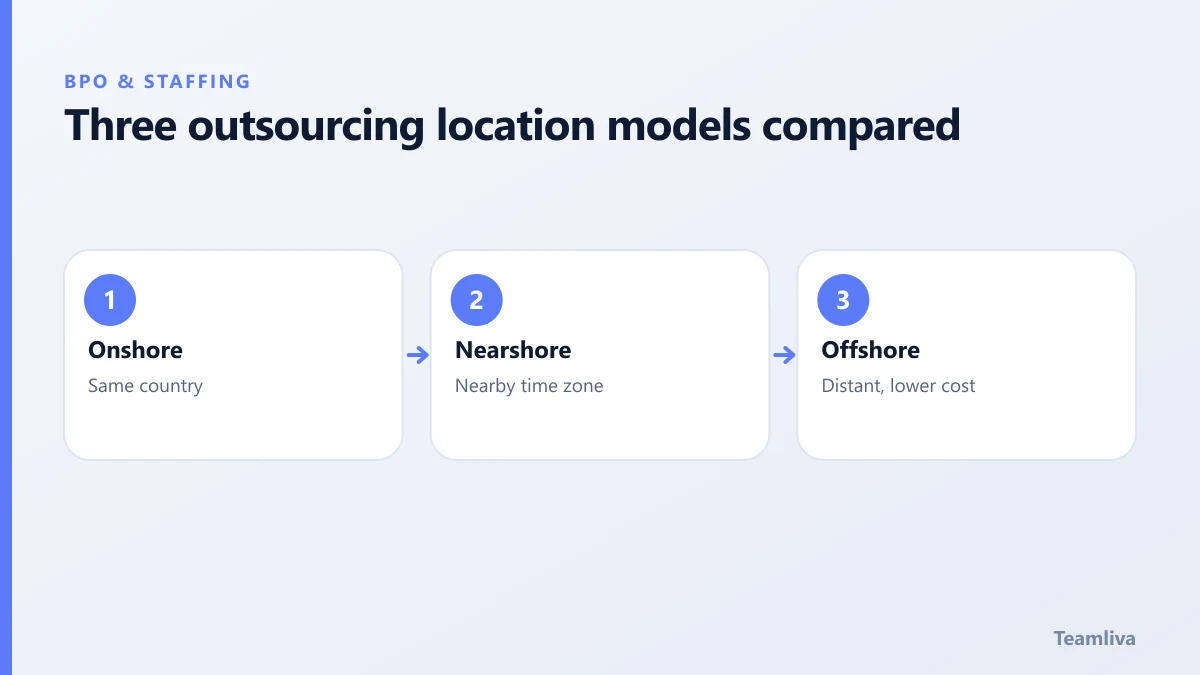
Offshore vs nearshore vs onshore outsourcing is a choice about location: onshore is in your country, nearshore in a nearby time zone and offshore in a distant, usually lower-cost country. The right model depends on cost, live contact, compliance and talent depth.
Where your outsourced team sits affects cost, communication and risk. Three models dominate the conversation: onshore, nearshore and offshore. Each suits different work, and none is best in every case. This guide compares them so you can choose deliberately.
Onshore outsourcing
The provider is in your own country.
Pros: same time zone and culture, simple legal environment, easy in-person meetings and often the least worry about compliance.
Cons: the highest cost of the three, and a smaller talent pool for some roles.
Best for: highly sensitive work, roles needing deep local knowledge and functions where live, in-person contact matters.
Nearshore outsourcing
The provider is in a nearby country, usually with a similar time zone. For US businesses, this often means Latin America or Canada.
Pros: overlapping working hours, easier travel, shared business norms and moderate cost.
Cons: costs are higher than offshore, and options depend on the language and skills you need.
Best for: work needing real-time collaboration, such as live customer support in English or Spanish.

Offshore outsourcing
The provider is in a distant country, such as Bangladesh, India or the Philippines for US clients.
Pros: the strongest cost efficiency, large talent pools and coverage outside your working hours.
Cons: time-zone gaps, cultural differences and more effort in oversight.
Best for: repeatable, well-documented processes, written-channel support, back-office and administrative work, and follow-the-sun coverage.
Side by side
| Factor | Onshore | Nearshore | Offshore |
|---|---|---|---|
| Cost | Highest | Middle | Lowest |
| Time-zone overlap | Full | High | Limited, by design |
| Talent pool | Limited | Medium | Large |
| Oversight effort | Low | Low to medium | Medium |
| Best for | Sensitive, local | Live collaboration | Volume, back office |
How to decide
- Rank what matters: cost, live contact, compliance or talent depth.
- Consider the work: repeatable and documented work suits offshore; judgement-heavy work suits onshore or nearshore.
- Check compliance: some data or contracts restrict where work may be performed. Confirm with your adviser.
- Plan communication: set overlap hours and written handoffs. See working across time zones.
- Pilot: test a small scope before committing.
Combine models
A hybrid is often the best answer. Keep client-facing or sensitive roles close, and place volume work offshore. For instance, a US healthcare group might keep clinical staff onshore and outsource medical billing follow-up offshore under a signed BAA. See BPO vs in-house teams.
Offshore destinations for US buyers
The main offshore hubs in Asia are the Philippines, India and Bangladesh. We compare them in Bangladesh vs India vs the Philippines and best BPO in Asia.
Reduce offshore risk
- Use a managed provider with named team leads.
- Require confidentiality agreements and device controls.
- Agree service levels and reporting. See BPO service level agreements.
- Keep documentation in your own systems.
- Plan for backup power, internet and staff cover.

Offshore vs nearshore vs onshore outsourcing: a scenario guide
- A US medical practice needs claims follow-up: offshore can work well with a signed BAA and HIPAA-aligned controls, because the work is repeatable and measurable.
- A software team needs daily stand-ups with developers: nearshore may fit better for overlapping hours.
- A law firm needs sensitive document handling: onshore may be required or preferred by clients.
- A retailer needs 24-hour email support: offshore teams working shifts can provide cover.
Offshore vs onshore staffing: a quick rule of thumb
If the work is repeatable, documented and measurable, offshore vs onshore staffing usually favours offshore on cost, while onshore wins when the work needs local presence, live judgement or close in-person collaboration. Many teams combine both.
Legal and regulatory questions
Before choosing a location, ask your adviser whether any laws, contracts or client requirements limit where data may be processed or work performed. Some public-sector and financial contracts have restrictions. If health data is involved, review the HHS HIPAA guidance.
Managing distance
- Overlap hours: agree them in writing.
- Written handoffs: a short daily note.
- Video meetings: a weekly review call.
- Shared guides: stored in your systems.
- Escalation rules: who to contact for urgent issues.
These habits matter more than the mileage. A well-run offshore team can outperform a poorly managed onshore one.
Key takeaways: offshore vs nearshore vs onshore outsourcing
- Offshore vs nearshore vs onshore outsourcing trades cost against live contact and control, so rank what matters most to you.
- Offshore suits repeatable, documented and written work; nearshore suits real-time collaboration; onshore suits sensitive local work.
- Check whether any law, contract or client requirement limits where data can be processed.
- Distance is managed with overlap hours, written handoffs, weekly video reviews and clear escalation rules.
- A hybrid model is often the best answer, keeping sensitive work close and volume work offshore.

Talk to Teamliva
Teamliva (Team Liva) provides offshore managed teams from Dhaka for US clients, with shifts aligned to US hours. See BPO and staffing solutions or contact us.
Frequently asked questions
What is the difference between offshore and nearshore?
Nearshore providers are in nearby countries with similar time zones, while offshore providers are in distant countries, often with larger time differences and lower costs.
Can I mix models?
Yes. Many businesses use onshore leads for client contact and offshore teams for volume work, or a nearshore team for live overlap plus offshore for overnight processing.
- #Teamliva
- #TeamLiva
- #BPO
- #Outsourcing
- #RemoteStaffing
- #OffshoreOutsourcing
- #Nearshore
- #Onshore
- #OutsourcingModels