Offshore Accounting Staff for CPA Firms: A Practical Guide
How CPA and accounting firms use offshore accounting staff for bookkeeping, tax prep and reconciliations: roles, workflows, security, quality review and cost.
In this article
Offshore accounting staff are trained accountants in another country who prepare bookkeeping, reconciliations, workpapers and draft tax returns for a CPA firm, while the firm's own licensed staff review and sign off. It lets firms grow without competing for scarce local hires.
The accounting talent shortage is real. Fewer graduates are entering the profession, and busy season stretches every team. An offshore team gives firms steady capacity all year.
Work offshore accounting staff can handle
- Bookkeeping and transaction categorisation.
- Bank and credit card reconciliations.
- Accounts payable and receivable processing.
- Payroll support and payroll tax filings preparation.
- Month-end close schedules and accruals.
- Workpaper preparation for reviews and audits.
- First-draft individual and business tax returns.
Advisory, client meetings, final review and anything that needs a licence stay with your firm.
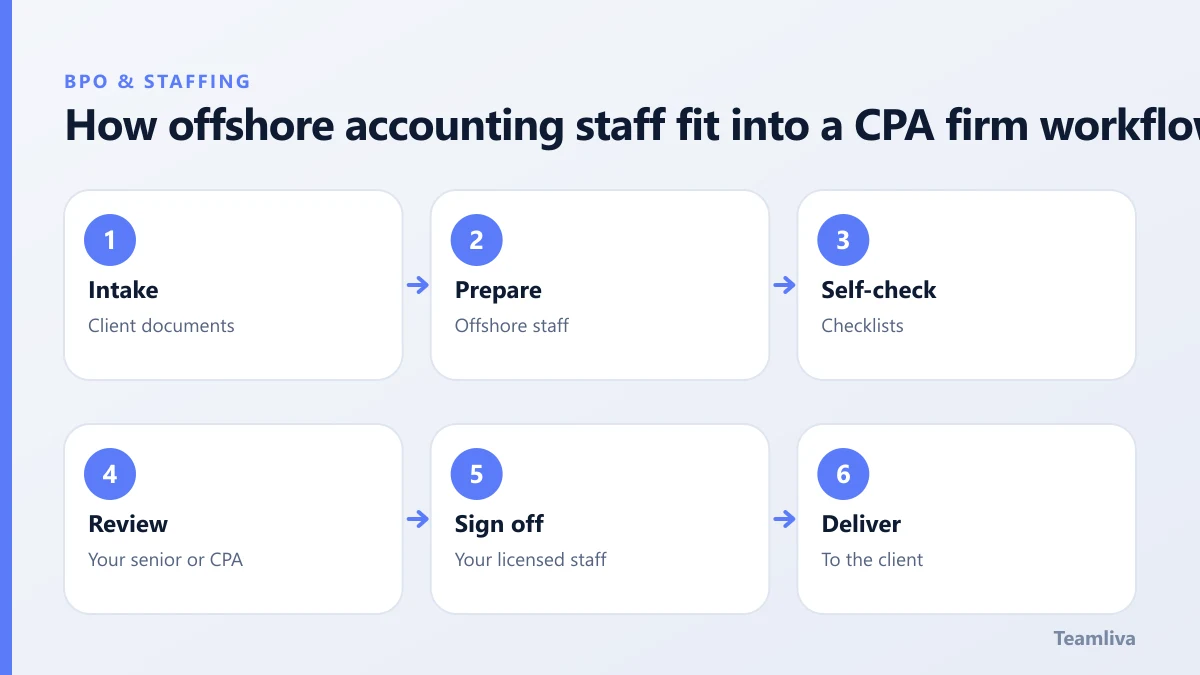
A workflow that keeps quality high
- Intake: client documents arrive in your portal.
- Prepare: offshore staff complete the work using your checklists.
- Self-review: they tick off a checklist and note open questions.
- Review: your senior or manager reviews and leaves notes.
- Sign off: licensed staff approve.
- Feedback: review notes become updates to checklists and training.
Track review points per file. A falling number is the clearest sign your offshore team is learning.

Security and client consent
Accounting data is sensitive. Insist on company-managed devices, a secure office, multi-factor authentication, no local storage, role-based access and signed confidentiality agreements. For US tax work, firms need written client consent before tax return information goes to preparers outside the country. The IRS guidance on Section 7216 explains the rules.
What an offshore accountant costs
Firms typically pay a monthly fee per full-time staff member, covering salary, benefits, office, equipment and management. That is often a fraction of the cost of a local staff accountant. Compare total cost, including your review time, using our offshore staffing cost guide.
Common concerns from firm partners
Will clients mind? Most clients care about accuracy, speed and confidentiality. Explain your review process and security controls, and get the required consent in writing.
Will quality drop? Not if every file still goes through your review. In many firms, review points fall within a few months as the team learns your standards.
What about time zones? Offshore staff can work overnight on files your team sends at the end of the day, so drafts are ready for review the next morning.
How to start
- Pick one service line, such as monthly bookkeeping clients.
- Document your process with checklists and sample files.
- Start with one or two hires and a named reviewer at your firm.
- Run a month in parallel before handing over full files.
- Expand to tax before busy season, not during it.
Our guides to the bookkeeping virtual assistant and how to hire offshore employees cover hiring in more detail.
Preparing for your first busy season with an offshore team
- Six months before: hire and train on bookkeeping and simple returns.
- Three months before: run a few prior-year returns as training files.
- One month before: agree daily targets, review turnaround and escalation rules.
- During busy season: daily stand-ups and a shared tracker of every return's status.
- After busy season: review what worked, update checklists and plan next year.

Measuring performance
Track files completed per week, review points per file, turnaround time from intake to review, and the share of files returned for rework. Share the numbers with the team so they can see their own progress.
Roles to start with
Most firms start with one of three roles. A staff bookkeeper handles monthly client books, reconciliations and reports. A tax preparer drafts individual and small business returns for review. An accounts payable or payroll specialist supports client back-office work. Choose the role where your local team is most stretched and where your process is already well documented.
Building trust with your local team
Some local staff worry that offshore hires threaten their jobs. Explain the plan clearly: the goal is to remove overflow and routine preparation, so local staff can focus on review, advisory work and client relationships. Involve senior staff in training and reviewing the new team. When local accountants see their own workload ease and their roles grow, support usually follows.
Software and access
Give the team access through your existing practice management, tax and document systems, with individual logins and multi-factor authentication. Avoid emailing client files; keep everything inside secure portals.
Key takeaways: offshore accounting staff
- Offshore accounting staff prepare bookkeeping, reconciliations, workpapers and draft returns for review.
- Your firm keeps client advice, final review and sign-off with licensed staff.
- A clear prepare, self-review, review and feedback loop keeps quality high.
- US firms need written client consent before sharing tax return information with offshore preparers.
- Start with one service line and train well ahead of busy season.

How Teamliva supports accounting firms
Teamliva (Team Liva) provides dedicated offshore accounting staff in Dhaka for US and UK firms, working in your software and to your review process. See our accounting and bookkeeping outsourcing service, our accounting pod blueprint, or contact us.
Frequently asked questions
What can offshore accounting staff do for a CPA firm?
Bookkeeping, bank and credit card reconciliations, accounts payable and receivable, payroll support, workpaper preparation, first-draft tax returns and month-end close tasks, all reviewed by your team.
Is it allowed to use offshore staff for tax preparation?
In the US, firms must get written client consent before disclosing tax return information to preparers outside the country, under IRS rules. Many firms add this consent to engagement letters.
Which software do offshore accountants use?
Common tools include QuickBooks Online, Xero, CCH, UltraTax, Lacerte, Drake, Karbon and document portals such as SmartVault or Canopy.
- #Teamliva
- #TeamLiva
- #BPO
- #Outsourcing
- #RemoteStaffing
- #OffshoreAccountingStaff
- #OutsourcedAccounting
- #CpaFirmStaffing
- #OffshoreBookkeeping