Build Operate Transfer (BOT) Model: How to Set Up an Offshore Office
The build operate transfer model lets a partner set up and run your offshore office, then hand it over to you. How the three phases work, costs, risks and when it fits.
In this article
Build operate transfer (BOT) is a model where a partner sets up an offshore office for you, runs it until it is stable, then transfers the team, office and operations to your company. You get your own offshore centre without taking on the early setup risk.
It suits companies that want long-term ownership of an offshore team but lack the local knowledge to start one from scratch.
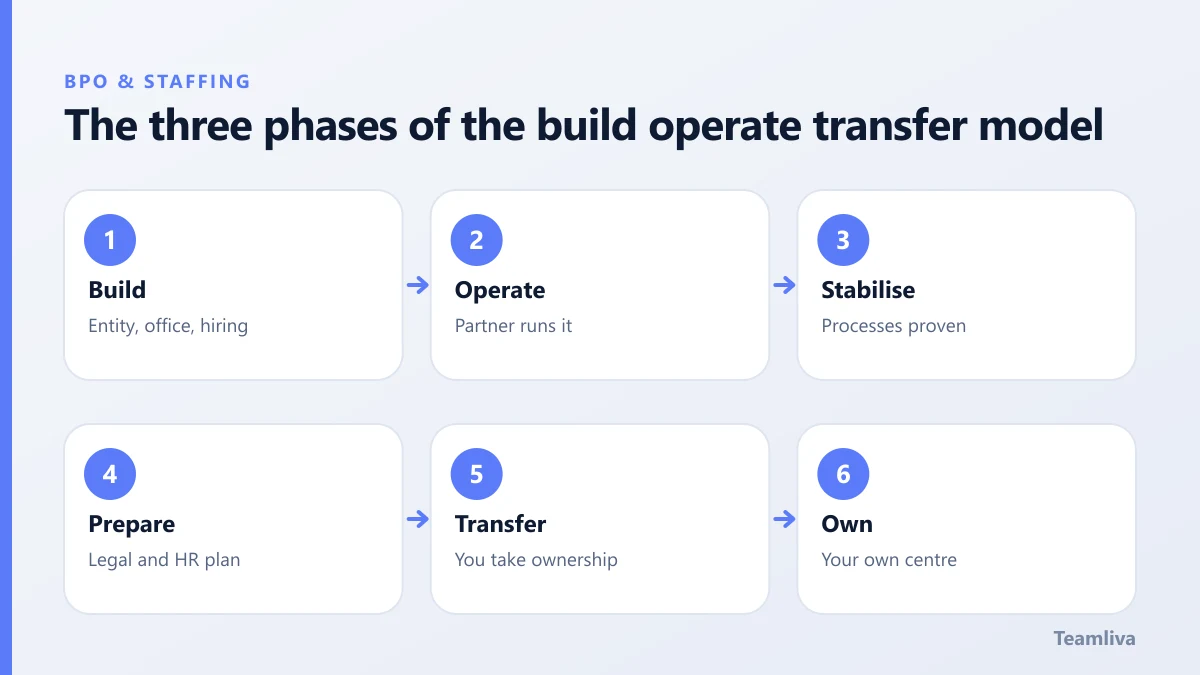
The three phases of build operate transfer
1. Build
The partner finds an office, sets up IT and security, and recruits the first team, often 10 to 50 people. Where needed, they also help register a local entity. You approve the key hires and the budget.
2. Operate
The partner runs the centre day to day: HR, payroll, facilities, compliance and retention. Your managers direct the work. This phase lasts until processes are proven and the team is stable, typically one to three years.
3. Transfer
You take over the employees, lease, equipment and processes, usually into your own local entity. The price or formula is agreed in the original contract.
When the BOT model makes sense
- You plan a large offshore team, typically 30 people or more.
- You want to own the centre in the long run.
- You lack local knowledge of law, hiring and real estate.
- You want to test a market before committing fully.
For smaller teams, a dedicated offshore team or offshore staffing is usually simpler and cheaper.

BOT vs captive center vs staffing
| Offshore staffing | BOT | Captive center | |
|---|---|---|---|
| Who owns the team | Partner | Partner, then you | You |
| Setup effort for you | Low | Medium | High |
| Upfront cost | Low | Medium | High |
| Long-term control | Medium | High | Highest |
Our article on captive centers vs outsourcing compares full ownership in more depth.
Costs to plan for
- Build fees, covering setup, recruiting and fit-out.
- Monthly operating fees per employee during the operate phase.
- A transfer fee, fixed or based on headcount.
- Your own costs after transfer, including local management, legal, accounting and HR.
Risks and how to reduce them
- Unclear transfer terms: fix the price, timing and conditions in the first contract.
- Staff attrition at transfer: keep salaries and benefits the same, and tell staff early.
- Weak processes: document everything during the operate phase.
- Legal surprises: take local legal advice on entity setup and employment transfer.
Choosing a BOT partner
Look for a partner with offices already running in the country, a strong recruiting pipeline, clear security controls and examples of past transfers. Our checklist on choosing an offshore staffing company applies here too.
Clauses every BOT contract needs
- Transfer trigger: a fixed date, a headcount milestone or your option to call the transfer.
- Transfer price: a fixed amount or a formula, such as a fee per employee.
- What transfers: staff, lease, equipment, software licences, processes and any entity.
- Employee terms: a commitment to keep pay and benefits at least equal after transfer.
- Non-solicitation: the partner should not recruit your transferred staff back.
- Exit without transfer: what happens if you decide not to take ownership.

Questions to ask yourself before choosing BOT
- Will we still want a centre this size in five years?
- Who in our company will run it after transfer?
- Are we ready for local legal, tax and HR responsibilities?
What the operate phase looks like day to day
During the operate phase, your managers lead the work while the partner runs everything around it. The partner handles recruiting, payroll, attendance, office facilities, internet, power backup and local compliance. It also reports on headcount, attrition and costs each month. Your team sets goals, reviews output and builds the culture you want to keep after transfer. Use this time to name the local leaders who will run the centre once it is yours. Train them on your company's policies, finance processes and reporting, so the handover feels like a change of employer on paper, not a change in how people work.
Preparing staff for the transfer
Tell employees about the plan well in advance. Explain what will change and, just as important, what will not. Keep pay, benefits, tenure and managers the same where possible.
Key takeaways: build operate transfer
- Build operate transfer lets a partner set up and run your offshore office, then hand it to you.
- The model runs in three phases: build, operate and transfer, usually over two to five years.
- It suits large, long-term teams where you want eventual ownership but lack local expertise.
- Fix the transfer price, timing and employee terms in the original contract.
- For smaller teams, a dedicated team or offshore staffing is usually simpler and cheaper.

Setting up an offshore office in Bangladesh with Teamliva
Teamliva (Team Liva) builds and runs offshore teams in Dhaka for US and UK companies, from a few seats to a full centre. See our dedicated offshore teams service or contact us to discuss your plans.
For a general definition of the contract model, see build–operate–transfer on Wikipedia.
Frequently asked questions
How long does a build operate transfer project take?
Most run two to five years in total. Build takes three to nine months, then the partner operates the centre until it is stable and you are ready to take over.
What is transferred at the end of a BOT agreement?
Usually the employees, the office lease, equipment, processes and sometimes a local legal entity, at a price or formula agreed at the start.
Is BOT only for software teams?
No. It is common for software and IT, but also for finance, customer support, healthcare operations and other back-office centres.
- #Teamliva
- #TeamLiva
- #BPO
- #Outsourcing
- #RemoteStaffing
- #BuildOperateTransfer
- #BotModel
- #OffshoreOfficeSetup
- #OffshoreDevelopmentCenter