Captive Center vs Outsourcing: Which Offshore Model Fits?
A captive center is your own offshore office; outsourcing hands the work to a partner. How they compare on cost, control, speed and risk, and the hybrid options in between.
In this article
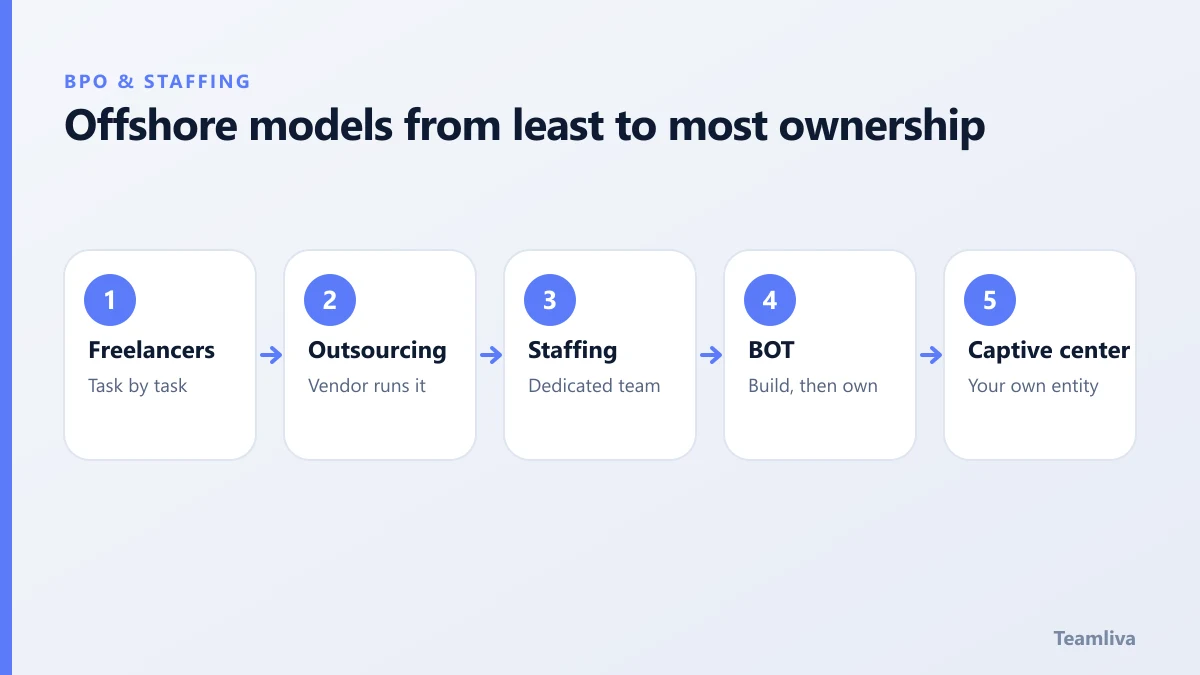
A captive center is an offshore office your company owns and runs through its own local entity, while outsourcing hands the work or the team to a partner that employs the people. A captive center gives the most control; outsourcing is faster, cheaper to start and lower risk.
Many large companies run captive centres, now often called global capability centers (GCCs). Smaller companies usually start with a partner and decide later whether to own.
What a captive center involves
- Registering a local company and bank accounts.
- Leasing and fitting out an office.
- Hiring local leadership, HR, finance and IT.
- Running payroll, tax and labour compliance.
- Recruiting and retaining every employee directly.
You get full control over culture, security and processes, but you also carry every cost and risk.
What outsourcing involves
A partner already has the entity, office, recruiting team and HR. You either buy a service, such as BPO, or a dedicated team that you direct, such as offshore staffing. You can start in weeks rather than months.

Captive center vs outsourcing compared
| Own centre | Outsourcing or staffing partner | |
|---|---|---|
| Time to start | 6–12 months | 2–8 weeks |
| Upfront cost | High | Low |
| Control | Full | Shared, by contract |
| Exit cost | High | Notice period |
| Local expertise needed | Yes | No |
| Best size | Large and long term | Any size |
When a captive center makes sense
- You plan a large team for many years.
- The work is core to your product or involves highly sensitive IP.
- You already have experience operating abroad.
- You can fund local leadership and a full support function.
When outsourcing makes sense
- You want to start quickly and test the model.
- Your team will be under 50 people for the foreseeable future.
- You lack local legal and HR knowledge.
- You want flexible commitments.
The middle ground
Two hybrid options sit between the extremes:
- Dedicated team or ODC: a partner employs a team that works only for you. See our guide to offshore development centers.
- Build operate transfer: a partner builds and runs the centre, then transfers it to you. See our guide to the build operate transfer model.
Many companies use a staffing partner first, then move to BOT or their own centre once the team is large and stable.
Questions to decide
- How big will the team be in three years?
- How sensitive is the work and the data?
- Do we have leaders willing to own a foreign operation?
- How quickly do we need people working?
If you cannot answer the first question with confidence, start with a partner.

A simple cost comparison
Imagine a team of 20 people. With a partner, you pay a monthly fee per person and little else. With your own centre, you also pay for entity setup, legal and audit fees, office fit-out, a local general manager, HR, finance and IT staff. Those fixed costs are spread across only 20 people, so the cost per head is often higher than using a partner. At several hundred people, the maths can reverse.
Moving from a partner to your own centre
If you start with a partner and later want to own, plan the move early:
- Ask about transfer terms before you sign the first contract.
- Keep processes and documentation in your own systems.
- Agree how staff can move to your entity without losing tenure.
- Allow six to twelve months for entity setup and transition.
Control, culture and security
Control is the main reason companies choose to own. With your own centre, you hire every person, set every policy and run your own security stack. Culture is easier to shape because staff are your direct employees. But a good staffing partner can deliver much of this too. You can approve every hire, require your own security tools, set your own processes and treat the team as part of your company. The difference is mainly who carries the legal and operational risk.
Exit and flexibility
Closing an owned offshore office means redundancies, lease exits and closing an entity, which can take a year and cost a great deal. Ending a partner contract usually means a notice period and a planned handover. If your plans may change, flexibility has real value.
Key takeaways: captive center
- A captive center is an offshore office you own and run through your own local entity.
- Outsourcing or staffing partners let you start in weeks, with low upfront cost and flexible exit.
- Owning the centre makes sense for large, long-term teams doing core or highly sensitive work.
- Dedicated teams and build operate transfer sit between the two extremes.
- If you cannot predict your team size in three years, start with a partner.

Starting with a partner in Bangladesh
Teamliva (Team Liva) runs dedicated offshore teams in Dhaka for US and UK companies, with a secure office, recruiting and HR already in place. See our dedicated offshore teams service or contact us.
For background, see outsourcing on Wikipedia.
Frequently asked questions
What is a captive center?
A captive center is an offshore office owned and run by the parent company through its own local legal entity. The staff are its direct employees.
Is a captive center the same as a global capability center?
Largely yes. Global capability center (GCC) is the newer term, often used for larger captive centres that handle technology, analytics and specialist work.
How many employees justify a captive center?
There is no fixed number, but most companies need a long-term plan for well over 50 to 100 people before the fixed costs of an entity and local management pay off.
- #Teamliva
- #TeamLiva
- #BPO
- #Outsourcing
- #RemoteStaffing
- #CaptiveCenter
- #GlobalCapabilityCenter
- #OffshoreOffice
- #OutsourcingModels