What Is an Offshore Development Center (ODC)?
An offshore development center is a dedicated remote team that works only for you. Here is how an ODC works, what it costs, how it compares to other models and how to set one up.
In this article
An offshore development center (ODC) is a dedicated team in another country that works only for your company, using your tools and processes, while a local partner handles hiring, office, payroll and HR. It gives you the control of an in-house team at a lower cost.
The term began in software development, but the same model now covers QA, data, design, support and back-office work. An ODC sits between hiring freelancers and opening your own foreign office.
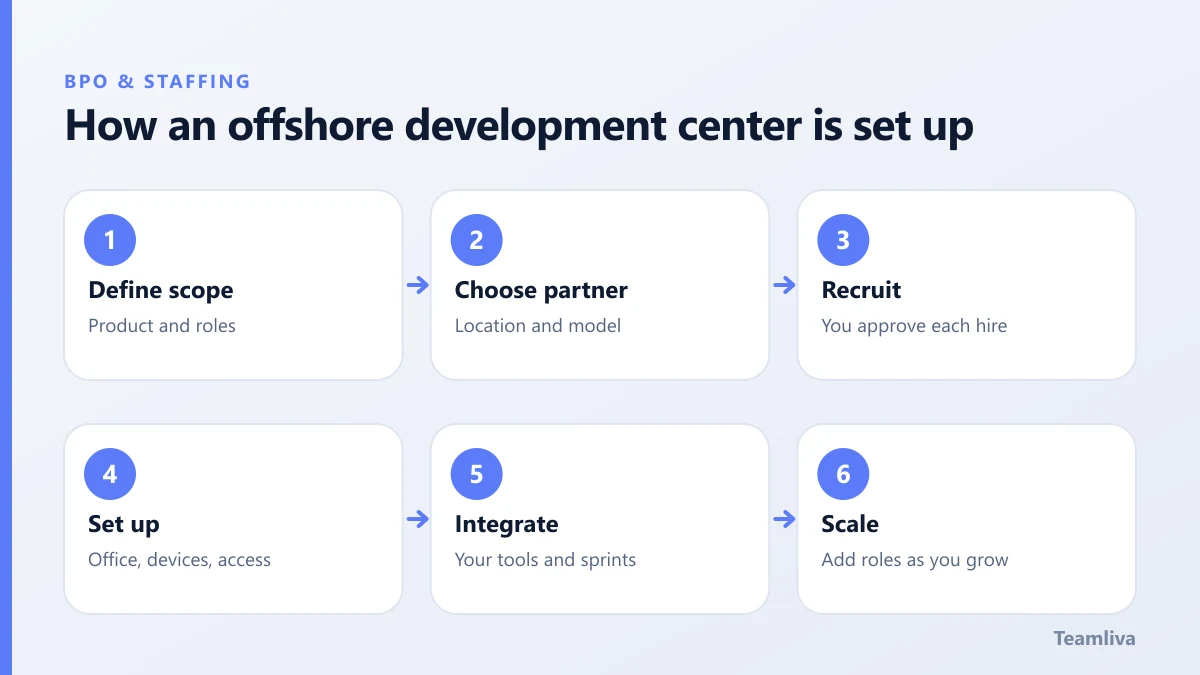
How an offshore development center works
- You define the roles and the skills you need.
- A partner recruits candidates. You interview and approve each hire.
- The partner employs the team and provides office space, equipment, internet and security.
- The team joins your workflow: your Jira, Slack, GitHub and sprint meetings.
- You direct the work. The partner handles HR, payroll, retention and facilities.
ODC vs other offshore models
- Project outsourcing: the vendor owns the delivery and the people. Good for fixed-scope projects, less control.
- Staff augmentation: individual specialists added to your team, often short term. See our guide to offshore staff augmentation.
- Dedicated team (ODC): a long-term dedicated team, built around your product.
- Captive center: you open and run your own legal entity abroad. Most control, most cost and risk.

Benefits of an ODC
- Lower cost than hiring the same roles locally, often by 50% or more.
- Full-time focus, because the team works only on your product.
- Knowledge stays with you, as people stay on your work for years.
- Faster scaling, since the partner already has recruiting and office capacity.
- Time zone coverage, with work continuing after your local team signs off.
What an offshore development center costs
You usually pay a monthly fee per team member. It covers salary, benefits, office, equipment and the partner's management margin. Costs vary mostly by role seniority and location. Our article on how much offshore staffing costs breaks down what sits inside the fee.
How to set up an ODC
- Start with a clear product scope and a role list for the first six months.
- Choose a location with the skills, time zone and stability you need.
- Pick a partner with a track record in your stack and strong security.
- Hire a team lead early, so someone owns daily delivery on the ground.
- Integrate fully. Add the team to your stand-ups, tools and code reviews from day one.
- Review quarterly and add roles as the product grows.
Our guide on how to build an offshore team walks through each step in more detail.
Risks to manage
Watch for weak communication, unclear ownership and poor security. Agree on IP ownership, code access rules and how people leave the team. If you may later want to own the centre outright, ask about the build operate transfer model.
A typical first-year ODC roadmap
- Months 1–2: hire a team lead and two or three core engineers; set up tools and access.
- Months 3–4: take on full features with code review from your local team.
- Months 5–8: add QA and a second squad; the offshore lead runs daily stand-ups.
- Months 9–12: the team owns a product area end to end, with quarterly planning alongside your local leads.

Signs your ODC is working
- Features ship on the same cadence as your local team.
- Review comments per pull request fall over time.
- Engineers raise risks early rather than after deadlines slip.
- Attrition stays low and people grow into senior roles.
- Your local engineers see the offshore team as colleagues, not a vendor.
Communication habits that make an ODC work
Distance is rarely the real problem; unclear communication is. Agree a few simple habits early. Hold a short daily stand-up during overlap hours. Write tickets with a clear goal, acceptance criteria and links to designs. Record key decisions in one shared place, not scattered across chat threads. Run demos at the end of each sprint, so the offshore engineers see how their work lands with users. Visit in person once or twice a year if you can. A few days together builds trust that months of video calls cannot.
Security basics for a development team
Keep all code in your own repositories and cloud accounts. Give each engineer an individual login with multi-factor authentication. Limit production access to the few people who need it, and log every change. Remove access on the same day someone leaves. Ask your partner to show how devices are managed and how the office network is protected.
Key takeaways: offshore development center
- An offshore development center is a dedicated team that works only for you, employed and supported by a local partner.
- You approve every hire and direct the work, while the partner handles office, payroll, HR and equipment.
- An ODC offers more control than project outsourcing and less setup risk than a captive center.
- Start small with a team lead and a few engineers, then scale as processes prove themselves.
- Agree IP ownership, security rules and exit terms in writing before work begins.

Starting an ODC with Teamliva
Teamliva (Team Liva) builds dedicated offshore teams in Dhaka, Bangladesh, for US and UK companies. You approve every hire and run the work; we handle recruiting, office, payroll and HR. See our dedicated offshore teams and web development services, or contact us.
For background on the wider practice, see offshore outsourcing on Wikipedia.
Frequently asked questions
What is the difference between an ODC and outsourcing?
With project outsourcing, a vendor delivers an agreed result and manages the people. With an offshore development center, the team works only for you, follows your processes and you direct the daily work.
How big should an offshore development center be?
Many start with three to five people, such as two developers, a QA engineer and a team lead, and grow once the workflow is stable.
Who owns the code written by an ODC?
You should. The service agreement and each employment contract should assign all intellectual property to your company.
- #Teamliva
- #TeamLiva
- #BPO
- #Outsourcing
- #RemoteStaffing
- #OffshoreDevelopmentCenter
- #Odc
- #DedicatedDevelopmentTeam
- #OffshoreSoftwareTeam