How to Hire Offshore Employees: A Step-by-Step Guide
A practical guide to hiring offshore employees: choosing roles and countries, picking a hiring model, screening candidates, contracts, pay and the first 90 days.
In this article
To hire offshore employees, pick roles with clear, measurable work, choose a country that fits the skills and hours you need, then hire through a staffing partner, an employer of record or your own entity. The steps below take you from job brief to a productive team member.
Offshore hiring has moved well beyond large corporations. Small and mid-sized US and UK companies now hire offshore employees for support, finance, healthcare admin, sales and software work. The ones who succeed treat it as real hiring, not a shortcut.
Step 1: Choose the right roles to hire offshore
Start with work that is repeatable, documented and easy to measure. Good first roles include:
- Customer support and live chat.
- Data entry, order processing and back-office admin.
- Bookkeeping and accounts payable.
- Medical billing, coding and insurance verification.
- Lead research and appointment setting.
- Design, development and QA.
Keep roles that depend on deep company context or key client relationships in-house for now. Our guide to what back-office work to outsource helps you draw the line.
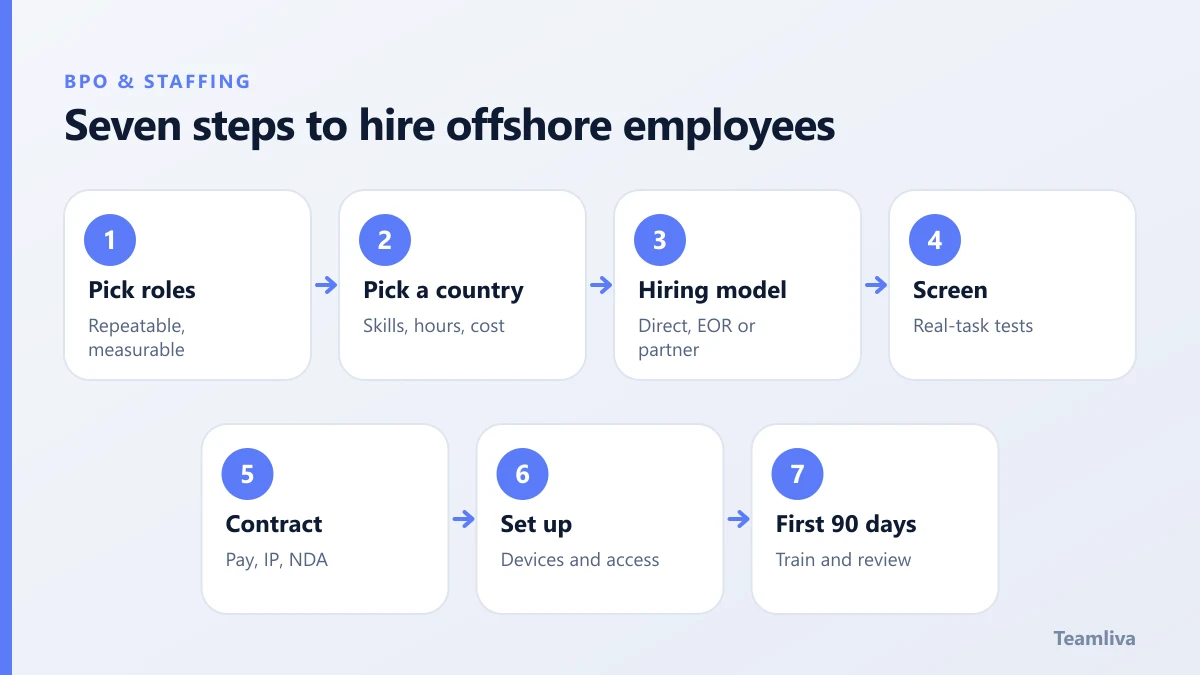
Step 2: Pick a country
Each market has strengths. The Philippines is known for voice support. India has a deep pool of engineers. Bangladesh offers strong value for back-office, healthcare admin and digital work. Compare English level, time zone overlap, skills and total cost. Our comparison of Bangladesh vs India vs the Philippines covers the trade-offs.

Step 3: Choose how you hire offshore employees
There are three main routes:
- Hire directly as contractors through job boards. Cheapest on paper, but you handle sourcing, payroll, compliance and retention yourself.
- Use an employer of record (EOR). The EOR employs the person legally on your behalf. You still recruit and manage them.
- Use an offshore staffing partner. The partner recruits, employs, equips and supports the team. You direct the daily work.
For most first hires, a staffing partner is the fastest and lowest-risk path. See offshore staffing vs outsourcing for how the models differ.
Step 4: Screen candidates with real work
Interviews alone rarely predict performance. Add a short paid test based on a real task, such as answering three support tickets or reconciling a sample statement. Check written English, attention to detail and how candidates ask questions. Our list of interview questions works for most offshore roles.
Step 5: Set contracts, pay and protections
Agree the salary in local currency, benefits, working hours, notice period and holidays. Protect your business with confidentiality, data protection and intellectual property clauses. If you use a partner, these sit in the partner's employment contract and your service agreement.
Step 6: Set up equipment and secure access
Give each new hire a company-managed device or a secure office seat, individual logins, multi-factor authentication and access only to the systems they need. Never share one login across several people.
Step 7: Plan the first 90 days
- Weeks 1–2: training, shadowing and written procedures.
- Weeks 3–6: live work with daily review.
- Weeks 7–12: weekly check-ins, clear targets and a 90-day review.
Our guide on how to manage an offshore team covers daily routines and communication.

A sample job brief for an offshore hire
A clear brief speeds up hiring and attracts better candidates. Include:
- Role title and purpose: one sentence on why the role exists.
- Daily tasks: the five to eight things the person will do most often.
- Tools: the software they will use from day one.
- Hours: shift times in your time zone and the overlap you need.
- Targets: how success will be measured after 90 days.
- Must-have skills: written English level, years of experience, specific systems.
Mistakes to avoid
- Hiring for a vague role, then blaming the location when it does not work.
- Skipping the real-task test to save a few days.
- Giving no written procedures and expecting people to guess.
- Managing only by output with no regular conversation.
- Paying below the local market and then losing good people within months.
Keeping offshore staff for the long term
Hiring is only half the job. Good people stay when they feel part of the team. Introduce new hires to your local colleagues, invite them to company meetings and recognise good work in public. Offer a clear path to more responsibility, such as training others or leading a small group. Review pay every year against the local market. Small gestures, like celebrating local holidays, also matter more than many managers expect.
Key takeaways: hire offshore employees
- To hire offshore employees successfully, start with repeatable, measurable roles and a clear job brief.
- Choose a country by skills, English level, time zone overlap and total cost, not hourly rate alone.
- A staffing partner is usually the fastest and lowest-risk route for a first offshore hire.
- Test candidates with a short paid task based on real work before you make an offer.
- Plan the first 90 days with training, daily review at first and a formal review at day 90.

How Teamliva helps with offshore hiring
Teamliva (Team Liva) recruits, employs and supports offshore employees in Dhaka for US and UK companies. You choose the people and direct their work; we handle hiring, payroll, office, equipment and HR. See our offshore staffing services or contact us with a role.
For background on the practice, see offshoring on Wikipedia.
Frequently asked questions
Is it legal to hire offshore employees?
Yes. You can hire people in other countries, but you must follow the employment and tax rules of the country where they live. Most companies use a staffing partner or an employer of record so they do not need a local legal entity.
How long does it take to hire offshore employees?
With a staffing partner, two to six weeks is typical from job brief to first day. Hiring directly through job boards often takes longer because you run every step yourself.
Which roles are easiest to hire offshore?
Roles with clear processes and measurable output: customer support, data entry, bookkeeping, medical billing, lead generation, IT helpdesk, design and software development.
- #Teamliva
- #TeamLiva
- #BPO
- #Outsourcing
- #RemoteStaffing
- #HireOffshoreEmployees
- #OffshoreHiring
- #OffshoreRecruitment
- #RemoteEmployees