How to Hire Offshore Developers Without the Usual Headaches
How to hire offshore developers who deliver: choosing a hiring model, testing skills, protecting code and IP, integrating the team and avoiding common mistakes.

In this article
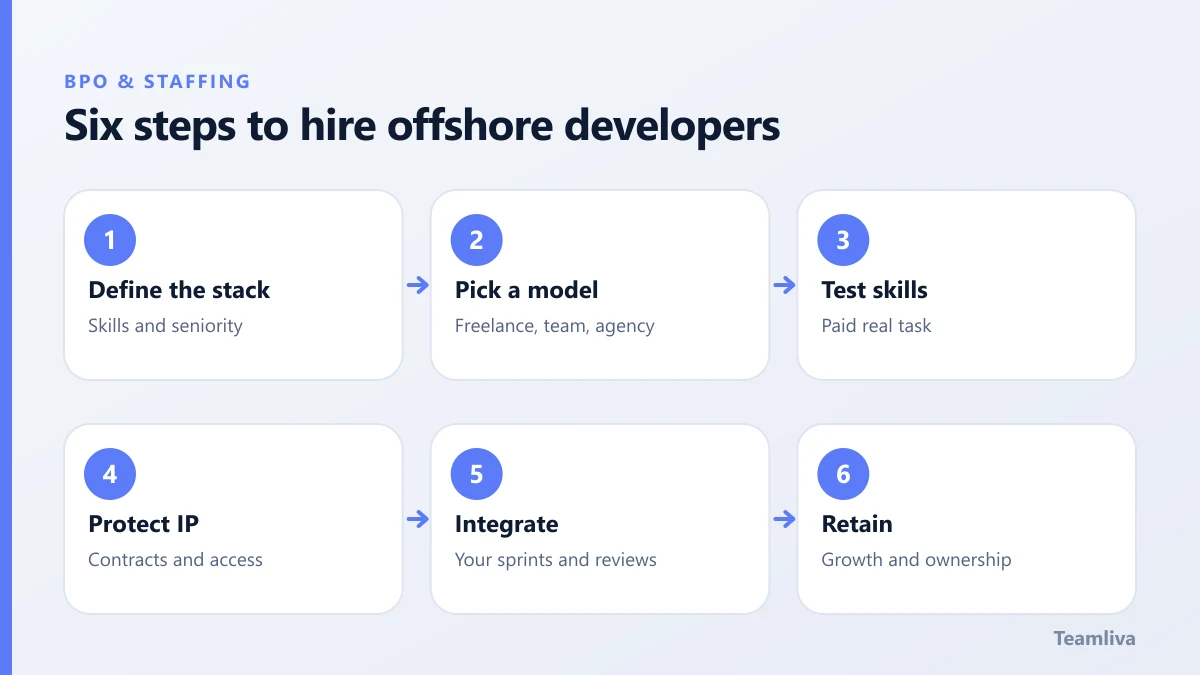
To hire offshore developers who deliver, define the exact skills you need, choose a hiring model, test candidates with a short paid task, protect your code with contracts and access controls, and integrate them fully into your team. Most failures come from skipping one of these steps, not from the location.
Step 1: Define what you need
Write down the stack, seniority and responsibilities. "A developer" is not a brief. "A mid-level React and Node developer who can own features from ticket to release, with two hours of overlap with US Eastern time" is. Decide whether you need individuals or a full team with QA and a lead.
Step 2: Choose how to hire offshore developers
- Freelance platforms: fast and flexible, but quality and commitment vary.
- Development agency: delivers a project, but you have less control of who works on it.
- Staff augmentation: individual developers join your team. See our offshore staff augmentation guide.
- Dedicated team or ODC: a long-term team that works only for you. See our offshore development center guide.
For ongoing product work, a dedicated team usually gives the best mix of control and cost.

Step 3: Test real skills
- Screen CVs and code samples for relevant experience.
- Set a short paid task close to your real work, ideally four hours or less.
- Review the code together and ask why they made each choice.
- Check communication, including written English and how they ask questions.
Skip abstract puzzles. A realistic task tells you far more.
Step 4: Protect your code and IP
- Contracts that assign all intellectual property to your company.
- Confidentiality clauses in employment and service agreements.
- Code kept in your repositories, under your organisation account.
- Individual accounts, multi-factor authentication and least-privilege access.
- Same-day access removal when someone leaves.
Step 5: Integrate, do not isolate
Offshore developers should join your stand-ups, code reviews, chat channels and planning. Pair them with a local engineer for the first few weeks. Give them real ownership of features, not just leftover tickets. Our guide on how to manage an offshore team covers rituals that work across time zones.
Common mistakes when you hire offshore developers
- Choosing on hourly rate alone.
- No overlap hours for questions and reviews.
- Vague tickets and no definition of done.
- Treating offshore staff as a separate, second-class team.
- Letting knowledge sit with one person, with no documentation.
Keeping developers engaged
Strong developers leave when work is dull or their growth stalls. Give offshore engineers real problems, credit for their work in release notes and a path to senior and lead roles. Budget for courses and conferences. Retaining one experienced developer saves months of hiring and onboarding.
What it costs
Rates vary by country and seniority. Look at total cost, including management time, tooling and rework, not just salary. Our offshore staffing cost guide explains what to compare.

A sample paid test task
Give candidates a small feature from a simplified version of your codebase:
- Add an API endpoint that returns filtered records.
- Write tests for the main cases.
- Add a short README note explaining any trade-offs.
Allow four hours, pay for the time and review the result together. Look at code clarity, test quality, how they handled unclear requirements and how well they explain their choices.
Questions to ask in the final interview
- Tell me about a bug you shipped and what you changed afterwards.
- How do you handle a ticket you think is badly specified?
- What does a good code review look like to you?
- How do you keep a team updated when you are blocked?
Choosing the right seniority mix
A team of only junior developers needs heavy guidance, which can slow your local engineers. A team of only seniors costs more than you may need. A common mix for a first team is one senior or lead, two mid-level developers and one QA engineer. The lead reviews code, mentors others and acts as the main contact with your engineering manager. As the team matures, you can add juniors who learn from the senior developers already on the team.
Time zones and overlap
Aim for at least two to four hours of overlap with your core team. Use that window for stand-ups, code reviews and quick questions. Outside overlap hours, offshore developers can work on well-defined tickets. Clear written handovers at the end of each day keep work moving around the clock instead of waiting.
Key takeaways: hire offshore developers
- Before you hire offshore developers, define the stack, seniority and overlap hours precisely.
- Dedicated teams suit ongoing product work better than freelancers or project agencies.
- A short, paid, realistic task predicts performance far better than puzzles or interviews alone.
- Protect your IP with contracts, your own repositories and individual, least-privilege access.
- Integrate offshore developers into stand-ups, reviews and planning from day one.

Hiring developers in Bangladesh with Teamliva
Teamliva (Team Liva) recruits and employs developers, QA engineers and designers in Dhaka who work as part of your team. See our web development and dedicated offshore teams services, or contact us with your stack.
For background on the field, see offshore software development on Wikipedia.
Frequently asked questions
Where is the best place to hire offshore developers?
India, Eastern Europe, Latin America, the Philippines, Vietnam and Bangladesh all have strong developer pools. Choose based on your stack, time zone needs, budget and English level.
How do I test an offshore developer?
Use a short, paid task close to your real work, followed by a code review conversation. It shows how they write, test, document and explain decisions.
How do I protect my code when I hire offshore developers?
Use contracts that assign all IP to your company, keep code in your own repositories, give individual accounts with least-privilege access, and remove access the day someone leaves.
- #Teamliva
- #TeamLiva
- #BPO
- #Outsourcing
- #RemoteStaffing
- #HireOffshoreDevelopers
- #OffshoreSoftwareDevelopers
- #RemoteDevelopers
- #OffshoreDevelopmentTeam