Virtual Assistant vs Employee vs Freelancer: Which Is Right?
Should you hire a virtual assistant, an in-house employee or a freelancer? Compare cost, control, reliability and risk to choose the model that fits your business.
In this article
When you need extra hands, three options usually come up: a virtual assistant through a managed provider, an in-house employee and an independent freelancer. Each one works. The right choice depends on your workload, budget and appetite for management.
This guide compares virtual assistant vs employee options honestly, so you can decide with confidence.
The three models in brief
- Virtual assistant (managed). A dedicated remote professional supplied by a provider, with supervision, backup and quality checks built in.
- Employee. A member of your payroll who works in your office or remotely under your direct management.
- Freelancer. An independent contractor who serves several clients and manages their own time and tools.
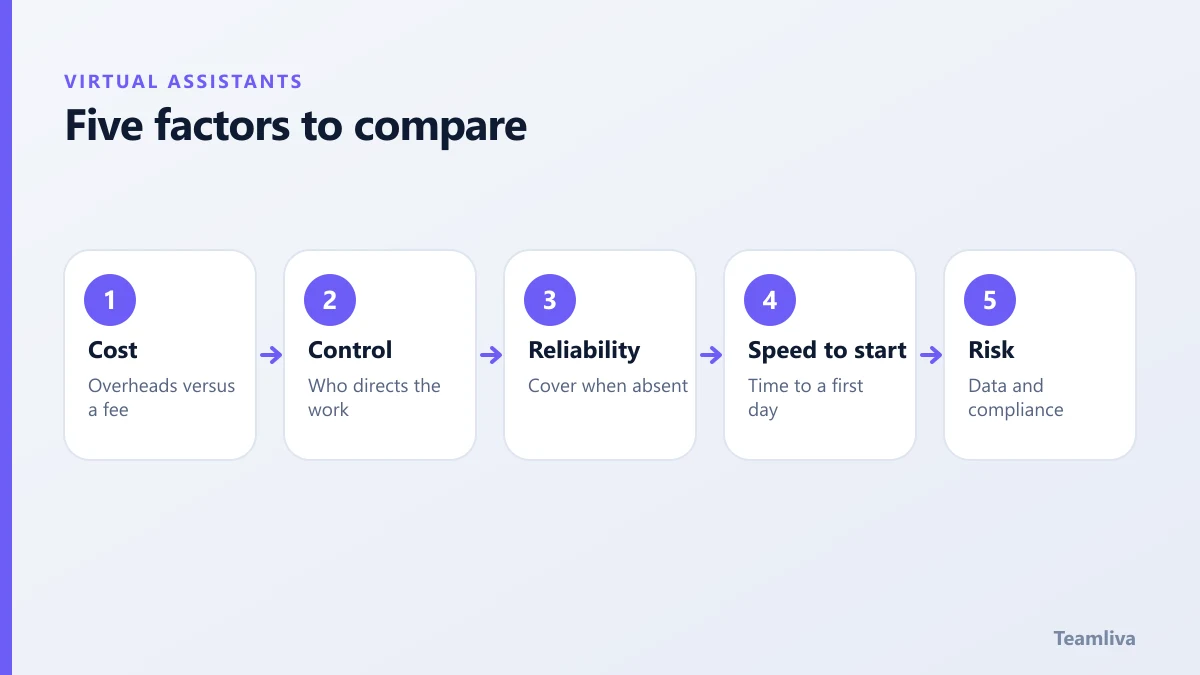
Comparing the key factors
Cost
An employee brings salary plus benefits, equipment, space, training and payroll administration. A freelancer charges per hour or project and carries their own overheads. A managed virtual assistant usually costs a predictable monthly or hourly fee with no office or equipment costs on your side.
Control
With an employee you have the most direct control. With a freelancer you agree deliverables and deadlines, not how they work. A managed assistant works in the middle. You direct the tasks, and the provider handles the people side.
Reliability and cover
Employees take holidays and sick leave. Freelancers can be booked elsewhere. A managed provider can usually provide backup, so your workflow does not stop when one person is away.
Speed to start
Recruiting an employee takes weeks or months. A freelancer can start quickly, but finding a good one takes effort. A provider with an assessed talent pool can often propose candidates much faster.
Risk and compliance
Employment brings legal obligations that depend on your location. Contractor status has its own rules. If you handle sensitive data, you also need confidentiality terms and secure working conditions, which a managed provider can often supply as standard.

When each option makes sense
Choose an employee when:
- The role is core, full-time and tied closely to your office culture.
- You need someone on site.
- You are ready to invest in long-term training.
Choose a freelancer when:
- The work is a defined project or occasional.
- You are comfortable vetting and managing the person yourself.
- Continuity is less critical.
Choose a managed virtual assistant when:
- You want ongoing support without the overhead of a hire.
- You need backup cover and quality oversight.
- You expect the workload to grow, and want to add people later.
A worked example
Imagine a small clinic that needs help with appointments, reminders and insurance checks. An in-house receptionist covers the front desk but is stretched by phone calls. A freelancer could help part-time, but availability is uncertain. A medical virtual assistant from a managed provider can take the scheduling and verification workflow, with a team lead and backup behind them.
Questions to ask before deciding
- How many hours of work do we really have each week?
- Do we have time to manage someone daily?
- What happens when this person is unavailable?
- How sensitive is the data involved?
- Will we need to scale up or down?
Our step-by-step hiring guide shows how to put your answer into action, and virtual assistant cost and pricing models explains what to expect on price.
Legal and tax points to check
The differences between an employee and a contractor are not only about convenience. They affect legal duties, taxes and benefits, and the rules vary by country. In the United States, for example, the tax authority explains how it decides whether someone is an employee or an independent contractor on its worker classification page. Wherever you are, ask a qualified adviser before you decide, especially if the person will work set hours under your direction.

Hidden costs to include in your comparison
When you compare virtual assistant vs employee options, look past the headline rate.
- Employees. Recruitment, training, equipment, software licences, paid leave, management time and the cost of replacing someone who leaves.
- Freelancers. Time spent finding, briefing and re-briefing people, plus the risk of unavailability at busy moments.
- Managed assistants. Usually a single, predictable fee, but check for setup charges, minimum hours and notice terms.
Add your own time to every option. An hour of management is an hour not spent on customers.
A simple decision guide
- Under ten hours a week of repeatable work? A freelancer or a small managed block is often enough.
- A steady part-time or full-time workload with quality needs? A dedicated managed assistant is worth considering.
- A role that must be on site or deeply tied to your culture? Hire an employee.
- Unsure? Start with a short managed pilot and review after a month. You can always change the model.
How Teamliva fits in
Teamliva places assessed remote professionals in managed pods, sized to the work. You keep control of the tasks. We supply the supervision, security standards and backup. Learn more on our BPO and staffing solutions page or contact us.
Virtual assistant vs employee: quick summary
For a fast comparison, use this summary.
- Best for steady, supervised support: a managed virtual assistant, because supervision, cover and quality checks are included.
- Best for core, on-site or culture-defining roles: an employee, because you have the most direct control.
- Best for defined projects and occasional work: a freelancer, because you pay for outcomes rather than ongoing capacity.
Whichever you choose, write down the scope, the targets and the review date. A clear agreement protects both sides and makes it easier to change the arrangement later.

The takeaway
There is no single winner. Match the model to the work: employees for core roles, freelancers for defined projects and managed virtual assistants for reliable, scalable support.
Frequently asked questions
Is a virtual assistant cheaper than an employee?
Often the total cost is lower, because you avoid office space, equipment and some overheads. The right comparison is the fully loaded cost of each option against the work you need done, not hourly rates alone.
Can I switch from a freelancer to a managed virtual assistant later?
Yes. Many businesses start with a freelancer and move to a managed model when they need backup cover, supervision or a team that can grow with them.
Which option is best for handling sensitive data?
Whichever gives you the strongest controls. Managed providers typically offer secured devices, access logging and formal agreements, which can be harder to arrange with an individual freelancer.
- #Teamliva
- #TeamLiva
- #VirtualAssistant
- #VirtualAssistantServices
- #HireAVirtualAssistant
- #EmployeeVsFreelancer
- #StaffingModels
- #Outsourcing