
Virtual Assistant Cost: Pricing Models and What Affects the Price
What does a virtual assistant cost? Compare hourly, monthly retainer and dedicated pricing, and learn the factors that move the price up or down.

In this article
Ask ten providers about virtual assistant cost and you will hear ten different answers. That is because price depends on the work, the skill level and the way the service is packaged. This guide helps you compare like with like.
We do not quote fixed prices here, because they vary by role and scope. Instead, we explain how pricing works so you can judge any quote you receive.
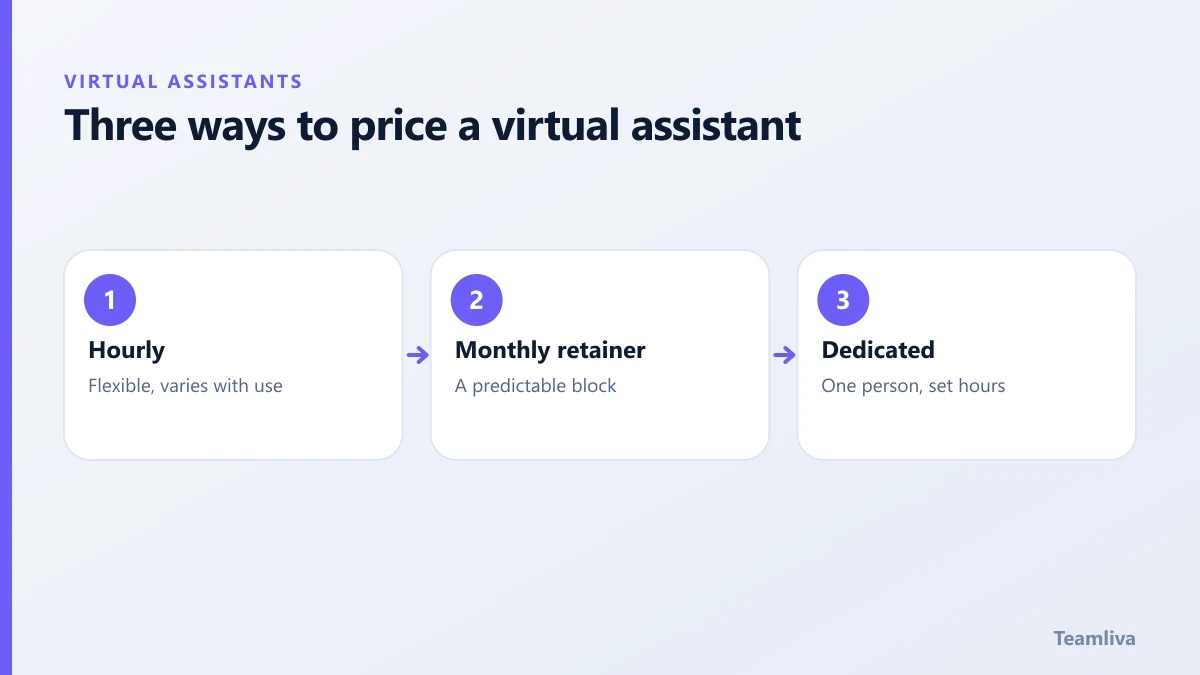
The three common pricing models
Hourly
You pay for the hours worked. This is flexible and easy to understand. It suits occasional or unpredictable workloads. The risk is uncertainty, as costs move with usage.
Monthly retainer
You pay a fixed amount for an agreed block of hours or an agreed scope each month. This is predictable and often gives a lower effective rate. Check whether unused hours roll over.
Dedicated assistant
You receive a person assigned to your account for set hours, such as full-time or part-time. This gives continuity and deep familiarity with your business. It works best when the workload is steady.
What affects virtual assistant cost
Several factors move the price:
- Skill level. General admin costs less than specialist work such as medical billing support or bookkeeping.
- Experience. Senior assistants who work independently cost more than juniors who need close direction.
- Hours and coverage. Extended, overnight or weekend cover usually costs more than standard hours.
- Language and communication needs. Strong written and spoken skills for customer-facing roles add value.
- Location of the provider. Cost of living in the assistant's country affects rates.
- Management and backup. A managed service includes supervision, quality checks and cover, which a bare freelancer rate does not.
- Tools and security. Secured devices, licences and compliance requirements can add cost, especially in healthcare.

Compare the total, not the hourly rate
An hourly rate on its own tells you little. Compare these things instead:
- What is included? Supervision, training, replacement cover and reporting.
- How much of your time will it take? Managing a poorly supported freelancer may cost you hours each week.
- What is the quality of the output? Errors carry a cost when they reach customers.
- How flexible is the contract? Notice periods and minimums matter.
Our comparison of virtual assistant vs employee vs freelancer shows how these factors play out across models.
How to judge value
A useful test is to compare the assistant's cost with the value of the time you reclaim. If you spend ten hours a week on admin and your time is worth far more than the hourly cost of an assistant, the decision is straightforward, provided you use those hours productively.
Also consider indirect gains. Faster customer replies, fewer missed appointments and cleaner records all protect revenue. In a medical setting, for instance, better insurance checks reduce avoidable denials, which we cover in medical claim denials.
Questions to ask for a clear quote
- What is the exact scope of work?
- Are there setup fees or minimum commitments?
- What happens if my assistant is unavailable?
- Who supervises the work, and how is quality checked?
- What are the notice terms if I need to change or stop?
- Are tools and security measures included?
A sensible approach to budgeting
Begin with a small, defined workflow. Measure the time saved and the quality achieved over the first month. Then decide whether to expand. Our guide to virtual assistants for small business includes a four-week plan.

Comparing two sample scenarios
Numbers differ by role, so here is a way to think about value instead of a price list.
Scenario one: a steady, defined workload. A clinic needs someone to manage scheduling and reminders every weekday. A dedicated assistant on a monthly arrangement gives continuity and predictable cost. Hourly billing would work, but hours would vary and the invoice would be harder to plan.
Scenario two: occasional, unpredictable work. A consultant needs help with proposals a few times each month. Hourly pricing suits this better, because there is no commitment during quiet weeks.
Match the pricing model to the shape of the work and you avoid paying for idle time.
Costs people forget
- Your management time. Include the hours you spend briefing, reviewing and giving feedback.
- Tool licences. Some roles need access to paid software.
- Overtime and out-of-hours rates. Ask how extra hours are billed.
- Replacement time. If the person leaves, what does it cost to restart?
- Training. Some providers include it, and others charge for it.
The US Small Business Administration explains general budgeting and cost planning in its business guide, which can help you set a realistic monthly budget.
Negotiating sensibly
Ask for clarity before discounts. A clear scope, a defined trial period and an agreed review date protect both sides. If a provider quotes far below the market, ask how supervision, backup and quality checks are covered. Low prices with no support can be the most expensive option in the end.
Talk to Teamliva
Teamliva builds packages around the work, from one dedicated specialist to a managed team. Share your workflow and we will scope the role and the price with you. Visit our BPO and staffing solutions page or contact the operations desk.

The takeaway
Virtual assistant cost depends on skill, hours, management and risk. Compare total value rather than the lowest rate, ask for a written scope and start small.
Frequently asked questions
Is the cheapest virtual assistant the best value?
Rarely. Low rates often come with more management effort, slower turnaround or higher error rates. Judge value by the finished work and the time you save, not by the hourly rate alone.
Are there hidden costs?
Ask about setup fees, minimum hours, notice periods, tool costs and overtime rates. A clear written quote should list all of these.
Can I change the hours later?
Many providers allow you to scale hours up or down with notice. Confirm the terms before you sign so you can adjust as your needs change.
- #Teamliva
- #TeamLiva
- #VirtualAssistant
- #VirtualAssistantServices
- #HireAVirtualAssistant
- #VirtualAssistantCost
- #Pricing
- #Budgeting
- #Outsourcing