Medical Claim Denials: Top Causes and How to Prevent Them
Most medical claim denials are preventable. Here are the most common causes, how denials differ from rejections, and the workflow that stops the same denial from returning every month.

In this article
Medical claim denials are one of the most expensive problems in healthcare administration. Every denied claim delays cash, costs staff time to rework, and may never be paid at all if nobody appeals it before the deadline.
The good news is that most denials follow patterns. Once you know the patterns, you can stop them at the source instead of fixing them one by one.
Denials versus rejections
The two words are often used as if they mean the same thing. They do not.
- A rejection is a claim the payer never accepted into processing. A missing field, an invalid code or a wrong member ID is enough. You fix the error and resubmit.
- A denial is a claim the payer processed and refused to pay in full or in part. It comes back with a reason code, and you must correct it or appeal it.
Rejections are usually caught by a claim scrubber. Denials need people, because they involve clinical, coding or contract questions.
The most common causes of medical claim denials
Registration and eligibility errors
A wrong date of birth, a typo in the subscriber ID or a lapsed policy will sink a claim. Verifying eligibility before the visit, not after the claim, removes a large share of these.
Missing or incorrect authorization
Some services need prior authorization. If it was never requested, expired, or covers a different code, the payer will deny the claim.
Coding problems
Diagnosis and procedure codes must support each other. Mismatched codes, missing modifiers and unbundled services all trigger denials. Our guide to medical coding basics shows how coding sits inside the wider revenue cycle.
Timely filing
Every payer sets a deadline for submitting claims. A claim that sits in a queue past that date is usually lost for good.
Credentialing gaps
A provider who is not enrolled with a payer cannot be paid by that payer. New hires and location changes are the usual culprits. Read more in our explainer on provider credentialing.
Medical necessity
Payers can deny services they judge unnecessary for the diagnosis. Clear documentation from the clinician is the best defence.
A denial management workflow that works
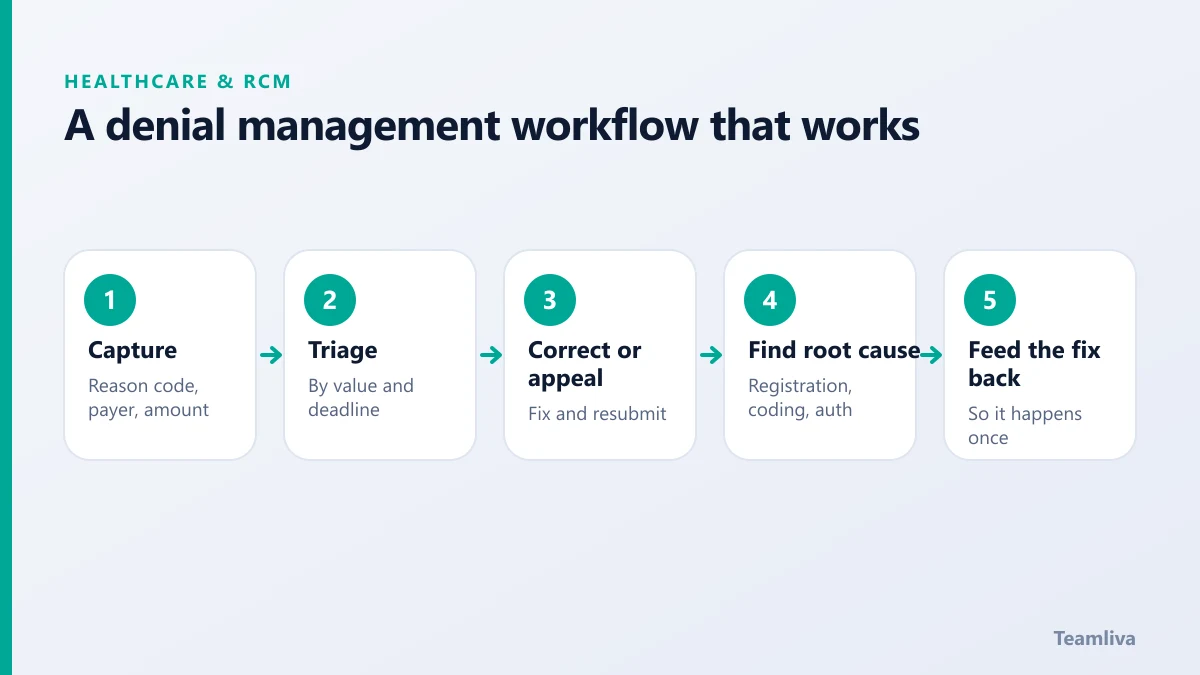
Fixing one claim is not the goal. Fixing the cause is. A repeatable workflow looks like this:
- Capture every denial with its reason code, payer, provider and dollar amount.
- Triage by value and deadline. Work high-dollar claims and near-deadline claims first.
- Correct and resubmit when the error is ours, or appeal with the right documentation when the payer is wrong.
- Categorise the root cause into registration, coding, authorization, credentialing or clinical documentation.
- Feed the fix back. Train the front desk, update the coding rules or change the checklist so the same denial stops appearing.
Step five is the one most practices skip. Without it, the team reworks the same denial month after month.
Metrics to track
Watch a small set of numbers every month, split by payer:
- Denial rate, the share of claims denied on first submission.
- Top denial reasons ranked by dollars lost.
- Appeal success rate, which shows whether appeals are worth the effort.
- Days to resolve a denial from receipt to payment.
A rising denial rate for a single payer usually points to a policy change you have not yet adapted to. The Centers for Medicare & Medicaid Services publishes claim and billing guidance that helps you stay ahead of public payer rules.
When to bring in a partner
Denial work is detailed and time sensitive. Small teams often cannot spare someone to chase appeals every day. An outsourced billing team can take over the workflow, report the root causes and give your staff a short list of process fixes. If you are comparing options, start with our checklist of questions to ask a billing partner. You can also see how the service is structured on our medical billing and RCM page.
Three preventable denials, and how to stop them
These examples are illustrative, but every billing team will recognise them.
The lapsed policy. A patient books online, and the front desk copies the insurance card from the last visit. The plan ended a month ago. The claim is denied for eligibility. A real-time eligibility check at scheduling, and again on the day of the visit, catches it in seconds.
The missing authorization. A referral for imaging needs prior authorization, but the request was made for a different procedure code. The payer denies the claim. The fix is a rule at scheduling: no authorization number on file, no appointment for the service.
The late claim. A batch of claims waits for a signature and slips past the filing window. There is no appeal for a missed deadline. A daily aging report with an owner for every claim over a set age prevents this.
How to reduce first-pass denials
Prevention beats appeals, because an appeal costs time even when you win. Focus on the front end:
- Verify eligibility and benefits before every visit.
- Build payer-specific rules into your claim scrubber.
- Keep a shared list of payers that need authorization for each service.
- Review the top five denial reasons every month with the front desk and coders.
Small, regular corrections do more than a big annual clean-up.
The takeaway
Medical claim denials are a process problem, not bad luck. Verify eligibility early, code carefully, file on time and keep credentialing current. Then diagnose every denial that still gets through, so it only happens once. If you want help building that workflow, talk to our operations desk.
Frequently asked questions
What is the difference between a claim rejection and a claim denial?
A rejection is stopped before the payer processes the claim, usually because of a formatting or data error, and it can be corrected and resubmitted. A denial is a processed claim the payer has decided not to pay, and it must be appealed or corrected under the payer rules.
How long do we have to appeal a denied claim?
It depends on the payer and the contract. Appeal windows range from a few weeks to a year, so check each payer agreement and track deadlines on every denied claim from the day it arrives.
Can denial management be outsourced?
Yes. Many practices hand denial management to a billing partner that reviews every denial, appeals it and reports root causes back to the front desk and coding team.
- #denial management
- #medical billing
- #rcm
- #claims