Provider Credentialing: How the Process Works and Why It Stalls Revenue
Credentialing decides when a new provider can be paid by a payer. Here is how enrollment works, the common causes of delay, and how to keep revenue moving while you wait.
In this article
Provider credentialing is the process of verifying a clinician's qualifications — licence, education, training, work history and malpractice history — so payers can confirm they are eligible to treat and bill their members. Closely related, payer enrollment is the step where the provider is approved to bill a particular insurance plan.
Until both are complete, a practice risks treating patients it cannot yet get paid for. That is why credentialing is a revenue issue as much as a compliance one.
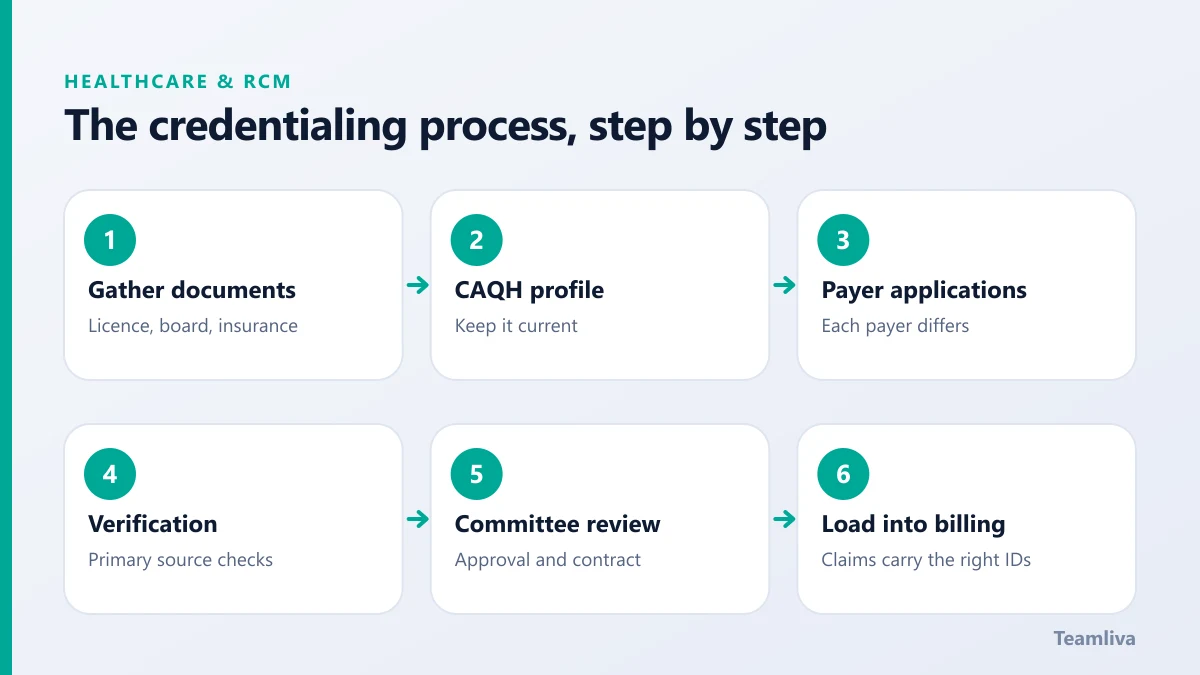
How the process typically works
- Gather documents. State licence, DEA registration where relevant, board certifications, education and training records, malpractice insurance and work history.
- Maintain the CAQH profile. Many commercial payers pull provider data from the CAQH database, so an incomplete or out-of-date profile slows everything down.
- Submit payer applications. Each payer has its own forms, requirements and timelines.
- Primary source verification. The payer independently confirms the information you submitted.
- Committee review and approval. Approval is followed by a contract and an effective date.
- Load the provider into your billing systems so claims carry the right identifiers.
Why it stalls revenue
Credentialing rarely fails outright; it drifts. The usual causes:
- Incomplete applications that bounce back for missing information.
- Stale CAQH data, especially expired attestations or documents.
- No single owner. Applications are started, then nobody chases the payer.
- Late starts. Beginning after the provider has already joined the practice means weeks of unbilled or delayed visits.
- Effective-date surprises. Approval may not be retroactive, so visits before the effective date can be difficult or impossible to bill.
Keeping revenue moving
- Start early — well before the provider's first scheduled patient.
- Track every application with a status, a next action and a follow-up date.
- Keep CAQH current and re-attest on schedule.
- Confirm effective dates in writing and schedule accordingly.
- Re-credential on schedule. Credentials expire; missing a renewal can interrupt payments for a provider who was already active.
Doing it in-house or outsourcing it
Credentialing is repetitive, deadline-driven and easy to let slip when a practice is busy. Many practices hand it to a dedicated specialist or an outsourced team so that applications always have an owner. If that sounds useful, see how credentialing fits into our medical billing, RCM and credentialing services, or read the broader picture in what revenue cycle management includes.
The takeaway
Treat credentialing as part of the revenue cycle. Start early, keep one owner, track every application, and confirm effective dates before you schedule patients.
Frequently asked questions
How long does provider credentialing take?
It varies widely by payer, state and how complete the application is. It commonly takes weeks to a few months, which is why applications should start well before a provider's first patient visit.
What is the difference between credentialing and payer enrollment?
Credentialing verifies a provider's qualifications. Payer enrollment (or contracting) is the separate process of getting the provider approved to bill a specific insurance plan. Both must finish before claims can be paid reliably.
- #credentialing
- #payer enrollment
- #rcm