What Is Revenue Cycle Management (RCM) in Healthcare?
Revenue cycle management is how a healthcare practice gets paid for the care it delivers. Here is what the cycle includes, where revenue leaks, and what to measure.
In this article
Revenue cycle management (RCM) is the set of administrative and clinical processes a healthcare practice uses to capture, bill and collect payment for patient care. It starts the moment a patient books an appointment and only ends when the balance is fully paid — by the payer, the patient, or both.
A practice can deliver excellent care and still struggle financially if the revenue cycle is weak. That is why RCM is treated as an operational discipline, not just a back-office chore.
The stages of the revenue cycle
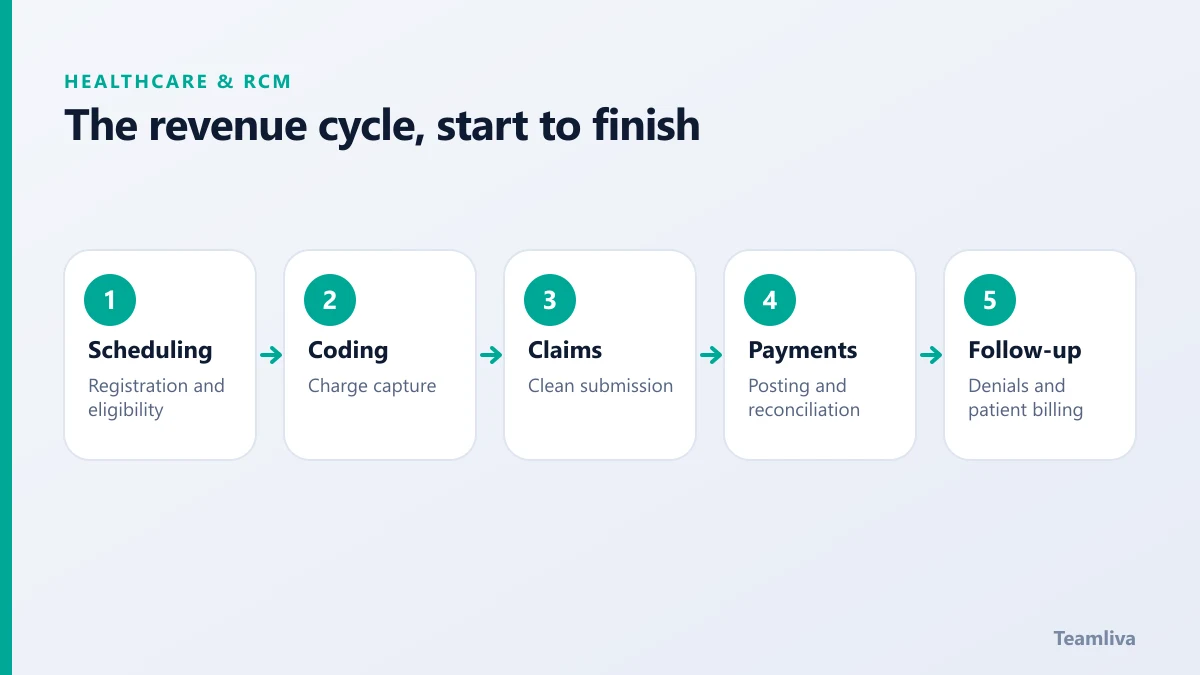
Every practice's workflow differs, but the cycle generally follows the same path.
Front end: before the visit
- Scheduling and registration — collecting accurate demographic and insurance details up front.
- Insurance verification and eligibility — confirming coverage, benefits and any prior authorization before the patient is seen.
- Provider enrollment — making sure each clinician is credentialed with the payers you bill. Delays here mean claims that cannot be paid; see our note on insurance credentialing.
Middle: the visit and the claim
- Charge capture and coding — translating the care delivered into the right diagnosis and procedure codes (ICD-10, CPT, HCPCS).
- Claim submission — sending clean, complete claims electronically. A "clean claim" is one that passes payer edits the first time.
Back end: getting paid
- Payment posting and reconciliation — matching remittances to claims and identifying underpayments.
- Claims follow-up — actively working claims that are unpaid or aging instead of waiting for a monthly batch review.
- Denial management — finding the root cause of denials, correcting and resubmitting or appealing them, and feeding the fix back into earlier steps.
- Patient billing — statements, payment plans and collections for the patient's share.
Where revenue usually leaks
Most leakage is not dramatic. It is small, repeated friction:
- Eligibility errors discovered only after the claim is denied.
- Coding gaps that lead to rejections or under-coded visits.
- Missed filing deadlines because nobody owns aging claims.
- Denials that are reworked but never diagnosed, so the same denial returns next month.
- Slow credentialing, which delays revenue from new providers by weeks or months depending on the payer.
What to measure
You cannot manage what you do not track. A handful of indicators tell you most of the story:
- Days in accounts receivable (A/R) — how long, on average, it takes to collect.
- First-pass acceptance rate — the share of claims accepted without rework.
- Denial rate and top denial reasons — the categories worth fixing first.
- Aging buckets — especially the share of receivables beyond 90 days.
- Net collection rate — how much of what you were entitled to collect you actually collected.
Track these monthly and by payer. Averages hide the one payer that is quietly dragging performance down.
Managing RCM in-house versus with a partner
Small and mid-sized practices often find that RCM is hard to staff well: it needs coders, billers, credentialing specialists and someone who chases claims — and it must keep pace with changing payer rules. Some practices build that team internally. Others work with an outsourced partner that runs the workflow end to end. Whichever route you choose, make sure someone is accountable for the whole cycle rather than for isolated tasks.
If you are weighing that decision, our overview of medical billing, RCM and credentialing services explains how an outsourced pod is structured. For the privacy side of handling patient data, the US Department of Health & Human Services publishes the HIPAA guidance that any billing partner should be working under.
The takeaway
Revenue cycle management is the difference between care delivered and revenue collected. Treat it as one connected process, measure it monthly, and fix problems at the step where they start — not at the end where they become denials.
Frequently asked questions
What is the difference between medical billing and revenue cycle management?
Medical billing is one step: preparing and submitting claims. Revenue cycle management covers the whole path from scheduling and insurance verification through coding, billing, payment posting, follow-up and denial management.
How do I know if my revenue cycle is underperforming?
Watch days in accounts receivable, the first-pass claim acceptance rate, the denial rate and the share of receivables older than 90 days. If they trend the wrong way over several months, revenue is leaking somewhere in the cycle.
- #rcm
- #medical billing
- #healthcare operations