Medical Billing Outsourcing: 7 Questions to Ask Before You Choose a Partner
Outsourcing medical billing can free your team and stabilise collections, but only with the right partner. These seven questions separate a real revenue cycle partner from a claims-submission vendor.
In this article
Medical billing outsourcing is appealing for an obvious reason: billing is detailed, rule-heavy work that pulls attention from patient care. But the quality of outsourced billing varies enormously, and switching partners later is disruptive. It is worth asking hard questions up front.
Here are seven that separate a genuine partner from a vendor that simply submits claims.
1. What exactly is included?
"Billing" can mean anything from keying charges to running the full revenue cycle. Ask for a written scope that names each task — credentialing and payer enrollment, coding, claim submission, payment posting, claims follow-up, denial management and reporting. Gaps in scope become gaps in revenue. Our medical billing and RCM service is scoped as one workflow for exactly this reason.
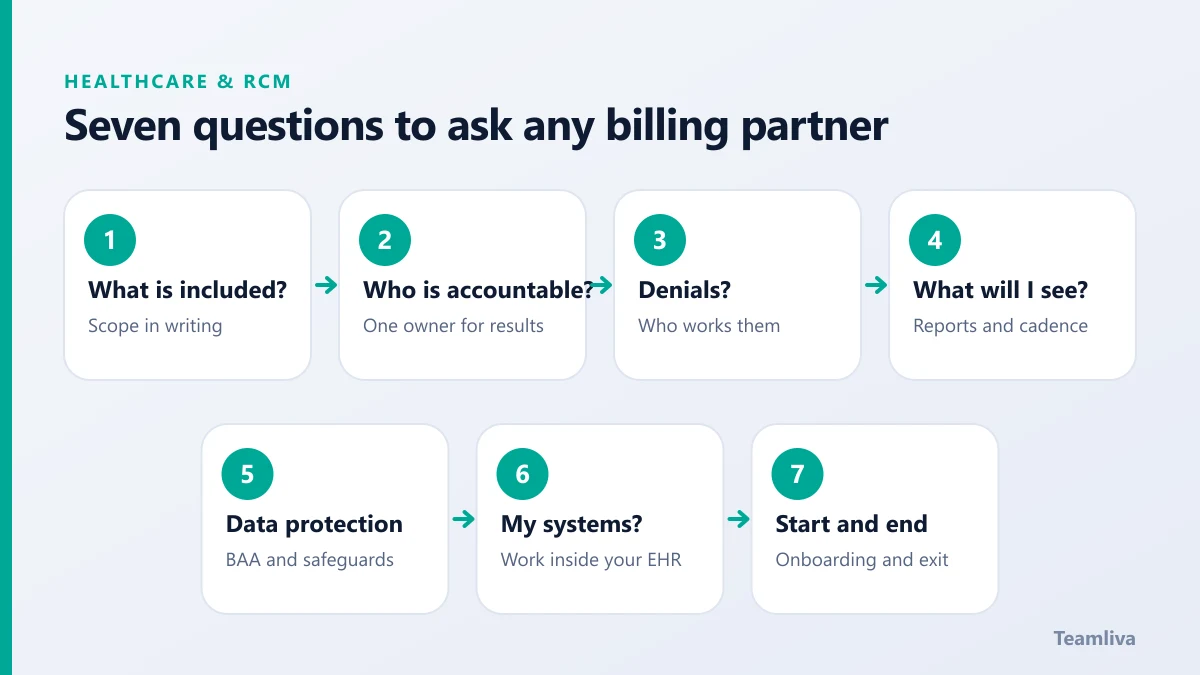
2. Who is accountable for the outcome?
The strongest arrangements have a named account team, not a rotating queue. Ask who you would talk to when a payer starts denying a specific code, and how quickly they respond.

3. How are denials handled?
Reworking a denied claim is table stakes. The better question is whether denials are analysed for root cause and fed back into coding and submission so they stop recurring. Ask to see how a partner categorises denial reasons and what they do with the pattern.
4. What will I see, and how often?
You should receive regular, plain-language reporting: days in A/R, first-pass acceptance rate, denial rate by reason and payer, aging buckets and net collections. Ask for a sample report before you sign. If it is only a spreadsheet of totals, you will not be able to act on it.
5. How is patient data protected?
Any partner handling protected health information must sign a Business Associate Agreement and work under HIPAA-aligned controls. Ask about encrypted workstations, role-based access and how access is reviewed. The HHS HIPAA guidance is the reference point.
6. Will they work in my existing systems?
Most practices do not want to replace their EHR or practice management software just to change billing vendors. Confirm which systems the partner already works in and what integration or access they need from you.

7. What happens at the start — and at the end?
Onboarding is where outsourced billing succeeds or fails. Ask how the partner audits your current A/R, how credentialing is handled in parallel, and how long it typically takes before claims flow on the new process. Then ask the uncomfortable question: if you leave, how do you get your data and workflow documentation back?
More questions that separate strong billing partners from weak ones
About their people
- How are billers trained on payer rules, and how often is training refreshed?
- What is the ratio of staff to accounts?
- Who will be my day-to-day contact, and what is the escalation path?
About their process
- How do you scrub claims before submission?
- How quickly are rejections worked?
- How do you handle underpayments?
About the numbers
- What were the average days in A/R and clean claim rate for a comparable client, after 6 months?
- How do you report results, and can I see a sample?
- How do you measure success for my practice?
About risk
- Where is patient data stored, and who can access it?
- What happens to my data if we end the contract?
- What insurance do you carry?
How to compare answers
Put each partner’s answers in a table and score them from one to five. Ask for a reference and a sample report. Then run a short pilot on a limited set of claims. The billing KPIs give you the measures to compare.
Key takeaways: medical billing outsourcing
- Medical billing outsourcing works best when scope, ownership of denials, reporting and data protection are agreed in writing before work starts.
- Ask who works denials and how root causes are fed back into coding and front-desk habits, not just how claims are submitted.
- Insist on a business associate agreement and named safeguards for patient data from day one.
- Compare partners on the same measures: days in A/R, clean claim rate, denial rate and net collection.
- Run a short pilot on a limited set of claims, and keep the right to leave with your data and files.

How to compare answers
Put the same seven questions to each shortlisted partner and score the answers side by side. Favour clarity over polish: a partner that explains its limits and its process plainly is usually more reliable than one that promises certainty.
If you would like to see how an outsourced pod is structured, read about healthcare staffing and operations support or talk to our operations desk.
Frequently asked questions
Do I have to switch EHR or practice management systems to outsource billing?
Not necessarily. A good partner works inside the systems you already use. If a vendor insists on a platform migration before they can start, treat that as a cost you need to price in.
How is patient data protected when billing is outsourced?
Your partner should sign a Business Associate Agreement (BAA), work on encrypted and access-controlled workstations, and be able to explain how access is logged and reviewed.
- #Teamliva
- #TeamLiva
- #MedicalBilling
- #RCM
- #HealthcareBPO
- #Outsourcing