Accounts Receivable Follow-Up in Medical Billing: A Practical Guide
Unpaid claims quietly age into lost revenue. This guide shows how to structure accounts receivable follow-up, prioritise by value and keep your aging report healthy.
In this article
Submitting a claim is not the end of the job. It is the start of a waiting period. Claims that are not paid on time need someone to ask why and to act. That ongoing work is accounts receivable follow-up, and it often decides how healthy cash flow really is.
Here is how to structure it so nothing slips through.
What accounts receivable follow-up covers
- Checking the status of submitted claims.
- Contacting payers about unpaid, delayed or underpaid claims.
- Correcting errors and resubmitting.
- Appealing denials with the right documentation.
- Recording every contact and outcome.
- Moving patient balances to the correct next step.
It sits between claim submission and final payment in the revenue cycle. If you want the bigger picture, read what revenue cycle management is.
Start with your aging report
The aging report groups balances by how long they have been outstanding, commonly in buckets such as 0 to 30, 31 to 60, 61 to 90 and over 90 days. It is your main work list.
Older balances are harder to collect, and payers have filing and appeal deadlines. So the older buckets need attention first, but do not ignore the younger ones. Catching a problem in the first month is much easier than after three.

Prioritise by value and deadline
Not every claim deserves the same effort. Sort your work by:
- Deadline risk. Claims close to a timely filing or appeal limit.
- Balance size. Higher balances first.
- Likelihood of payment. Claims with a clear fixable error are quick wins.
- Payer behaviour. Some payers need a different approach than others.
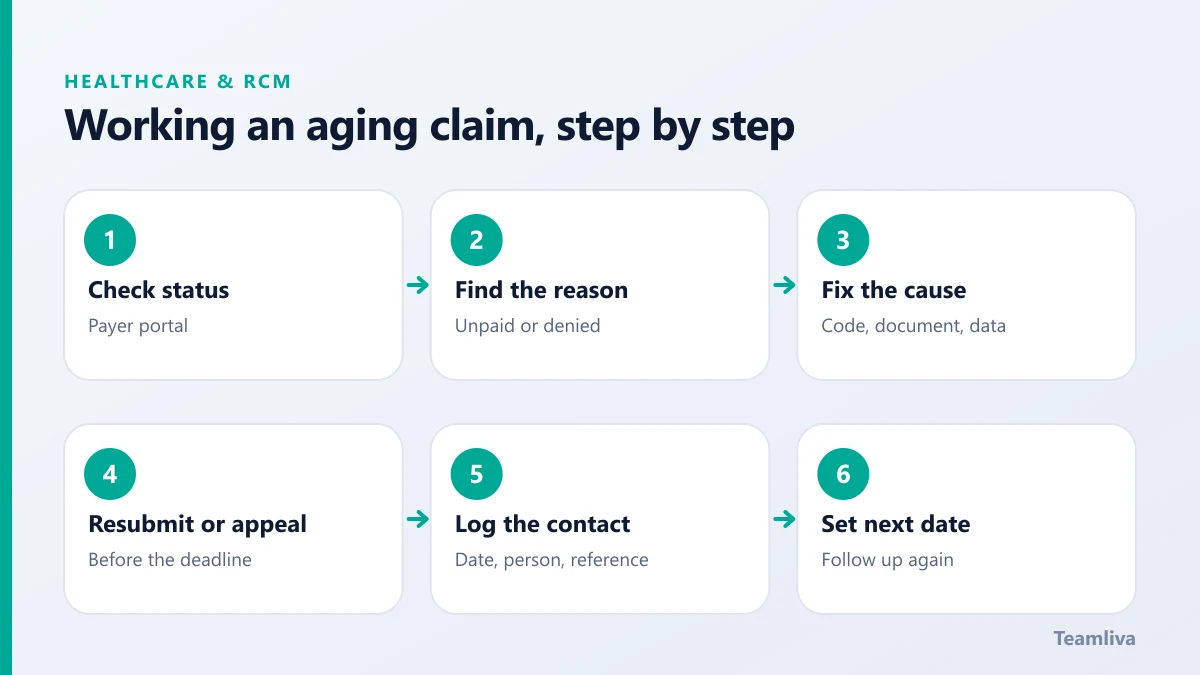
Work each claim with a routine
A consistent routine keeps quality high.
- Check the claim status in the payer portal.
- Note the reason if the claim is unpaid or denied.
- Fix the cause, whether it is a coding fix, a missing document or a data correction.
- Resubmit or appeal within the payer's timeline.
- Record the date, the contact person, the reference number and the next action.
- Set a follow-up date and stick to it.
The note in step 5 matters more than it looks. Without a record, the next person starts from zero.
Find the root cause, not only the fix
If the same problem keeps appearing, working the claim is not enough. Group denials by reason and payer, then feed the fix back to registration, coding or authorization. Our guide to medical claim denials shows a workflow for this.
Track the right measures
- Days in accounts receivable. How long it takes to collect on average.
- Percentage over 90 days. How much is at risk.
- Follow-up completion. Whether scheduled actions actually happen.
- Recovery rate on appealed claims.
Our list of medical billing KPIs to track every month explains how to read them.
Common pitfalls
- Waiting for a monthly review instead of working claims daily.
- Skipping documentation of calls.
- Letting appeal deadlines pass.
- Treating all payers the same.

Outsourcing follow-up
Follow-up is repetitive, detailed and deadline-driven, which suits a specialist team. A dedicated pod can work aging buckets daily, keep clean notes and report results. Protected health information must be safeguarded throughout, as explained by the US Department of Health and Human Services.
Scripts and notes that save time
A short script keeps payer calls efficient. Before dialling, have the claim number, patient details, date of service and billed amount ready. Ask these questions in order:
- What is the current status of this claim?
- If it is unpaid, what is the reason and what is needed to release it?
- What is the expected date of payment or response?
- Can you give me a reference number for this call?
Record the answers in a consistent note format: date, name of the contact, reference number, outcome and next step. Clear notes let anyone pick up the account without repeating the call.
Underpayments deserve attention
Not every problem is a denial. A claim that is paid at a lower amount than your contract allows is an underpayment. Compare each payment with the expected rate, flag differences and file a dispute where the contract supports it. Over a year, small underpayments can add up to a significant sum.
Working patient balances
Patient responsibility needs a different tone. Send clear statements, offer payment options and be ready to explain charges. Be polite and consistent, and record every conversation. A simple payment plan often collects more than a stern reminder.
The Healthcare Financial Management Association shares industry guidance on collections and revenue cycle practices on its website, which is a helpful reference when you refine your process.
How Teamliva helps
Teamliva runs remote medical billing and RCM teams that include claims follow-up, denial management and payment posting, working inside your systems under agreed service levels. Learn more about our medical billing and RCM services or contact us.

The takeaway
Good accounts receivable follow-up means working the aging report on a schedule, prioritising by deadline and value, documenting every contact and fixing root causes. Do that consistently and cash arrives sooner.
Frequently asked questions
What is accounts receivable follow-up in medical billing?
It is the ongoing work of checking unpaid or underpaid claims, contacting payers, correcting or appealing problems and recording the outcome until every claim is resolved.
How often should aging claims be worked?
Claims should be reviewed on a fixed schedule, not only monthly. Many teams work older and higher-value claims daily and lower-priority accounts weekly.
What is a healthy share of receivables past 90 days?
It varies by specialty and payer mix, so set your own baseline and watch the trend. The goal is a steady decline in the share of older balances.
- #Teamliva
- #TeamLiva
- #MedicalBilling
- #RCM
- #HealthcareBPO
- #AccountsReceivable
- #AgingClaims