Medical Coding Basics: ICD-10, CPT and HCPCS Explained
Medical coding turns patient care into the codes payers use to pay claims. This guide explains ICD-10, CPT and HCPCS, how they fit together and why coding accuracy drives revenue.
In this article
Medical coding is the translation layer of healthcare. A clinician documents what happened during a visit. A coder converts that documentation into standard codes. A payer reads those codes and decides what to pay.
If the codes are wrong, the claim is wrong. That is why medical coding sits at the centre of a healthy revenue cycle.
The three main code sets
ICD-10: the diagnosis
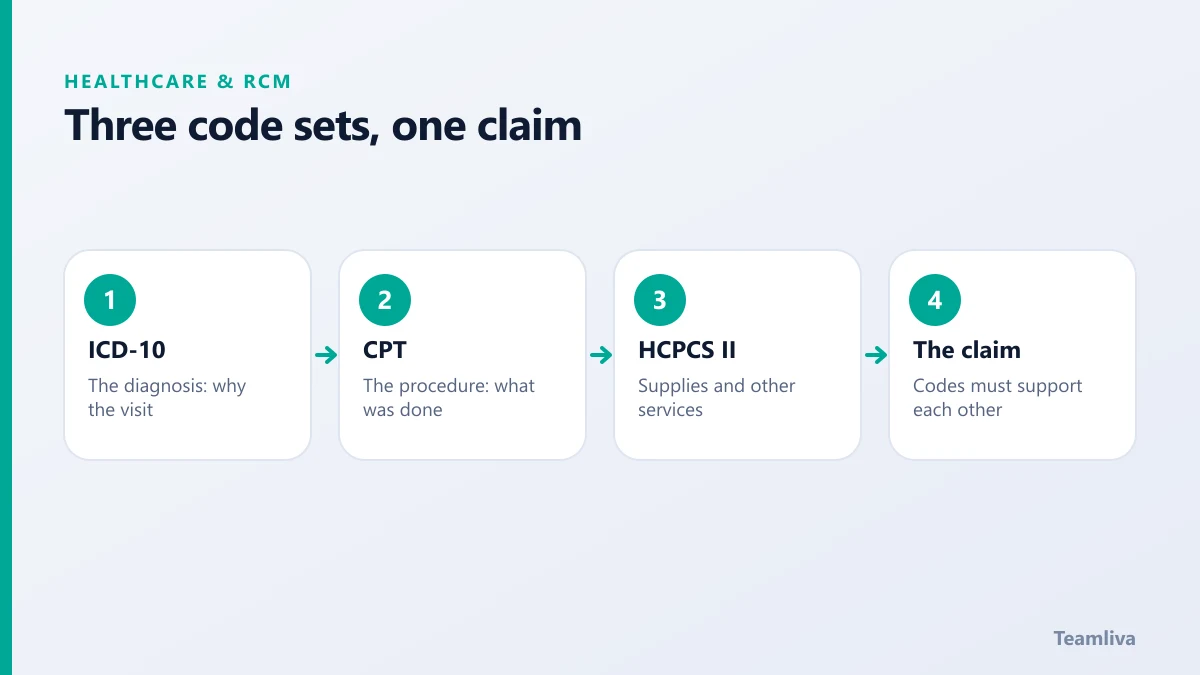
The International Classification of Diseases, Tenth Revision, describes conditions, symptoms and injuries. In the United States, ICD-10-CM is used for diagnoses. It answers the question, "Why was the patient here?"
ICD-10 codes are alphanumeric and can be very specific. The right level of detail matters, because vague codes invite denials.
CPT: the procedure or service
Current Procedural Terminology codes describe what the provider did, from an office visit to a surgical procedure. The American Medical Association maintains the CPT code set. It answers the question, "What did the provider do?"
Many CPT codes accept modifiers. A modifier adds context, for example that a procedure was bilateral or that two services on the same day were distinct.
HCPCS Level II: supplies and other services
Healthcare Common Procedure Coding System Level II codes cover items CPT does not, such as durable medical equipment, ambulance services and certain drugs. Public payers rely on them heavily.
How the codes work together
A claim links each service to the diagnosis that justifies it. The payer checks that the pairing makes sense. A knee X-ray tied to an unrelated diagnosis will be questioned. This is the idea of medical necessity, and the documentation must support it.
Good coders therefore do more than look up codes. They read the clinical note, confirm the documentation is complete and query the provider when something is unclear.
Why medical coding accuracy matters
It affects payment
Under-coding leaves money on the table. Over-coding creates compliance risk and can lead to audits and repayment demands. Accurate coding sits between the two.
It affects denials
Coding errors are among the leading causes of medical claim denials. A missing modifier or a mismatched code pair is often all it takes.
It affects reporting
Codes feed quality reporting, risk adjustment and analytics. Poor coding distorts every report built on top of it.
Common coding mistakes
- Unbundling, which means billing separately for services that should be billed as one.
- Missing or wrong modifiers.
- Using an unspecified diagnosis when the note supports a more specific one.
- Copying codes from the last visit instead of coding the current encounter.
- Outdated code sets after an annual update.
How to keep coding quality high
- Document clearly. Coders can only code what the clinician wrote.
- Audit regularly. Review a sample of coded charts every month and track error rates by coder and by code.
- Train on updates. Schedule training whenever code sets change.
- Use a claim scrubber, but do not treat it as a substitute for a trained coder.
- Close the loop. When a denial traces back to coding, feed the lesson into the next audit.
The CMS site has a useful reference on ICD-10 codes and the regular updates to them.
In-house or outsourced coding?
Coding is a specialist skill, and certified coders are not always easy to hire or retain. Some practices keep coding in-house and outsource billing. Others hand over the whole workflow so one team owns the result. Teamliva supports both models through its medical billing, RCM and coding services.
A short worked example
Take an established patient who visits for a sore throat. The clinician documents the symptoms, performs a rapid strep test and prescribes treatment.
- The ICD-10 code records the diagnosis, for example acute streptococcal pharyngitis if the test is positive.
- The CPT codes record the visit level and the rapid test performed.
- A HCPCS code may apply if a supply or item is billed separately.
The claim then links the test to the diagnosis. If the note said only "sore throat" and the test result was not recorded, the coder cannot assign the specific diagnosis. The claim may be paid at a lower level, or questioned. Complete documentation is the coder's raw material.
Skills that separate good coders
Strong coders share a few habits:
- They read the whole note, not just the assessment line.
- They know the payer rules, because the same service can be coded differently for different payers.
- They query providers politely and precisely when documentation is unclear.
- They keep learning, since guidelines and code sets change every year.
Certification helps, but ongoing audits and feedback matter just as much.
Coding and compliance
Accurate coding is also a compliance duty. Payers and government programmes audit claims, and they look for patterns such as repeated high-level visit codes or services billed without support in the note. The safest position is simple: code what the documentation supports, keep evidence of your audits and correct errors quickly when you find them. A culture that treats coding as a shared responsibility between clinicians and coders is far easier to defend than one that leaves it to a single person at the end of the process.
The takeaway
Medical coding is precise work that decides how, and whether, a practice gets paid. Learn the three code sets, insist on complete documentation and audit often. Accurate codes make cleaner claims, fewer denials and steadier cash flow.
Frequently asked questions
What is the difference between ICD-10 and CPT codes?
ICD-10 codes describe the diagnosis, meaning why the patient needed care. CPT codes describe the procedure or service performed. A claim needs both, and they must support each other.
What are HCPCS codes used for?
HCPCS Level II codes cover items and services that CPT does not, such as supplies, equipment and some drugs. They are used heavily with Medicare and Medicaid.
How often do medical codes change?
Code sets are updated regularly, and many changes take effect at the start of the year or fiscal year. Coders need ongoing training to keep up.
- #medical coding
- #icd-10
- #cpt
- #hcpcs