BPO Pricing Models Explained: Hourly, FTE, Per Transaction and Fixed Fee
BPO providers price work in several ways. Compare hourly, per-FTE, per-transaction and fixed-fee models, plus the hidden costs to check before you sign.
In this article
BPO pricing models include hourly rates, per-FTE monthly fees, per-transaction charges and fixed-fee managed services; the best one aligns the provider’s incentives with the result you want. Always compare hidden costs and total cost of ownership.
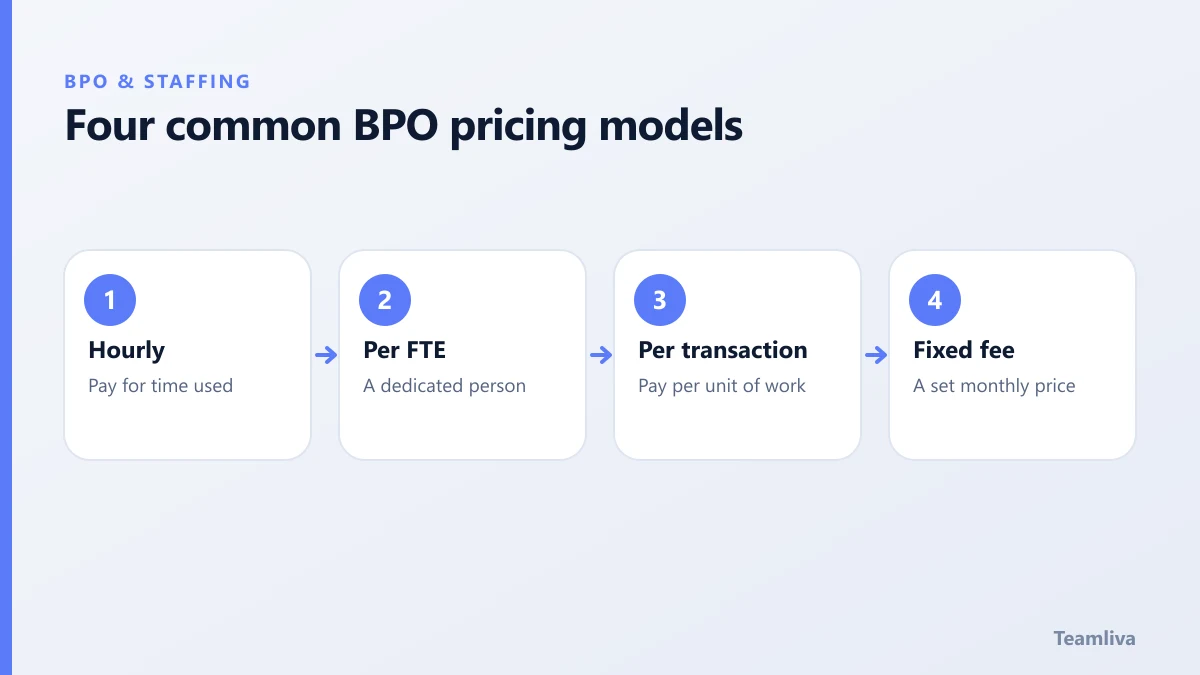
Two BPO quotes can look very different and still be fair, because providers price work in different ways. Before you compare numbers, compare models. This guide explains the four most common and where each fits.
1. Hourly pricing
You pay for the hours worked at an agreed rate.
Good for: variable or uncertain workloads, short projects and trials.
Watch for: unclear time tracking, overtime premiums and no incentive for efficiency, since more hours means more revenue for the provider.
2. Per FTE (dedicated team member)
You pay a monthly fee for a full-time equivalent dedicated to your work.
Good for: steady, predictable workloads and roles where knowledge builds over time, such as a dedicated virtual assistant.
Watch for: paying for idle time when volume drops. Agree how you can scale up and down and with what notice.

3. Per transaction or per unit
You pay for each unit delivered: per claim submitted, ticket resolved or record processed.
Good for: high-volume, well-defined work where output is easy to count.
Watch for: incentives that favour speed over quality. Pair this model with quality targets and penalties. Define what counts as a transaction.
4. Fixed fee or managed service
You pay a fixed monthly fee for a defined scope and service levels.
Good for: ongoing processes where you care about outcomes, not hours, such as a full customer support desk.
Watch for: scope creep disputes. Define what is in and out of scope, and how changes are priced.
Comparison
| Model | Cost predictability | Flexibility | Incentive to watch |
|---|---|---|---|
| Hourly | Low | High | More hours means more revenue |
| Per FTE | High | Medium | Idle time is paid |
| Per transaction | Medium | High | Speed over quality |
| Fixed fee | High | Medium | Scope disputes |
Medical billing is often priced as a percentage of collections; see medical billing outsourcing questions to ask.
Hidden costs to ask about
- Setup or onboarding fees.
- Minimum monthly commitments.
- Overtime and weekend premiums.
- Software and tool licences.
- Training and retraining charges.
- Replacement fees when staff change.
- Currency conversion and payment fees.
- Charges for changes in scope.
Put every item in writing, and ask the provider to confirm what the quote includes.
Total cost of ownership
Add your own costs: management time, rework from errors, delays and the effort of switching. A slightly higher price with strong management often wins on total cost. The same logic applies to virtual assistant cost and pricing models.
How to compare quotes
- Give each provider the same brief.
- Ask them to itemise inclusions and exclusions.
- Convert each to a monthly cost for your expected volume.
- Add hidden costs.
- Compare service levels, not only price.

Negotiation tips
- Ask for a pilot rate, then an agreed rate after proof of quality.
- Link some fees to quality targets.
- Agree how price changes when volume rises or falls.
- Clarify notice periods and exit terms. See BPO service level agreements.
BPO pricing models: choosing by type of work
- Unpredictable, project-like work: hourly, with a cap.
- Steady support or admin: per FTE.
- High-volume, countable work: per transaction, with quality targets.
- A full function with outcomes: fixed fee with service levels.
- Healthcare billing: often a percentage of collections; check how it treats denials and patient balances.
Questions that expose hidden costs
- "Does this price include supervision and quality checks?"
- "Are tools and licences included?"
- "What is the notice period for reducing hours?"
- "What do you charge for changes in scope?"
- "How are public holidays and absences handled?"
Review pricing regularly
Prices should reflect the current work. Review at least once a year, and after any large change in volume. If automation reduces the work, ask the provider to reflect that in price. A good partner will discuss this openly, and you should reward improvements that reduce cost without reducing quality. Read about the wider comparison of outsourcing models for location effects on price. Wikipedia’s BPO article provides more background.
Key takeaways: BPO pricing models
- BPO pricing models differ in who carries the risk: hourly shifts it to you, per-transaction to the provider, and fixed fees share it.
- Choose the model that matches the work: steady roles suit per-FTE, countable work suits per-transaction, full functions suit a fixed fee.
- Pair per-transaction pricing with quality targets so speed does not beat accuracy.
- Ask for every hidden cost in writing: setup, minimums, overtime, tools, training and replacement.
- Compare total cost of ownership, including your own management time, not only the headline rate.

Talk to us
Teamliva (Team Liva) provides clear, itemised quotes for BPO and staffing engagements. Explore BPO and staffing solutions or contact us for a quote based on your scope.
Frequently asked questions
Which BPO pricing model is best?
It depends on the work. Steady, predictable work suits per-FTE or fixed fees. Variable volume suits per-transaction or hourly pricing. Choose the model that aligns incentives with the outcome you want.
What hidden costs should I ask about?
Setup fees, minimum commitments, overtime, tool licences, training, replacement costs, currency fees and charges for scope changes.
- #Teamliva
- #TeamLiva
- #BPO
- #Outsourcing
- #RemoteStaffing
- #BpoPricing
- #OutsourcingCost
- #FtePricing
- #PerTransactionPricing