
The First 90 Days of a BPO Engagement: A Transition Plan
A good BPO start decides everything that follows. Use this 90-day transition plan to move work smoothly: discovery, documentation, pilot, stabilisation and review.
In this article
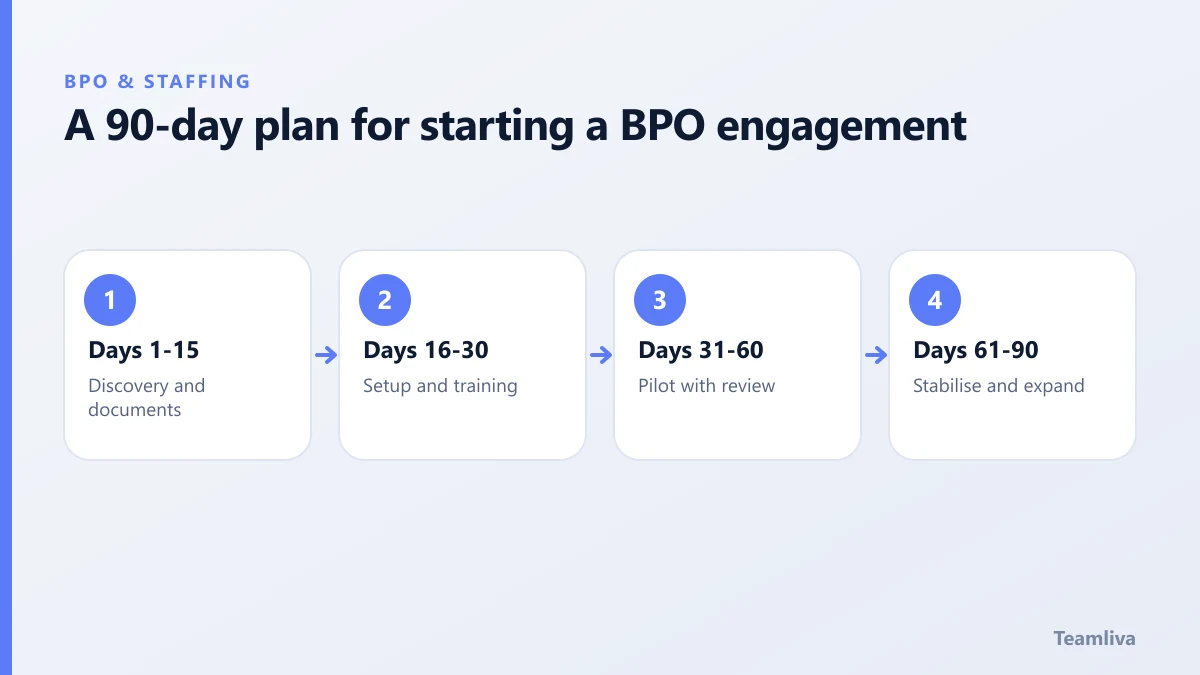
A BPO transition plan moves work to a provider in four phases over about 90 days: discovery and documentation, setup and training, a supervised pilot, then stabilisation and expansion. Documentation and clear measures are the biggest predictors of success.
The first 90 days set the tone for the whole relationship. Most disappointing outsourcing experiences trace back to a rushed start: work that was never documented, unclear targets and no one owning the transition. This plan gives you a simple, four-phase structure you can adapt.
Phase 1: Discovery and documentation (days 1 to 15)
- Map the process step by step, including the exceptions.
- Record the baseline: volumes, turnaround, error rates and costs today.
- Write guides with screenshots, examples and decision rules.
- Define success: the measures you will use and the targets for day 90.
- Agree the governance: named leads on each side, meeting rhythm and escalation path.
This phase decides the rest. Time invested here saves weeks later.
Phase 2: Setup and training (days 16 to 30)
- Security first: sign confidentiality agreements, set up controlled devices, limited accounts and multi-factor authentication. See HIPAA compliance for remote teams if health data is involved.
- Train the team using your guides, and let them shadow live work.
- Test the tools: logins, permissions and reporting.
- Set service levels in writing; see BPO service level agreements.

Phase 3: Pilot with review (days 31 to 60)
- Start with a subset of the work: one queue, one location or one provider group.
- Review closely: check a high share of output in the first two weeks, then sample.
- Hold short daily check-ins and a weekly review of the measures.
- Fix the guides every time a gap appears.
- Compare with the baseline to see the real difference.
Phase 4: Stabilise and expand (days 61 to 90)
- Move more work across in steps as quality holds.
- Reduce the review rate as accuracy proves stable.
- Agree the ongoing reporting cadence and a monthly business review.
- Document lessons and update the service levels if needed.
- Decide the next candidates for outsourcing.
Roles on your side
- Owner: one person accountable for the relationship.
- Process expert: someone who knows the work and can answer questions.
- Approver: someone who signs off on scope and changes.
Common mistakes
- Skipping documentation because "everyone knows how we do it".
- Moving everything at once.
- No baseline, so nobody can say whether it worked.
- Vague escalation, so problems wait.
- Treating the provider as a black box.
Communication rhythm
- Daily: short update on volume, blockers and questions.
- Weekly: review of the measures and issues.
- Monthly: business review with strategy and service-level discussion.
For remote and time-zone-shifted teams, read working across time zones and how to manage a virtual assistant remotely.

Before you start
Choose your provider carefully using the BPO checklist and settle pricing using BPO pricing models explained.
A BPO transition plan checklist you can copy
Before kickoff
- Process map and written guides
- Baseline measures recorded
- Owners named on both sides
- Confidentiality agreement signed
- Access list approved
During the pilot
- Daily check-in held
- Weekly review of measures
- Guides updated after every gap
- Issues logged with cause and fix
Before scaling
- Accuracy stable for at least two weeks
- Service levels met
- Escalations falling
- Backup cover in place
Communicating with your own team
Tell your staff what is changing and why, which tasks are moving and what will not change. Explain how their roles may shift toward higher-value work. Involve them in writing the guides, since they know the exceptions. Good communication reduces resistance and speeds up the transition.
How to tell whether the transition worked
At day 90, compare the measures with the baseline: cost per unit, turnaround, error rate and customer satisfaction. Also ask your team whether they are spending time on better work. If results are mixed, adjust scope, training or the provider before scaling further. A transition is a start, not an ending.
Key takeaways: BPO transition plan
- A BPO transition plan works best in four phases: document, set up and train, pilot with review, then stabilise and expand.
- Record baseline measures before you start, or you will not be able to prove the result.
- Name an owner on each side and set a daily, weekly and monthly rhythm of communication.
- Update the written guides every time a gap appears; the guides become your most valuable asset.
- Scale only after accuracy has held steady for at least two weeks.
Further reading: Business process outsourcing on Wikipedia.

Start with Teamliva
Teamliva (Team Liva) follows a discovery, scope, team, secure setup, pilot and management process on every engagement. See our BPO and staffing solutions or contact us.
Frequently asked questions
How long does BPO transition take?
Simple processes can go live in days, but a realistic plan for stable, measured operation is 60 to 90 days. Complex work may take longer.
What is the biggest reason BPO transitions fail?
Poor documentation and unclear expectations. Work that lives only in one person’s head does not transfer well.
- #Teamliva
- #TeamLiva
- #BPO
- #Outsourcing
- #RemoteStaffing
- #BpoTransitionPlan
- #OutsourcingOnboarding
- #First90Days
- #BpoImplementation