Prior Authorization: How the Process Works and How to Speed It Up
Prior authorization delays care and drains staff time. Learn how the process works, where requests stall and how a dedicated team can keep approvals moving.
In this article
Few tasks frustrate a healthcare team as much as prior authorization. It adds paperwork, delays treatment and pulls staff away from patients. Yet it is unavoidable for many services, so a reliable process is essential.
This guide explains how prior authorization works, where it goes wrong and how to make it faster.
What prior authorization is
Prior authorization is a health plan's requirement that certain services be approved before they are delivered. It applies to some procedures, imaging, specialist referrals and medicines. The exact list differs by plan and changes over time.
If a service needs approval and none was obtained, the claim is likely to be denied. That can leave the practice or the patient with the bill.
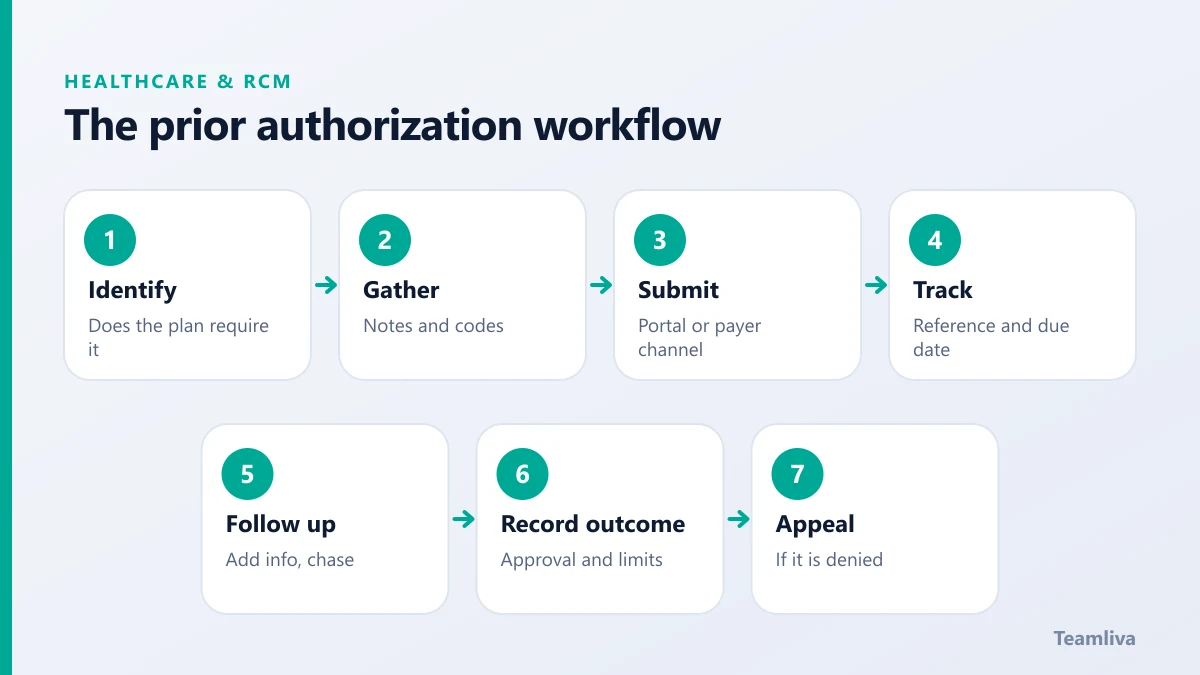
The typical workflow
- Identify the requirement. Check the patient's plan rules for the planned service.
- Gather documentation. Collect clinical notes, diagnosis codes, test results and the ordering clinician's details.
- Submit the request. Send it through the payer's portal or the required channel.
- Track the status. Record the reference number and expected response date.
- Follow up. Chase pending requests and provide extra information when asked.
- Record the outcome. Save the approval, dates and any limits, then update scheduling and billing.
- Appeal if denied. Review the reason, correct or add documentation and resubmit.

Where requests stall
- Missing or unclear documentation. Payers ask for more information, and the request goes to the back of the queue.
- Wrong codes. A mismatch between the diagnosis and the procedure invites denial.
- No owner. Requests are sent but nobody follows them up.
- Late submission. Waiting until the week of the visit leaves no margin.
- Expired approvals. An approval valid for a limited period lapses before the visit.
How to make prior authorization faster
Build a payer requirements sheet
Keep a simple, current list of which services need approval for each major payer and what documents they expect. Update it whenever a payer changes its rules.
Start early
Submit as soon as the service is scheduled. Build the required lead time into your scheduling rules.
Use checklists
A standard checklist per service type ensures nothing is missing on the first submission. It also lowers the rework rate.
Track every request
Use a simple tracker with status, submission date, follow-up date and owner. Review it daily.
Learn from denials
Record the reason for every denial and look for patterns. Feed fixes back to front-desk and clinical teams. Our guide to medical claim denials shows how root-cause review works.
Measure the work
Useful indicators include average turnaround time, first-submission approval rate, the number of requests pending past their target date and the count of visits delayed by authorization. The American Medical Association tracks industry concerns on its prior authorization resource page.
Should you outsource it?
Prior authorization is repetitive, deadline-driven and process-heavy, which suits a dedicated team. A managed pod can submit requests, follow them up daily and report on turnaround, while your clinicians remain in charge of clinical decisions. The team also needs proper privacy safeguards, as described in HIPAA compliance for remote teams.
What to include in a strong request
A complete first submission is the best way to avoid delays. Before you send a request, check that it includes:
- Patient demographics and insurance details, verified for the date of service.
- The ordering clinician's name, identifiers and contact details.
- Diagnosis and procedure codes that support each other.
- Clinical notes that show why the service is needed, including earlier treatments where relevant.
- Supporting results, such as imaging or lab reports.
- The requested dates and the place of service.
Add a short summary sentence at the top of the clinical notes. Reviewers read many requests, and a clear summary helps yours stand out.

Handling urgent requests
Some services cannot wait. Agree an urgent pathway in advance.
- Define what counts as urgent, with the clinician's input.
- Flag urgent requests at the top of the tracker.
- Use the fastest submission channel the payer offers, and follow up the same day.
- Record every call, including the person you spoke to and the reference number.
Working with your team
Front-desk staff, clinicians and the authorization team all touch the process. Hold a short weekly review of pending requests and denials. Share the top three reasons for problems and the fix for each. That habit turns a frustrating task into a process that steadily improves.
How Teamliva helps
Teamliva provides HIPAA-aligned remote teams for healthcare operations, including insurance verification, authorization tracking and denial follow-up, alongside medical billing and RCM support. See our medical billing and RCM services and healthcare staffing, or contact us.
Quick reference for your team
Keep this short list on the wall.
- Check the requirement at scheduling, not on the day of the visit.
- Submit complete requests with a one-line clinical summary.
- Record the reference number and the follow-up date every time.
- Chase pending requests daily, and urgent ones the same day.
- Store the approval details where scheduling and billing can see them.
- Review denials weekly and fix the cause upstream.
These habits keep approvals moving and cut the number of visits that are delayed or unpaid.

The takeaway
A reliable prior authorization process depends on early submission, complete documentation, daily tracking and learning from denials. Give the work a clear owner, and both patients and revenue benefit.
Frequently asked questions
What is prior authorization?
It is a requirement from a health plan that certain services, medicines or procedures be approved before they are delivered. Without approval, the plan may refuse to pay.
Why do prior authorization requests get denied?
Common causes include missing clinical documentation, incorrect codes, expired approvals, wrong plan details and requests submitted after the service date.
Can prior authorization work be outsourced?
Yes. Many practices assign it to a dedicated team that submits requests, tracks status, follows up with payers and reports on turnaround times. Clinical decisions remain with the clinician.
- #Teamliva
- #TeamLiva
- #MedicalBilling
- #RCM
- #HealthcareBPO
- #PriorAuthorization
- #HealthcareOperations
- #Insurance