Virtual Assistant Contract and NDA Checklist: What to Put in Writing
Hiring a virtual assistant? Use this contract and NDA checklist to cover scope, confidentiality, ownership, payment, notice and access before work begins.
In this article
A virtual assistant contract should cover scope, confidentiality, ownership of work, payment, access rules, notice and governing law. Use the checklist below to prepare, and ask a lawyer to review the final agreement for your jurisdiction.
This article is a practical checklist, not legal advice. Contract law differs by country and state, and cross-border arrangements add complexity, so have a qualified lawyer review your final agreement. What follows is what to make sure your agreement covers, so that lawyer’s time is well spent.
Why put it in writing
A written agreement removes guesswork about who does what, who owns the work, how confidential information is treated and how either side can end the arrangement. It also protects a good assistant by setting clear expectations and payment terms.
Seven clauses to include
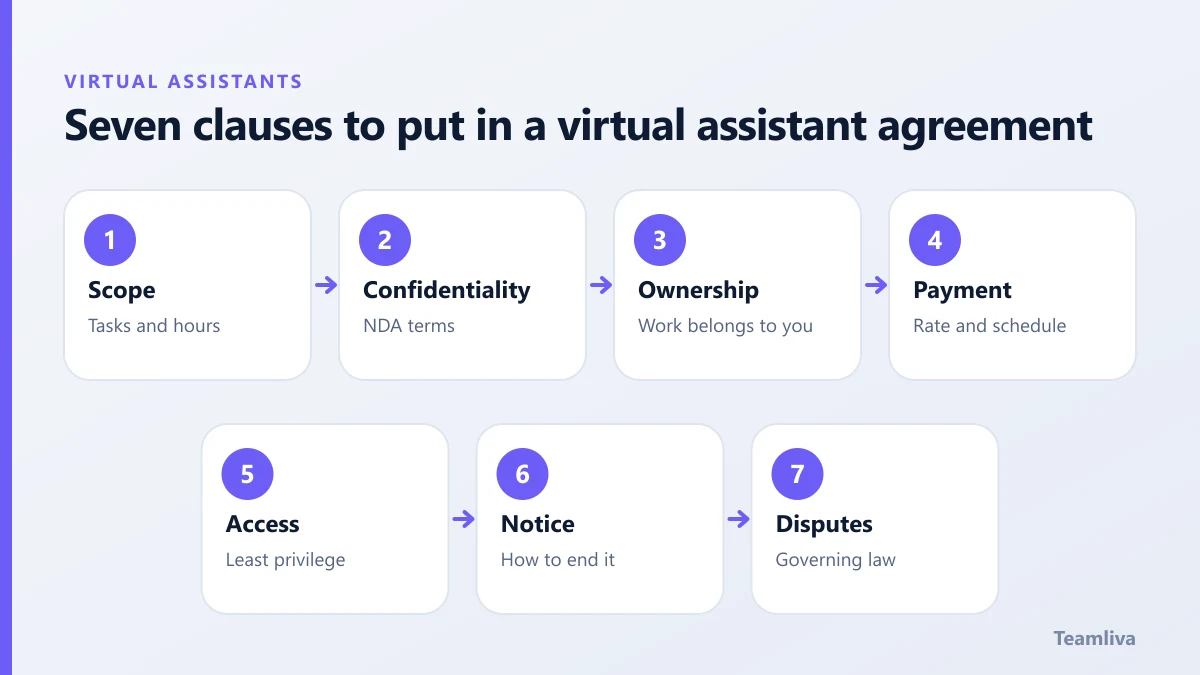
1. Scope of work
List the services, expected hours, working days and the overlap window. Include a line that the scope can be changed by written agreement. Reuse the description from your job description.
2. Confidentiality (NDA)
Define what counts as confidential: customer data, financial details, systems, methods and anything marked or obviously private. State that the assistant may use it only for your work, must not copy or share it, and that the obligation survives the end of the engagement. Set the length of the survival period.
3. Ownership of work product
Say that everything created in the course of the work, such as documents, templates and account setups, belongs to you. Where a contractor creates original material, an assignment clause is normal.
4. Payment terms
Cover the rate or monthly fee, invoicing dates, currency, method of payment and who pays transfer fees. State how hours are recorded and what happens with unapproved overtime.
5. Access and security rules
Set out how the assistant may access your systems: named accounts, no shared passwords, multi-factor authentication, approved devices only, and no storing data on personal cloud accounts. Add that access ends the day the engagement ends. See virtual assistant data security.
6. Term and notice
State the start date, any trial period, and how much notice either party must give. A one to two week notice for a small engagement is common, but choose what suits you. Include immediate termination for serious breaches such as a data leak.
7. Governing law and disputes
Say which law applies and how disputes are handled. Cross-border contracts benefit from a lawyer’s advice on this point.

Healthcare additions
If the assistant will touch patient information, you will also need a business associate agreement and training. The US Department of Health and Human Services describes requirements on its HIPAA pages. Read our note on the medical virtual assistant role.
Employee or contractor?
How you classify the relationship affects taxes and obligations. In the US the IRS explains the distinction on its worker classification page. Local rules where the assistant lives also matter, which is one reason many businesses use a managed provider that carries the employment relationship. See virtual assistant vs employee vs freelancer.
Handy pre-signing checklist
- Scope, hours and overlap written down.
- NDA signed before any data is shared.
- Ownership of work clarified.
- Payment schedule and currency agreed.
- Access rules and offboarding steps included.
- Notice period and trial terms defined.
- Reviewed by a lawyer.

Extra clauses worth considering in a virtual assistant contract
- Non-solicitation: if you use a provider, this stops either side hiring the other’s staff directly without agreement.
- Data return and deletion: what happens to files, chat history and copies when the engagement ends.
- Subcontracting: whether the assistant may pass your work to anyone else. The usual answer is no.
- Insurance and liability: what happens if a mistake causes a loss.
- Working hours and holidays: how leave is requested and covered.
- Equipment: who provides devices and what security software they must run.
A note on plain language
Long, complicated contracts are harder to follow and harder to enforce. Where possible, write clauses in plain sentences and keep the total document short. A two-page agreement that both sides understand is more useful than a twenty-page one that neither has read.
Keep the paperwork alive
- Save signed copies in a shared folder.
- Put review dates in your calendar, at least once a year.
- Update the scope in writing when duties change.
- Keep a short offboarding checklist: remove accounts, recover files, confirm deletion, pay the final invoice.
Pair the contract with the security practices in virtual assistant data security so that written rules and day-to-day habits match.

If you use a managed provider
The provider’s master agreement usually covers confidentiality, device security and replacement cover, so your paperwork is simpler. Ask to see the terms before you commit. Teamliva signs an NDA and, where needed, a BAA at the start of an engagement. See our virtual assistant services or contact us for a copy of the standard terms.
Frequently asked questions
Do I need a contract for a virtual assistant?
Yes. A written agreement protects both sides by setting scope, confidentiality, payment and how the arrangement ends. Ask a lawyer to review it for your jurisdiction.
Is an NDA enough on its own?
An NDA covers confidential information, but you also need terms for scope, ownership of work, payment, security practices and termination.
- #Teamliva
- #TeamLiva
- #VirtualAssistant
- #VirtualAssistantServices
- #HireAVirtualAssistant
- #VirtualAssistantContract
- #Nda
- #Confidentiality
- #Hiring