Virtual Assistant vs Executive Assistant: What Is the Difference?
Virtual assistant or executive assistant? Compare scope, cost, location, seniority and when each role makes sense for your business.
In this article
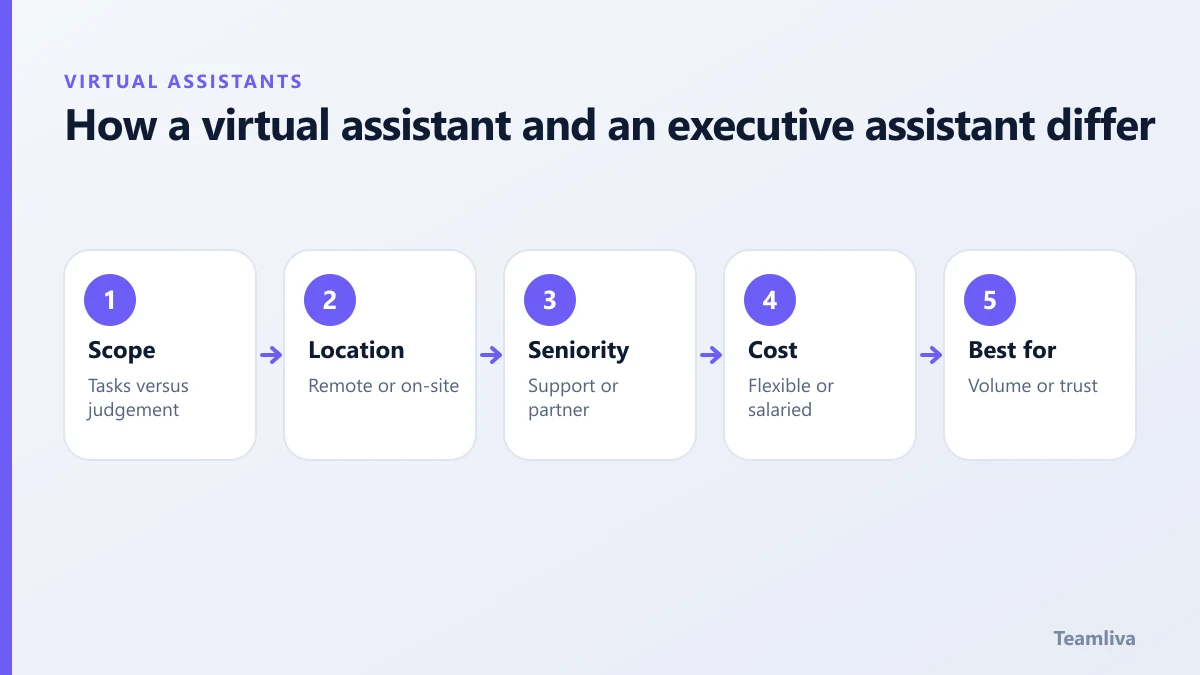
The virtual assistant vs executive assistant difference is that one describes how the person works (remotely) and the other describes how senior the role is. A virtual assistant follows processes; an executive assistant acts with judgement on behalf of a senior leader.
The titles "virtual assistant" and "executive assistant" are often used as if they were interchangeable. They are not. One describes where and how the person works. The other describes how senior the work is. Understanding the difference helps you hire the right person and avoid paying for the wrong level.
What is a virtual assistant?
A virtual assistant (VA) is a remote professional who provides administrative, operational or support services from outside your office. The defining feature is the working arrangement: remote, often contracted, usually flexible in hours. The tasks vary, from inbox management and scheduling to data entry, customer support and bookkeeping support. There is more in our guide to what a virtual assistant is.
What is an executive assistant?
An executive assistant (EA) supports a senior leader such as a CEO, founder or director. The defining feature is the level of trust and judgement. An EA often manages a leader’s calendar priorities, screens communications, prepares briefings, coordinates projects and represents the leader internally. An EA can be in the office or remote.

Side-by-side differences
| Factor | Virtual assistant | Executive assistant |
|---|---|---|
| Defined by | Remote working arrangement | Seniority and trust |
| Typical scope | Tasks and workflows | Priorities and judgement |
| Decision-making | Follows instructions | Acts on behalf of the leader |
| Engagement | Flexible hours or contract | Often salaried, long-term |
| Cost | Scales with hours | Higher fixed cost |
| Best for | Volume and routine work | Leadership support |
The overlap: the executive virtual assistant
Many founders hire an experienced remote person and give them EA-level responsibilities. That person is effectively an executive virtual assistant. This can work very well when you have a trusted, senior candidate and clear boundaries on what they may decide alone. It fails when a junior VA is handed strategic responsibilities without guidance.
When a virtual assistant is the better fit
- The work is repeatable and can be documented.
- You need flexible or part-time support.
- You want to try delegation before committing to a full-time salary.
- Your budget favours a defined scope. See virtual assistant for small business.
When an executive assistant is the better fit
- You are a senior leader with a dense calendar and many stakeholders.
- You need someone who anticipates needs and acts without step-by-step instruction.
- Confidential, high-stakes communications are a daily reality.
- You want an in-person presence.
How to choose
- List everything you want delegated.
- Mark each item as "follows a process" or "needs judgement".
- If most items follow a process, hire a virtual assistant.
- If most need judgement and confidentiality, hire an executive assistant, remote or local.
- If it is mixed, start with a VA on processes and add responsibilities as trust grows.
Use the tasks worth delegating list to sort your own workload. Then check the hiring steps.

Choosing between a virtual assistant vs executive assistant: a short test
Write down the last ten tasks you wish someone else had done. For each, ask: "Could I explain this in five bullet points?" If most answers are yes, you need process support, and a virtual assistant fits. If most tasks begin with "it depends" or involve sensitive judgement calls, you need an executive assistant, in the office or remote.
Costs and commitment
An executive assistant is usually a salaried, long-term hire whose cost reflects seniority and trust. A virtual assistant can be engaged for a defined number of hours, which makes it easier to test the value of delegation. The virtual assistant pricing models show the options.
Building trust step by step
Whichever role you choose, the process for building trust is similar:
- Start with low-risk tasks such as scheduling and research.
- Add tasks that involve customers or money, with approval steps.
- Write down decisions the assistant may make alone, such as rescheduling meetings under a set length.
- Review regularly and widen the limits as accuracy proves itself.
Many leaders end up with both: an executive assistant for confidential, high-stakes work and a virtual assistant for volume tasks such as data entry and inbox triage. The two roles complement each other rather than compete.
Key takeaways: virtual assistant vs executive assistant
- A virtual assistant vs executive assistant choice depends on whether the work follows a process or needs judgement.
- An executive assistant acts on behalf of a senior leader; a virtual assistant carries out defined tasks remotely.
- Test delegation with a virtual assistant before committing to a salaried executive hire.
- Widen the limits of any assistant in steps, writing down the decisions they may make alone.
- Many leaders use both, with an executive assistant for confidential work and a virtual assistant for volume tasks.
Further reading: Virtual assistant (occupation) on Wikipedia.

Getting started with Teamliva
Teamliva places managed virtual assistants for administrative, customer support, healthcare and back-office roles. If you are unsure which level you need, tell us about your workload and we will suggest one. You can also read about our virtual assistant services.
Frequently asked questions
Is a virtual assistant the same as an executive assistant?
No. A virtual assistant is defined by working remotely and often by handling tasks in a defined scope. An executive assistant is defined by supporting a senior leader with high-trust, judgement-heavy work, and may be remote or on-site.
Can a virtual assistant become an executive assistant?
Yes. With experience and trust, a virtual assistant can take on executive-level work such as managing a leader’s schedule, communications and projects.
- #Teamliva
- #TeamLiva
- #VirtualAssistant
- #VirtualAssistantServices
- #HireAVirtualAssistant
- #ExecutiveAssistant
- #AdminSupport
- #Hiring