How to Choose a Customer Support Outsourcing Company: What to Look For
How to vet a customer support outsourcing company: dedicated vs shared agents, US-based vs offshore, quality and security checks, the questions to ask before signing and how to run a pilot.
In this article
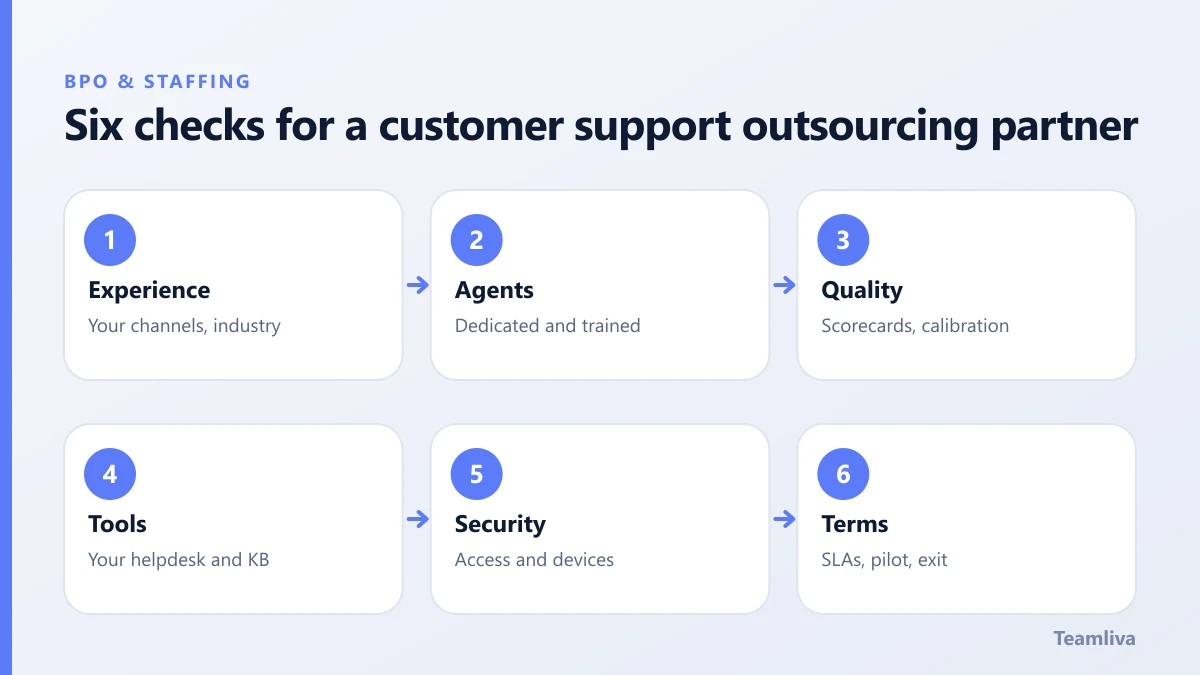
Choose a customer support outsourcing company on evidence, not promises. The right partner has run support like yours before, gives you agents dedicated to your account inside your own helpdesk, can show exactly how it measures and coaches quality, and will put service levels, security controls and exit terms in writing. Then prove it with a short, paid pilot before you commit.
This guide is for founders and support leaders comparing providers, whether they are US-based, nearshore or offshore. If you have not yet decided what to outsource, start with our customer support outsourcing setup guide.
Decide what you are buying first
Providers can only be compared against a clear brief. Write down:
- Channels: email, chat, social messages, phone, or a mix. See our guide to omnichannel support if you need them joined up.
- Volume and hours: tickets or contacts per day, peaks, and the hours you need covered.
- Scope: what agents should resolve themselves, and what they must escalate to you.
- Tools: your helpdesk, CRM and knowledge base.
- Languages and tone: how you want customers to be spoken to.
Dedicated or shared agents?
| Dedicated agents | Shared (pooled) agents | |
|---|---|---|
| Who they work for | Only your company | Several clients at once |
| Product knowledge | Builds over time | Thinner, script-led |
| Pricing | Per agent or per hour | Per ticket, minute or contact |
| Best for | Steady volume, complex products | Low or very spiky volume, simple queries |
| Control | You shape training and tone | Provider’s standard process |
Shared models can be cheaper at low volume. Once you have steady daily work, dedicated agents usually give better consistency because the same people learn your product.
US-based, nearshore or offshore?
Location changes cost, hours and hiring depth more than it changes quality. Quality comes from hiring, training and management, wherever the team sits.
- US-based providers cost the most. They can suit phone-heavy work, regulated conversations or customers who expect a local voice.
- Nearshore providers in a similar time zone sit in between on cost.
- Offshore providers cost the least. They work well for email, chat and tickets, and can arrange shifts that cover US business hours.
Our comparison of offshore, nearshore and onshore outsourcing goes into the trade-offs. Whichever you choose, ask the same questions below.

What to look for in a customer support outsourcing company
- Relevant experience. Ask for examples in your industry and channels, and speak to a reference client of a similar size.
- Hiring and training. How are agents screened? Writing tests matter for email and chat. How long is product training, and who signs off that an agent is ready?
- Quality assurance. Ask to see a scorecard. How many conversations are reviewed per agent each week, and will they hold regular calibration sessions with you so both sides score the same way?
- Metrics and reporting. Agree definitions for first response time, resolution time, customer satisfaction (CSAT), quality score and backlog, then ask for a sample weekly report.
- Your tools. The team should work in your helpdesk and your knowledge base, and you should own the macros and articles they write.
- Escalation. Who handles refunds, angry customers, bugs and urgent issues, and how quickly do they reach you?
- Security. Named logins, multi-factor authentication, access limited to what the role needs, company-managed devices and signed confidentiality agreements. Keep card numbers out of chat and email; if agents must take payments, ask how the provider meets the PCI Data Security Standard.
- Continuity. How are sick days, holidays and attrition covered? What happens during a power or internet outage?
- Commercials. Understand the pricing model, minimum term, ramp-up fees and what is included, such as a team lead and QA.
Questions to ask before you sign
- How are service levels measured, and what happens when they are missed? Our guide to BPO service level agreements shows what to include.
- Who owns the knowledge base, macros and training material?
- How quickly is an agent replaced if they leave or are not a good fit?
- How are volume increases and decreases priced?
- Where will the work be done, and are any subcontractors involved?
- What is the notice period, and what help do we get to move the work at the end?
- How is our data returned or deleted when the contract ends?
- Are prices fixed for the term, and how are increases agreed?
For a broader, non-support-specific list, see our 12-point BPO checklist.

Run a pilot before you commit
A pilot turns promises into evidence:
- Pick one channel and one queue with steady volume.
- Agree success measures up front, such as response time, CSAT and quality score, compared with your current baseline.
- Review a sample of conversations together every week.
- Decide at the end of the pilot whether to expand, adjust or stop.
Red flags
- No sample report or scorecard until after you sign.
- Agents who would work only in the provider’s own tools.
- Shared logins or vague answers about data access.
- Long minimum terms with no pilot or exit help.
- Guaranteed results before they have seen your tickets.

How Teamliva approaches support outsourcing
Teamliva provides customer support outsourcing from Bangladesh with agents dedicated to your account. They work in your helpdesk, from a written knowledge base, on your hours. Conversations are sampled, scored and coached, and you get regular reports. Team members sign confidentiality agreements, work on controlled devices and receive only the access their role needs. If you are comparing providers, use the questions above with us too.
Frequently asked questions
What is the best customer support outsourcing company?
There is no single best provider. The right one has handled your channels and type of customer before, will give you dedicated agents in your own helpdesk, can show how it measures and coaches quality, and performs well in a paid pilot. Compare two or three providers against the same criteria.
Should I choose a US-based or an offshore support provider?
US-based teams cost more but suit phone-heavy, highly regulated or very nuanced conversations. Offshore teams cost less and work well for email, chat and ticket support, with shifts arranged to cover US hours. Many companies keep sensitive escalations in-house and outsource the rest.
What should I ask a BPO before signing a contract?
Ask how service levels are measured and what happens when they are missed, who owns the knowledge base and macros, how agents are replaced, how volume changes are priced, where the work is done, which subcontractors are used, the notice period, and what help you get to move the work elsewhere at the end.
How long does it take to launch outsourced support?
It depends on the channels, volume and how ready your knowledge base is. A small email or chat team can often go live within a few weeks once access and documentation are in place; phone and multilingual support usually take longer.
- #Teamliva
- #TeamLiva
- #BPO
- #Outsourcing
- #RemoteStaffing
- #CustomerSupportOutsourcing
- #CustomerServiceOutsourcing
- #BpoSelection
- #OutsourcingContracts