Medical Billing Outsourcing Cost: Pricing Models Explained
Medical billing outsourcing cost explained: percentage-of-collections, per-claim and dedicated-team pricing, what each includes, and how to compare quotes fairly.

In this article
Medical billing outsourcing cost depends mainly on the pricing model: a percentage of collections, a flat fee per claim, or a monthly fee for a dedicated team. The cheapest headline rate is not always the lowest total cost, so compare quotes on the same scope and the same claim data.
What drives medical billing outsourcing cost
Four things move the price more than anything else:
- Volume. More claims per month usually means a lower rate per claim or a lower percentage.
- Specialty and payer mix. Specialties with complex coding, prior authorisations or many denials take more work per claim.
- Scope. Charge entry and claim submission cost less than full revenue cycle work that includes denials, appeals, patient billing and A/R follow-up.
- Who supplies the software. Some vendors work in your practice management system; others bundle their own and charge for it.
If you are new to the subject, start with our guide to revenue cycle management.
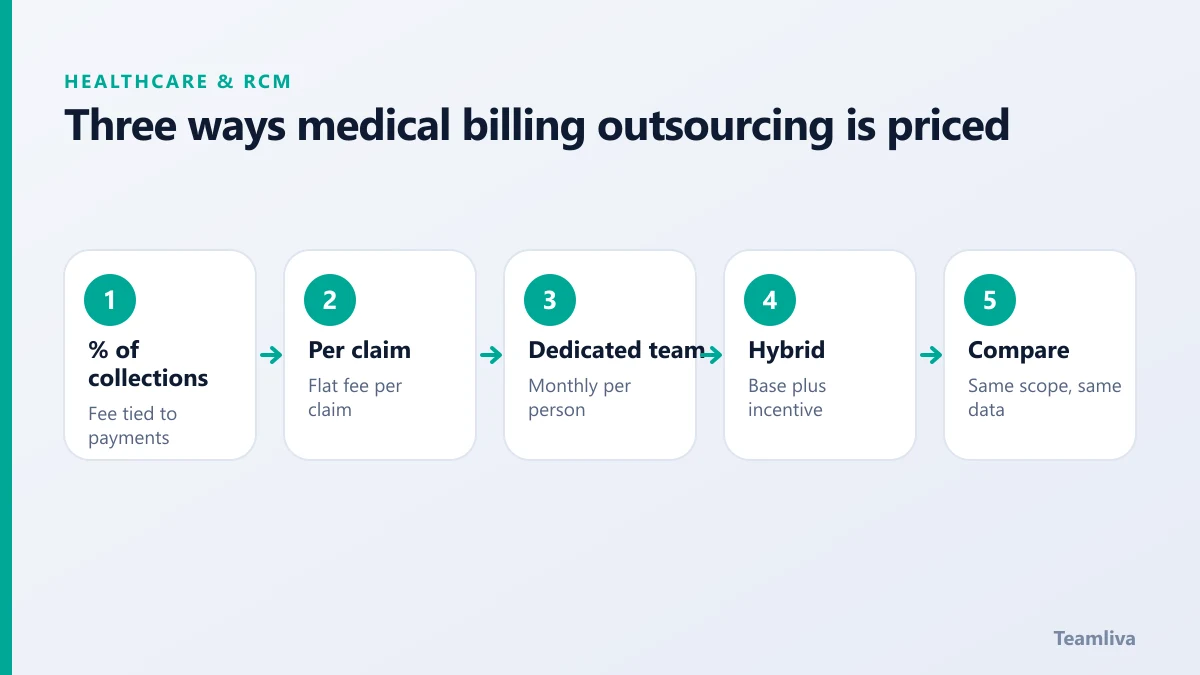
The three common pricing models
Percentage of collections
The vendor keeps a share of what the practice actually collects. It ties the vendor's income to your results, which is its main appeal. The percentage is usually lower for high-volume practices and higher for small or complex ones. Ask exactly which payments count: insurance only, or patient payments too.
Per-claim pricing
You pay a flat fee for each claim submitted or each claim worked. It is easy to forecast, but check what one "claim" includes. Rework, appeals and patient statements are sometimes billed separately, which can raise the real medical billing outsourcing cost.
Dedicated team (per person, per month)
You pay a monthly fee for named billers, coders or A/R specialists who work only on your accounts, often inside your own systems. This is how most offshore staffing works. It suits practices with steady volume that want control, direct communication and a predictable bill. Our article on how much offshore staffing costs explains how these monthly fees are built.

What should be included in the price
Ask every vendor to list, in writing, which of these are included:
- Charge entry and claim scrubbing.
- Electronic claim submission and clearinghouse fees.
- Payment posting and reconciliation.
- Denial management and appeals.
- A/R follow-up on aged claims.
- Patient statements and patient calls.
- Monthly reporting and a named account lead.
A quote that looks low often leaves out denials and A/R follow-up. That is where most lost revenue sits, as our guide to claim denials shows.
Hidden costs to watch for
- Setup or onboarding fees.
- Minimum monthly charges regardless of volume.
- Extra fees for credentialing, prior authorisations or patient calls.
- Software or clearinghouse fees passed through at a mark-up.
- Fees to export your data or end the contract.
How to compare medical billing quotes fairly
Give each vendor the same brief: monthly claim volume, specialties, payer mix, current days in A/R and current denial rate. Ask for an all-in monthly estimate at your current volume, not just a rate. Then compare total cost against the results each vendor commits to, such as clean claim rate and days in A/R. Our list of medical billing KPIs gives you the measures to ask for.
In-house vs outsourced: the real comparison
An in-house biller's cost is more than salary. Add benefits, payroll taxes, software seats, training, cover for leave and the revenue lost while a vacancy is open. Many practices find that outsourcing costs less once these are counted, but the bigger gain is usually faster, more complete collections.

When outsourcing is not the cheaper option
Outsourcing may not save money if your volume is very low, if your current team already performs well on denials and A/R, or if your payer mix needs deep local knowledge that a new team would take months to learn. In those cases, outsourcing only the backlog or the A/R follow-up can be a better first step.
A worked example: comparing two quotes
Imagine a practice that sends around 1,500 claims a month. Vendor A quotes a percentage of collections. Vendor B quotes a dedicated two-person team for a fixed monthly fee. To compare them fairly:
- Estimate monthly collections from the last six months of deposits.
- Apply Vendor A's percentage to that figure, then add any setup, software or statement fees.
- Add Vendor B's monthly fee to any software or clearinghouse costs it does not include.
- Check the scope of each. If one excludes denials or A/R follow-up, price that work separately.
- Compare the commitments. Look at promised clean claim rate, days in A/R and reporting.
The lower monthly figure is only the better deal if both vendors do the same work to the same standard. A vendor that collects more of what you are owed can cost more and still leave you better off.
Questions to ask before you sign
- Is the price fixed for a year, and how does it change if volume grows?
- Who owns the data, and how is it returned if we leave?
- What is the notice period, and are there exit fees?
- Who is our named account lead, and how often do we meet?
- Can we start with a pilot on one location or one payer group?
Key takeaways: medical billing outsourcing cost
- Medical billing outsourcing cost depends mostly on the pricing model, your volume, your specialty and the scope of work.
- Percentage-of-collections pricing ties the fee to results; a dedicated team gives control and a predictable monthly bill.
- Low quotes often leave out denials and A/R follow-up, which is where most lost revenue sits.
- Compare vendors on an all-in monthly estimate for the same scope, plus the results each one commits to.
- Count the full cost of in-house billing, including benefits, software, training and vacancies, before deciding.

How Teamliva prices medical billing
Teamliva (Team Liva) provides dedicated medical billing and RCM specialists who work inside your systems under a business associate agreement. Pricing is a clear monthly fee per specialist, agreed after we review your volume and scope. See our medical billing and RCM services or contact us for a quote based on your own numbers.
For an independent overview of how claims and payments work in US healthcare, the Centers for Medicare & Medicaid Services publishes billing guidance for providers.
Frequently asked questions
How much does it cost to outsource medical billing?
Pricing depends on the model. Percentage-of-collections contracts are commonly quoted in the mid single digits of what the practice collects, per-claim pricing charges a flat fee for each claim, and a dedicated team is billed per person per month.
Which medical billing pricing model is best?
Percentage of collections suits practices that want the vendor paid on results. A dedicated team suits practices with steady volume that want control over the work and predictable monthly cost.
What hidden costs should I watch for?
Setup fees, separate charges for denial work or patient statements, minimum monthly fees, software fees and charges for reports or for leaving the contract.
- #Teamliva
- #TeamLiva
- #MedicalBilling
- #RCM
- #HealthcareBPO
- #MedicalBillingOutsourcingCost
- #MedicalBillingPricing
- #RevenueCycleManagement
- #RcmOutsourcing