Medical Billing Company in Bangladesh: A Guide for US Practices
Thinking of outsourcing medical billing to Bangladesh? Learn what to check on HIPAA, payer knowledge, reporting and pricing before choosing a provider.
In this article
A medical billing company in Bangladesh can support US practices with claims, coding, follow-up and denial management, provided it signs a business associate agreement, applies HIPAA-aligned safeguards and trains staff on US payers. Confirm the details with your compliance adviser.
Outsourcing medical billing can lift a practice out of the daily grind of claims, denials and follow-up. Some US practices now look to Bangladesh for that support, drawn by cost efficiency and a large pool of educated, English-capable staff. The risks are real, though: patient data, payer rules and revenue are all at stake. This guide sets out what to check.
Why practices consider Bangladesh
- Competitive cost compared with US billing staff.
- A large graduate workforce comfortable with written English and detailed administrative work.
- Willingness to work shifted hours that match US business days.
The technical skill of billing is learnable and teachable. What differs between providers is training, supervision and compliance.
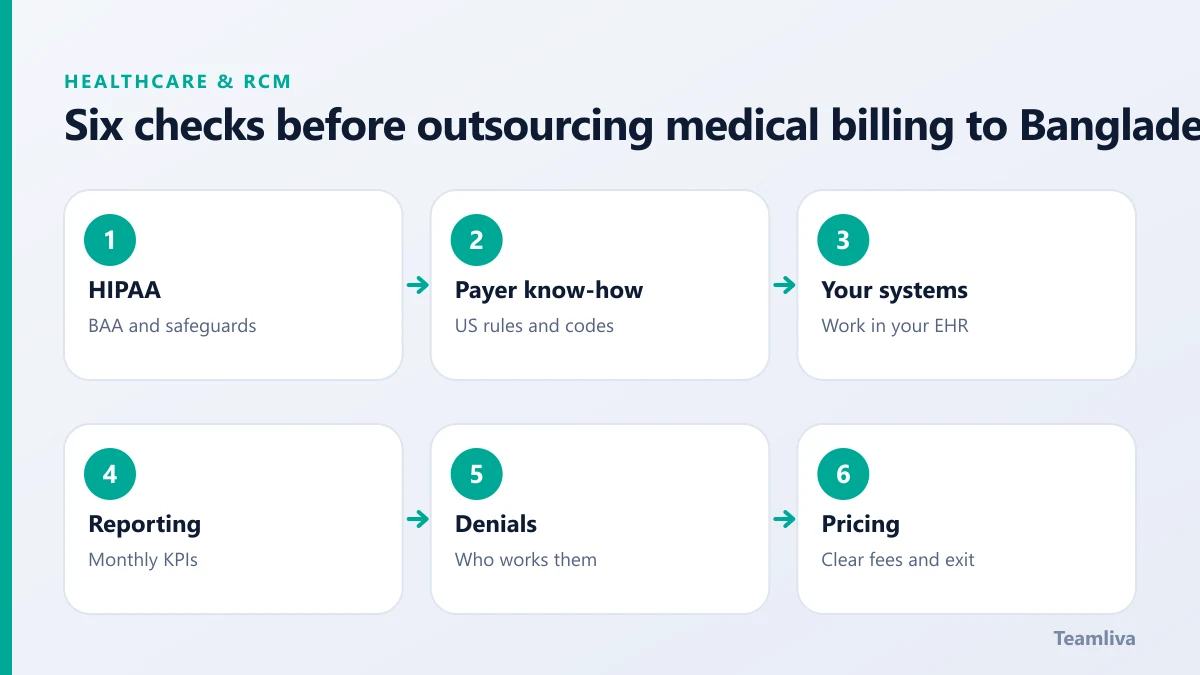
Six checks before you sign
1. HIPAA and data protection
Require a business associate agreement, encrypted and access-controlled workstations, role-based access, audit logs and staff training. The US Department of Health and Human Services describes what is required on its HIPAA pages, and we summarise the practical side in HIPAA compliance for remote teams.
2. Payer and coding knowledge
Ask how staff are trained on US payers, ICD-10, CPT and HCPCS codes, and how they stay current. See medical coding basics.
3. Work inside your systems
A good provider works in your EHR and practice management system rather than forcing a migration.
4. Reporting
Expect monthly reports on the measures in medical billing KPIs to track: days in A/R, clean claim rate, denial rate and net collection.
5. Denials and follow-up
Ask who works denials and how root causes are fed back. Read medical claim denials: causes and prevention and accounts receivable follow-up.
6. Pricing and exit
Compare percentage-of-collections and flat-fee models, and get setup fees, minimums and exit terms in writing. Our questions to ask a billing partner covers this.

What to keep in-house
Clinical documentation, provider decisions and patient relationships remain with your practice. You should also keep oversight of your own credentialing status and payer contracts, even if a provider helps administer them; see provider credentialing explained.
Onboarding with minimal disruption
- Share a list of payers, systems and current A/R.
- Agree the workflow and cut-over date.
- Start with a subset of claims or one provider.
- Review daily in week one, weekly after that.
- Compare results with your baseline after 60 to 90 days.
Time zones and communication
Billing teams in Bangladesh usually work evening or night shifts to overlap with US hours. Agree an overlap window for questions and a weekly review call.
Questions US practices should put to a medical billing company in Bangladesh
- How do you train staff on US payers, and how do you track changes in payer rules?
- Are staff certified in coding, or supervised by certified coders?
- What tools do you use, and can you work inside my systems?
- How do you protect patient information on devices, networks and in email?
- How do you handle a breach or suspected incident?
- What reports will I receive, and when?
- What happens to my data and files if we end the contract?

Signs of a quality billing operation
- A clear process for scrubbing claims before submission.
- Daily work queues, with rejections and denials handled within set times.
- Weekly or monthly reporting of the KPIs that matter.
- Written procedures that new staff follow.
- Regular audits of a sample of claims.
Managing the relationship
Hold a weekly call in the first three months and a monthly review after that. Share changes in payers, fees or providers immediately. Keep an issue log with dates, causes and fixes. Encourage the provider to raise problems early: the goal is fewer surprises. For metrics to review, see medical billing KPIs to track.
Key takeaways: medical billing company in Bangladesh
- A medical billing company in Bangladesh should sign a business associate agreement and apply HIPAA-aligned safeguards before touching patient data.
- Ask how staff are trained on US payers and coding rules, and how they keep up with changes.
- Prefer a provider that works inside your existing EHR and practice management system.
- Expect monthly reports on days in A/R, clean claim rate, denial rate and net collection.
- Start with a subset of claims, compare results with your baseline after 60 to 90 days, then expand.

How Teamliva works
Teamliva (Team Liva) is a Dhaka-based BPO with a dedicated medical billing and RCM service for US practices, covering credentialing, coding, billing, claims follow-up and denial management. All staff work under HIPAA-aligned procedures with an NDA and BAA. See medical billing, RCM and credentialing services and contact us.
Frequently asked questions
Can a US practice outsource medical billing to Bangladesh?
Yes, provided the provider signs a business associate agreement, applies HIPAA-aligned safeguards and has staff trained in US billing rules. Confirm requirements with your compliance adviser.
What should I ask a medical billing provider first?
Ask who does the work, how they are trained on US payers, how PHI is protected, what reports you receive and how denials are handled.
- #Teamliva
- #TeamLiva
- #MedicalBilling
- #RCM
- #HealthcareBPO
- #MedicalBillingBangladesh
- #MedicalBillingOutsourcing
- #RcmOutsourcing
- #Hipaa
- #Bangladesh