Remote Healthcare Staffing: What It Is and How It Works
Remote healthcare staffing gives clinics and health systems trained clinical operations, care coordination and telehealth support without a local hire. Here is which roles work remotely and how to start safely.
In this article
Remote healthcare staffing means placing trained administrative and clinical operations professionals with a healthcare organisation, working securely from a distance. It is now a common way for clinics, group practices and health systems to add capacity without building out office space or waiting through a long local hiring cycle.
This guide explains where remote healthcare staffing fits, where it does not, and how to launch it safely.
Why organisations look at remote healthcare staffing
Healthcare teams are stretched. Phones go unanswered, prior authorizations pile up and care coordinators spend their days on paperwork. Remote staff can absorb that work so that on-site clinicians spend more time with patients.
The common drivers are:
- Capacity. Extra hands for peak periods and growth.
- Coverage. Support across extended hours and time zones.
- Cost control. Predictable staffing costs without the overhead of local hires.
- Specialist skills. Access to people who already know EHR workflows and healthcare terminology.
Roles that work well remotely
Clinical operations support
Chart preparation, referral tracking, results follow-up and documentation support keep the clinical workflow moving.
Care coordination
Coordinators contact patients, arrange follow-up, manage referrals and make sure care plans do not stall between visits.
Telehealth liaison
A liaison prepares patients for virtual visits, checks technology and handles the logistics around each appointment.
Revenue cycle roles
Insurance verification, prior authorization and claims follow-up are natural remote roles. See how they connect in our overview of revenue cycle management.
Direct, hands-on patient care remains local. Remote staffing complements clinicians rather than replacing them.
Security and compliance come first
Patient data is protected by law. In the United States, the Health Insurance Portability and Accountability Act sets the rules, and the HHS publishes HIPAA guidance for professionals. Before any remote team member touches a record, check that:
- A Business Associate Agreement is in place with the staffing partner.
- Workstations are encrypted and locked down.
- Access follows least privilege, so people see only what their role needs.
- Activity is logged and reviewed.
- Staff have completed HIPAA training and understand incident reporting.
Our detailed note on HIPAA compliance for remote teams goes deeper into each item.
How to launch a remote healthcare team
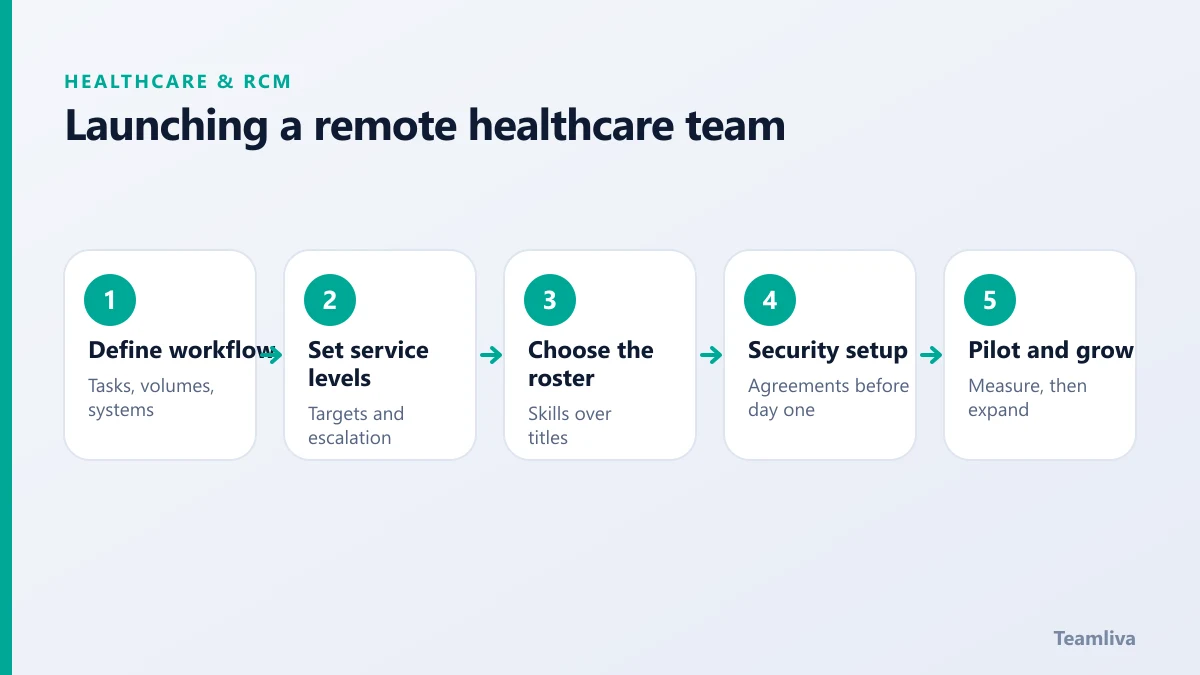
- Define the workflow. Write down the tasks, volumes and systems involved.
- Set the service levels. Agree response times, accuracy targets and escalation paths.
- Choose the roster. Review candidates against the skills you need, not just their titles.
- Complete security setup. Sign agreements and configure access before day one.
- Start with a pilot. Begin with a small pod, measure it and expand once it works.
Teamliva structures its healthcare staffing this way, with a pre-vetted roster, secure setup and continuous quality audits.
Mistakes to avoid
- Hiring before the process is documented.
- Skipping the pilot and moving the whole function at once.
- Treating security as paperwork instead of a working control.
- Leaving no named owner on your side of the relationship.
What good remote team management looks like
Remote does not mean unsupervised. The best-run teams have a clear structure.
- A named team lead who owns quality and answers to you.
- Daily huddles to flag issues, blockers and volume changes.
- A shared queue or task board, so nothing lives only in someone's inbox.
- Weekly quality reviews of a sample of completed work.
- Written procedures that new team members can follow from their first shift.
Tools matter less than routine. A simple, consistent rhythm beats an elaborate system nobody uses.
Questions to ask a staffing partner
Before you sign, ask:
- How do you vet skills and experience, and can we review profiles?
- What happens if a team member leaves or is not the right fit?
- How is coverage handled for absences and holidays?
- Which systems and EHRs has the team worked in?
- How do you report on quality and service levels?
Clear answers to these show a partner that has done this before. You can also compare with our guidance on choosing a BPO or outsourcing model.
Who benefits most from remote healthcare staffing
Some organisations gain more than others. Small and mid-sized practices often benefit because they cannot justify a full local team for every function. Growing groups use remote staff to absorb new locations without a matching increase in office space. Telehealth-focused providers use them to handle scheduling, intake and follow-up across time zones. Larger systems use remote pods for well-defined back-office work so that internal teams can concentrate on patient-facing tasks.
If your work is repetitive, documented and measurable, it is probably a good candidate. If it depends on constant in-person judgement, keep it local.
Whatever the size of your organisation, begin with one clearly defined function. Prove that it works, document what you learn and then decide where remote support should go next. That measured pace protects patients, protects staff and makes the return on the investment easy to see.
The takeaway
Remote healthcare staffing works when the roles are well chosen, the security is real and the service levels are written down. Start small, measure the results and grow the team with confidence. To discuss your own needs, contact our team.
Frequently asked questions
Which healthcare roles can be staffed remotely?
Administrative and coordination roles work best: clinical operations support, care coordination, patient outreach, telehealth liaison work, scheduling, insurance verification and documentation support. Hands-on clinical care stays on site.
How is patient privacy protected with remote staff?
Through a signed Business Associate Agreement, encrypted and access-controlled workstations, role-based access to systems and regular audits of who accessed what.
How quickly can a remote healthcare team start?
That depends on scope and security setup. A well-defined role with a ready roster can begin in days, while a larger managed team takes longer to configure and train.
- #healthcare staffing
- #remote staffing
- #care coordination
- #telehealth