Offshore Development Center Benefits: 8 Advantages and the Trade-offs
The real benefits of an offshore development center, how to make sure you actually get each one, the trade-offs nobody puts in the brochure, and a quick test for whether an ODC is worth it for you.
In this article
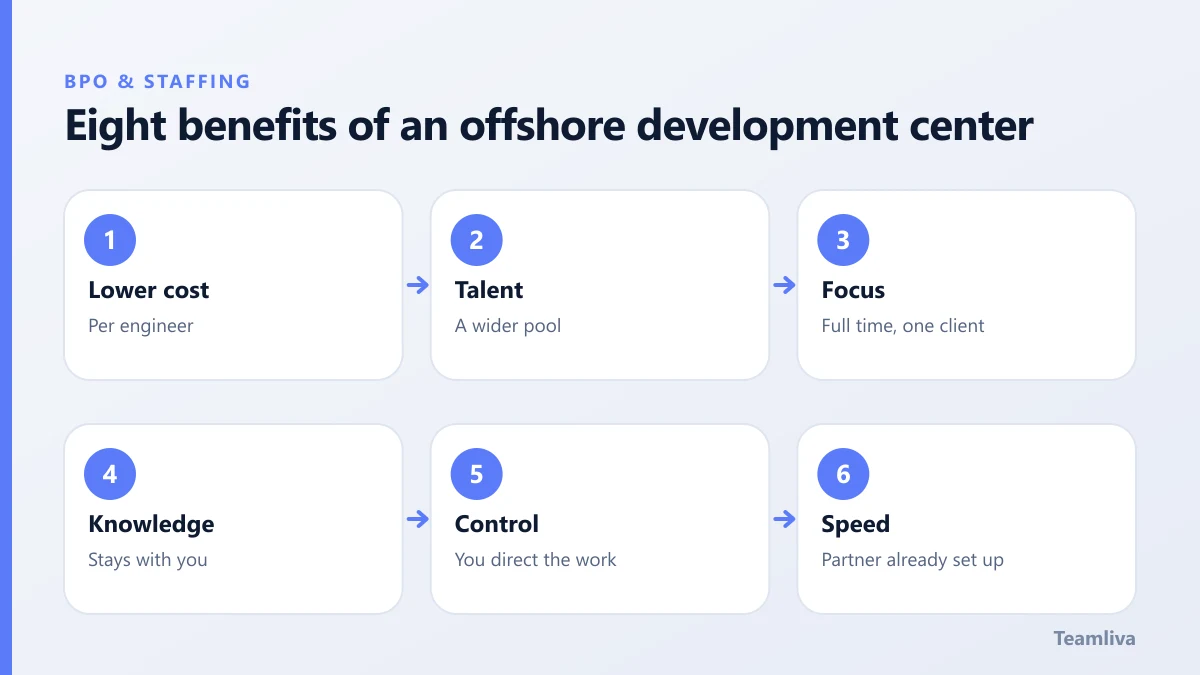
The main offshore development center benefits are a lower cost per engineer, access to a wider talent pool, a team that works only on your product, knowledge that stays with you, more control than project outsourcing, a faster start than opening your own entity, extended working hours and a path to ownership later. You only get them if the ODC is set up and managed well. This guide explains each benefit, how to make sure you actually get it, and the trade-offs to plan for.
New to the term? Start with what an offshore development center is.
1. Lower cost per engineer
Salary levels differ widely between countries, which is what makes an ODC economical. A partner wraps salary, benefits, office, equipment and management into one monthly fee per engineer. The saving depends on the roles, seniority, location and fee, so compare the total monthly cost per engineer against a fully loaded local hire. Our offshore savings calculator lets you model your own numbers.
Make sure you get it: ask for an itemised fee and check for extras such as recruiting charges, equipment and notice-period costs. See how much offshore staffing costs.
2. Access to a wider talent pool
Hiring locally limits you to one city's market. An ODC lets you recruit where the skills you need are available, which helps for hard-to-fill roles.
Make sure you get it: interview every candidate yourself with a real technical exercise, rather than accepting CVs.

3. A team that works only on your product
In a dedicated ODC, engineers work full time for one client. They learn your codebase, your users and your standards, and they are not pulled onto another client's deadline.
Make sure you get it: put "full time, single client" in the contract. Our ODC services checklist explains what else to ask.
4. Knowledge stays with you
Freelancers and project vendors take knowledge with them when the work ends. A long-term ODC team builds it up year after year.
Make sure you get it: keep documentation, code and decisions in your own systems, and invest in retention: career paths, training and fair pay reviews.
5. More control than project outsourcing
With project outsourcing, the vendor decides who works on what. In an ODC, you set priorities, run the backlog and review the code. Our comparison of offshore staffing and outsourcing explains the difference.
Make sure you get it: run the ODC in your own sprints, tools and code review process.
6. A faster start than your own entity
A partner already has the legal entity, office, recruiters and HR. You skip months of company registration and office set-up that a captive center requires.
Make sure you get it: start with a small pilot team and agree how quickly further roles will be recruited.
7. Longer working hours
A team in a different time zone can keep work moving after your local team signs off, for example testing, fixes or overnight builds.
Make sure you get it: plan a few hours of overlap for stand-ups and decisions, and write clear handover notes. Without overlap, time zones become a delay instead of a benefit.

8. A path to ownership
If the centre grows, some companies take it over through build operate transfer, moving the team into their own entity.
Make sure you get it: agree transfer terms in the first contract, not when you are already dependent on the partner.
The trade-offs to plan for
| Trade-off | What it looks like | How to manage it |
|---|---|---|
| Management time | Your leads spend time on reviews and communication | A technical lead on the ground; a steady meeting rhythm |
| Communication gaps | Misunderstood requirements, rework | Clear tickets, overlap hours, demos every sprint |
| Attrition | Good engineers leave and take context with them | Real ownership, career paths, documentation |
| Security and IP | Code or data exposed | Your repositories, individual logins, signed IP agreements |
| Hidden costs | Fees that grow after signing | Itemised pricing and price-review rules in the contract |
Our guide to offshoring risks covers each one in more depth.
Is an ODC worth it for you?
An ODC is usually worth it when:
- You have ongoing product work, not just a one-off project.
- You can give the team clear ownership of part of the product.
- Someone on your side has time to lead and review the work.
- You need more engineers than you can hire locally at the right cost.
It is usually not worth it when the work is a short, fixed project, when your product direction changes every week, or when nobody can manage the team.
Measuring your offshore development center benefits
After six months, review delivery cadence and quality against your local teams, the total cost per engineer against budget, attrition, and how much knowledge the team holds. If you are ready to go ahead, follow our 10-step plan to build an offshore development center.

Getting the benefits with Teamliva
If the checklist above points to yes, Teamliva (Team Liva) is one partner-run option, based in Dhaka, Bangladesh. Developers, QA engineers and designers work on your product alone, each hire is your decision, and the employment side is ours. Read about our dedicated offshore teams.
Frequently asked questions
What is the biggest benefit of an offshore development center?
For most companies it is getting a stable, full-time engineering team that works only on their product, at a lower total cost than hiring the same people locally, while keeping control of the work.
What are the disadvantages of an offshore development center?
It needs management time, clear communication across time zones and good security. Attrition, unclear ownership and hidden costs are the most common problems, and all are manageable if planned for.
Is an ODC cheaper than project outsourcing?
Not always for a single, well-defined project. An ODC usually becomes better value for ongoing product work, because you pay for capacity rather than for change requests, and knowledge builds in the team.
Is an offshore development center a good idea for startups?
It can be, once the product direction is clear enough to give a small team real ownership. Very early startups that change direction weekly often do better with a smaller, more flexible arrangement first.
- #Teamliva
- #TeamLiva
- #BPO
- #Outsourcing
- #RemoteStaffing
- #OffshoreDevelopmentCenterBenefits
- #OdcAdvantages
- #OffshoreDevelopment
- #DedicatedDevelopmentTeam