How to Build an Offshore Development Center: A 10-Step Plan
A practical, step-by-step plan to build an offshore development center: what it should own, which ODC model to choose, the first team, security and tooling, onboarding and how to measure delivery.
In this article
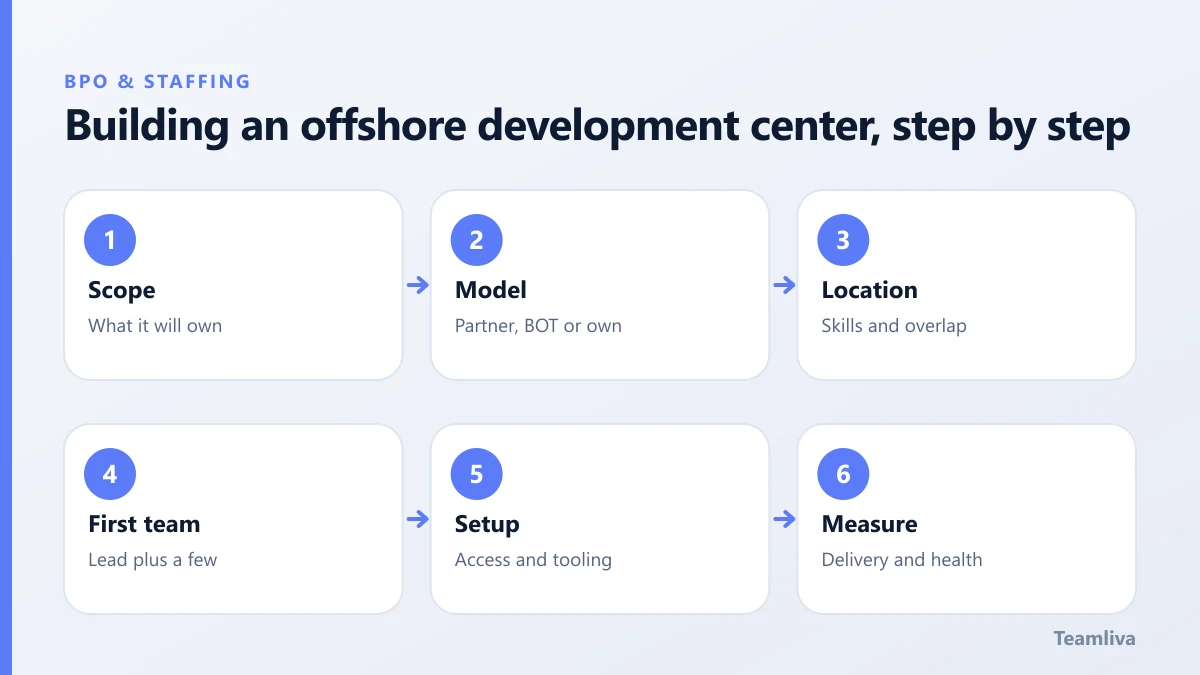
To build an offshore development center, decide what part of your product it will own, choose the model (a partner-run dedicated team, build operate transfer or your own entity), pick a location, start with a technical lead and a few engineers, set up access and tooling in your own systems, and measure delivery from the first sprint. Most failures come from skipping the first two steps, not from the engineering.
If you are still deciding whether you need one at all, read what an offshore development center is first.
Step 1: Decide what the ODC will own
An ODC works best when it owns something, such as a product area, a service or a platform layer, rather than receiving random tickets. Write down:
- The product area or components it will be responsible for.
- What "done" means for that area in the first six months.
- Which decisions stay with your local team, such as architecture and priorities.
- Who on your side owns the relationship and reviews the work.
Teams given ownership build knowledge and stay. Teams treated as overflow get bored and leave.
Step 2: Choose your ODC model
There are three main types of offshore development center, plus hybrids.
| Model | Who employs the team | Time to start | Upfront cost and risk | Best for |
|---|---|---|---|---|
| Partner-run dedicated ODC | A local partner | Fastest | Lowest | Most companies, especially at the start |
| Build operate transfer (BOT) | Partner, then you | Medium | Medium | Companies that want to own it later |
| Your own development center (captive / GCC) | Your own local entity | Slowest | Highest | Large, long-term teams with experience abroad |
Each has a deeper guide: build operate transfer and captive centers vs outsourcing. If a provider calls its offer an "ODC", check whether it means a dedicated team you direct or a vendor's delivery centre; our explainer on offshore delivery vs development centers shows how to tell.

Step 3: Pick a location
Compare locations on five things: the skills you need, English and communication, time-zone overlap with your team, political and infrastructure stability, and total cost. Our comparison of Bangladesh, India and the Philippines is a useful starting point.
Step 4: Design the first team
Start small and senior enough to work independently:
- A technical lead who owns delivery on the ground and talks to your engineering leadership daily.
- Two to four engineers in your main stack.
- QA early, so quality is built in rather than added later.
Add DevOps, more engineers and a second squad once the first is delivering steadily.
Step 5: Choose a partner (or set up your entity)
If you go with a partner, give each candidate the same brief and compare how they recruit, who leads on site, how they protect your code and what the fee includes. Our checklist of offshore development center services lists the ten questions to ask. If you are building your own entity, plan for local legal, payroll, HR and office set-up before the first hire.
Step 6: Set up access, tooling and security
- Keep code in your repositories and cloud accounts from day one.
- Give every engineer an individual login, with single sign-on and multi-factor authentication where possible.
- Grant least-privilege access, and keep production access limited until trust is earned.
- Use managed, encrypted devices.
- Make sure IP assignment and confidentiality agreements are signed before access is given.
- Remove access the same day someone leaves.
Step 7: Hire and onboard
Interview every candidate yourself, using a real technical exercise. Our guide to hiring offshore developers covers testing and IP. For onboarding, prepare architecture notes, a local setup guide and a list of starter tickets, and pair each new engineer with someone experienced for the first weeks.

Step 8: Integrate into one delivery process
Treat the ODC as part of your engineering team, not a supplier. Same sprints, same backlog, same code review standards, same definition of done. Run stand-ups in the overlap hours, demo work together at the end of each sprint and record decisions in one shared place. Our guide to managing an offshore team covers the habits that keep distance from becoming a problem.
Step 9: Measure delivery
Track the same delivery measures for the ODC as for your local teams. The DORA metrics are a widely used set: change lead time, deployment frequency, failed deployment recovery time, change fail rate and deployment rework rate. Add team health signals such as attrition, review turnaround and how early risks are raised.
Step 10: Grow, and decide about ownership
Add people in batches once delivery is steady, with a lead for each small group. Our guide to scaling an offshore team covers this. If you may want to own the centre one day, agree transfer terms early, while you still have negotiating room.
What to budget for when you build an offshore development center
Whatever model you choose, plan for: salaries and benefits, office and equipment, internet and backup power, recruiting, management (the partner's fee or your own local leaders), travel for occasional in-person visits, and tools and licences. Compare total monthly cost per engineer rather than headline rates; our offshore savings calculator and guide to offshore staffing costs help.
Mistakes to avoid
- Starting with no clear ownership, so the team only gets leftover tickets.
- Hiring a large team before the first few engineers are productive.
- Code or accounts living in the provider's systems.
- No technical lead on the ground.
- Measuring hours instead of delivery.
- Leaving IP, security and exit terms until later.

Building an ODC with Teamliva
Prefer not to set up an entity yourself? Teamliva (Team Liva) offers the partner-run route from Dhaka, Bangladesh, for US and UK companies: you choose and direct the engineers, and we employ them and run the office, payroll and HR. Start with a small first team through our dedicated offshore teams service, or see our web development work.
Frequently asked questions
How long does it take to build an offshore development center?
With a partner that already has an entity, office and recruiters, the first engineers can usually start within weeks of approval, depending on how fast suitable people are found. Building your own centre means registering an entity, finding an office and hiring local management first, which usually takes many months.
What are the types of offshore development center?
The main models are a partner-run dedicated ODC, where a partner employs a team that works only for you; build operate transfer, where a partner sets it up and later hands it over; and your own development center (a captive or global capability center) run through your own local entity. Many companies combine them over time.
How big should the first ODC team be?
Small. A technical lead plus two to four engineers, with QA added early, is enough to prove the model on real work. Grow once delivery is steady.
Should we build our own development center or use a partner?
Use a partner if you want to start quickly, test the model or stay flexible. Consider your own centre only for a large, long-term team where you are ready to run a foreign entity. Build operate transfer sits between the two.
- #Teamliva
- #TeamLiva
- #BPO
- #Outsourcing
- #RemoteStaffing
- #BuildOffshoreDevelopmentCenter
- #OdcModel
- #TypesOfOffshoreDevelopmentCenter
- #OwnDevelopmentCenter