How to Scale an Offshore Team: From Pilot to Full Programme
Your offshore pilot works. Now what? How to scale an offshore team in waves: when you are ready, the management layer to build first, recruiting in batches, adding departments and keeping control.
In this article
To scale an offshore team, grow in waves rather than all at once: prove the pilot against agreed measures, write down how the work is done, put a team lead and quality checks in place before adding headcount, hire and train in batches, add one department at a time, and govern the programme with regular reviews. Teams that scale this way keep the quality that made the pilot worth expanding.
This guide is for operations and finance leaders whose small offshore pilot is working and who are now planning a larger, longer-term programme. If you are still at the start, read how to build an offshore team first.
Signs your pilot is ready to scale
Expanding too early copies problems into every new hire. Before you add people, check that:
- Results are stable. The pilot has met its agreed measures, such as accuracy, turnaround or response time, for several consecutive weeks, not just once.
- The work is written down. Procedures, examples and edge cases live in a shared guide, not in one person’s head.
- A second person has learned from the guide. If a new hire can reach standard using your documentation, the process can scale.
- Someone on your side owns it. A named internal owner has time each week for reviews and decisions.
- The cost model is clear. You know the full monthly cost per person, including supervision and equipment, so the business case for more seats is real.
If any of these is missing, fix it with the people you have before you hire more.
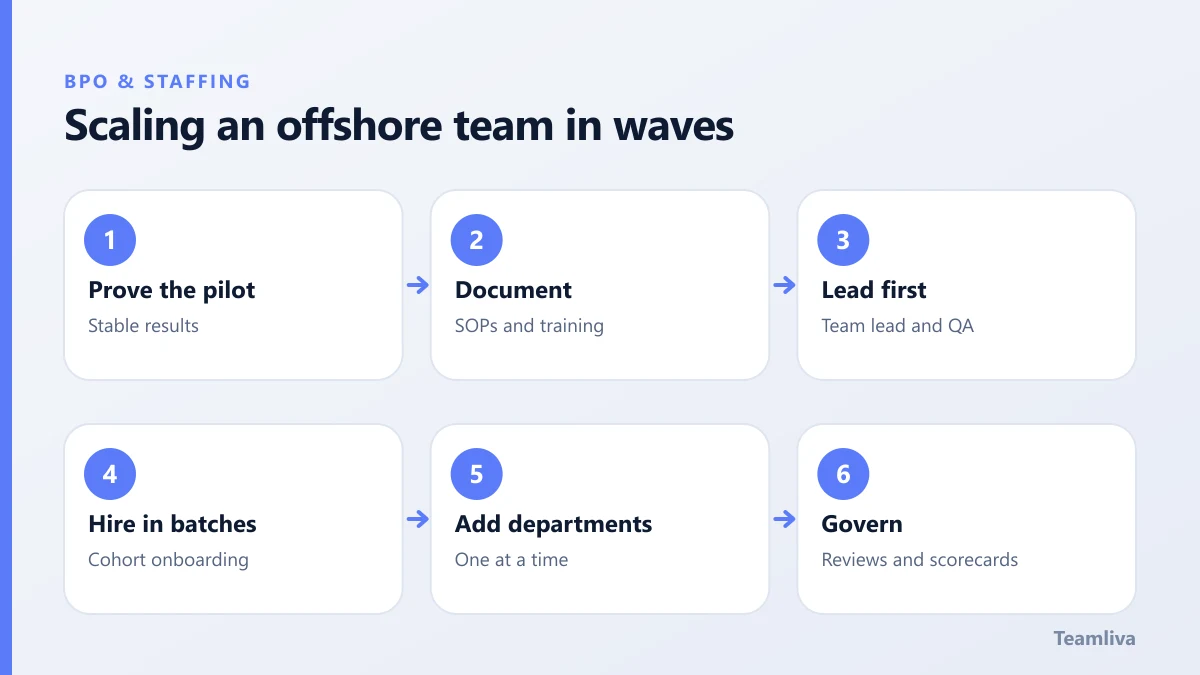
Plan a programme, not just a headcount
Write a one-page plan that shows the waves you expect, what must be true before each starts and how you will know it worked.
| Wave | Scope | Before it starts | Done when |
|---|---|---|---|
| Pilot | 2–5 people, one process | Brief, access, measures agreed | Measures met for several weeks |
| Wave 1 | Grow the first process | Team lead in place, guide complete | New hires reach standard on schedule |
| Wave 2 | Second process or department | Owner and measures for the new area | Both areas stable at once |
| Wave 3+ | Further departments | Programme reviews running | Scorecard steady across areas |
Treat the numbers in each wave as your own decision, based on demand and on how many people you can train well at once.

Build the management layer first
The most common scaling failure is adding people faster than anyone can supervise them. Put these roles in place before the headcount arrives:
- Team leads. One for each small group, reviewing work, coaching and acting as the first escalation point. Our guidance is to add a lead once a team reaches four or five people.
- Quality review. Someone who samples work against a scorecard, so standards do not drift as the team grows.
- Training. A trainer or experienced team member who runs onboarding for each new group.
- A single programme contact. One person at the provider who is accountable for the whole relationship, not just one team.
Recruit in batches and onboard in cohorts
Hiring one person at a time across many roles stretches trainers thin. Instead:
- Agree the profile and skills test for each role up front.
- Hire a small batch for one role at a time.
- Train them together as a cohort, using your written guide and real examples.
- Pair each new person with an experienced team member for their first weeks.
- Start the next batch only when the current one reaches standard.
The first 90 days of each wave can follow the same structure as a BPO transition plan: document, train, pilot, then stabilise.
Keep knowledge in your own systems
As a programme grows, knowledge is the asset most at risk. Keep procedures, templates, recordings and decision logs in tools you own, update them whenever a process changes, and make updating the guide part of each team lead’s job. If you ever change provider or bring the team in-house, this is what lets you continue without starting over.
Adding new departments
Each new function needs its own owner, measures and security setup. A few examples:
- Customer support: clear service levels, a knowledge base and sampled quality reviews. Our customer support setup guide walks through the steps.
- Finance and accounting: approval limits, separation of duties and read-only access where possible. See offshore accounting staff for a worked example.
- Healthcare administration: a business associate agreement and HIPAA-aligned controls before anyone sees patient data, as covered in our guide to HIPAA for outsourced teams.
Start with the department whose work is most repeatable and easiest to measure, and add more sensitive work once governance is working.
Govern the programme as it grows
A small pilot can run on a weekly call. A programme needs a rhythm:
- Weekly: operational review per team, covering volumes, quality and blockers.
- Monthly: a business review across teams, with a scorecard and actions.
- Quarterly: roadmap, staffing plan and a review of who has access to what.
Agree these measures and remedies in writing; our guide to service level agreements shows what to include. Revisit the main offshoring risks at each quarterly review, because attrition, dependency and security exposure all grow with size.

Dedicated programme or shared BPO at scale?
At larger sizes, some buyers are offered shared seats, where agents work across several clients. That can be cheaper for low or unpredictable volume. For steady work, a dedicated team keeps product knowledge in your account and gives you direct control of training and standards. Our comparison of offshore staffing and outsourcing explains the trade-off.
When to consider your own centre
Very large, long-term programmes sometimes move from a partner to a company-owned operation, either through build operate transfer or by setting up a captive center. The right point depends on your size, plans and appetite for running a foreign entity. If you might go that way, make sure your contract allows staff and processes to transfer, and on what terms, before you scale.
Mistakes to avoid when you scale an offshore team
- Adding headcount before a team lead and quality review exist.
- Copying an undocumented process to new people.
- Expanding into several departments at the same time.
- Measuring hours and seats instead of results.
- Leaving procedures in the provider’s systems instead of yours.
- Signing volume commitments you cannot change if demand drops.
Questions to ask a provider before you scale with them
- How have you grown a team from a pilot to a larger programme? Can we speak to that client?
- How long does recruiting usually take for these roles, and how many people can you train at once?
- Who leads the programme, and who covers when they are away?
- How are price changes, volume increases and reductions handled in the contract?
- Can staff and documentation transfer to us later, and on what terms?
Use the same questions you used to choose the provider and compare the answers with what happened in the pilot.

Scaling with Teamliva
Teamliva builds dedicated offshore teams that range from a single specialist to a full operations team, with a named team lead, written procedures, regular performance reporting and cover arrangements. If your pilot is working and you are planning the next wave, ask us the questions above and judge us on the answers.
Frequently asked questions
How fast can an offshore team scale?
It depends on the roles, how complete your documentation is and how many new people your trainers and team leads can absorb at once. Scaling in batches, with each group stable before the next starts, is slower on paper but usually faster than recovering from a rushed expansion.
When should we add a team lead?
Before the team grows past a handful of people. A lead who reviews work, coaches and reports means you are not the only person coordinating, and gives every later hire someone to learn from.
Should a growing programme use one provider or several?
One provider is simpler to govern and keeps standards consistent. Some larger companies add a second provider for resilience once the first is stable, but each provider needs its own owner, scorecard and documentation.
Can a dedicated team move to our own entity later?
Sometimes. Build operate transfer and captive models exist for this, but transfer is only available if your contract allows it. Agree the terms before you scale, not after.
- #Teamliva
- #TeamLiva
- #BPO
- #Outsourcing
- #RemoteStaffing
- #ScaleAnOffshoreTeam
- #DedicatedOffshoreTeam
- #OffshoreProgramme
- #TeamExpansion