Outsourced Medical Sales Support: How to Structure Your Team With a Partner
Which parts of a medical sales team to keep in-house, which to give an outsourcing partner, three ways to structure the team, hand-off rules and the compliance guardrails to agree before anyone makes a call.

In this article
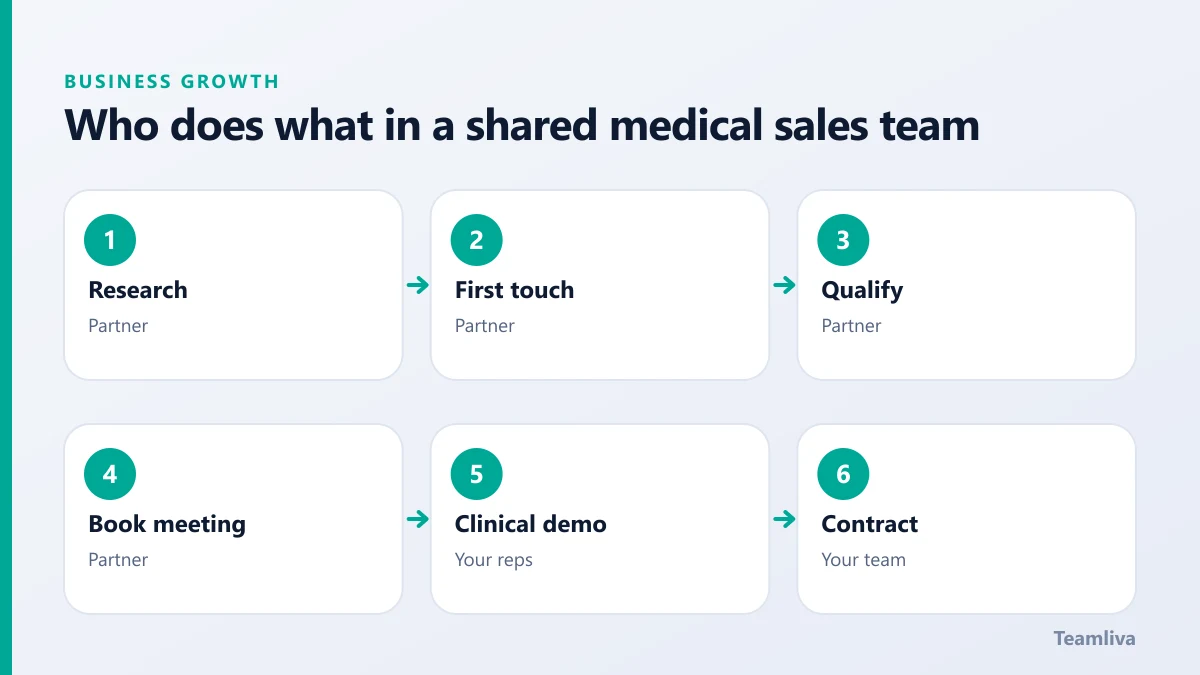
To structure a medical sales team with an outsourcing partner, keep the clinical, relationship and contracting work with your own people and give the partner the repeatable work that feeds them: account research, list building, first-touch outreach, qualification, meeting scheduling and CRM upkeep. Then agree one playbook, clear hand-off rules and compliance guardrails before anyone makes a call.
This guide is for sales leaders at medical device, diagnostics, health technology and healthcare services companies that sell to hospitals, practices and other providers. It is practical guidance, not legal advice; your compliance team should approve the guardrails for your products.
Which parts of a medical sales team to keep in-house
| Role | Usually kept in-house | Often outsourced | Why |
|---|---|---|---|
| Territory or field reps | ✔ | Clinical credibility, relationships and on-site visits | |
| Clinical specialists | ✔ | Product use, training and clinical questions | |
| Inside sales and closing | ✔ or shared | Pricing, negotiation and contracts | |
| Sales development and appointment setting | ✔ | Repeatable outreach to a defined playbook | |
| Account research and list building | ✔ | Time-consuming, rules-based work | |
| CRM upkeep and sales support | ✔ | Keeps records current so reps can sell |
The principle is simple: a partner extends the top of your funnel, and your own people own every conversation that needs clinical knowledge or commercial authority.
Three ways to structure the team
1. Territory-aligned pod
Each outsourced SDR supports one or two of your field reps, working their accounts and booking into their calendars. Good when reps cover defined regions and know their accounts well.
2. Product-line pod
SDRs specialise in one product or service line and book for whichever rep covers the account. Good when products have different buyers, such as a capital equipment line sold to hospital leadership and a consumables line sold to department managers.
3. Follow-up and re-engagement desk
The partner follows up conference, webinar and inbound leads, and re-engages accounts that went quiet. Good as a low-risk first step, because the contacts already know your company.
Example: a company with six field reps covering hospitals in two regions might start with a two-person territory pod for one region, keep the other region as a comparison, and expand only if the pod’s meetings convert as well as the reps’ own.

Map the buying group before outreach starts
Medical purchases rarely rest with one person. Depending on the product, the buying group can include clinicians, department heads, purchasing and supply chain, finance, IT and a value analysis committee that reviews new products. Give the partner a simple map of who you want to reach, in what order, and which roles your own reps must handle personally.
Hand-off rules that keep reps happy
Most friction between outsourced SDRs and field reps comes from vague hand-offs. Agree in writing:
- What a qualified meeting is: for example, the right role at a target facility type, a stated need or project, and a realistic timeframe.
- What goes into the CRM: contact, role, facility, the need in their words, and any objections raised.
- How meetings are booked: calendar access, meeting length, and how much notice reps need.
- How reps give feedback: a quick accept or reject on each meeting, with a reason, reviewed weekly.
- Response times: how quickly reps follow up on hot leads the partner passes over.
Our guide to appointment setting services covers scripts, channels and pricing models in more depth.
Compliance guardrails to agree first
Medical sales carries rules that general B2B outreach does not. Agree these with your compliance team and write them into the partner’s playbook:
- Approved messaging only. Outsourced reps use the wording your regulatory and legal teams have approved, make no clinical or performance claims beyond it, and pass every clinical question to your staff.
- Nothing of value. Outsourced reps should never offer gifts, meals, payments or anything else of value to clinicians. The federal Anti-Kickback Statute makes it a crime to knowingly and willfully offer remuneration to induce referrals for items or services paid for by federal health care programs, and many payments and transfers of value from manufacturers to clinicians and teaching hospitals must be reported under CMS Open Payments. Follow your company’s code of conduct and the industry code you have adopted, such as the AdvaMed code for device companies or the PhRMA code for drug companies.
- Email rules. The CAN-SPAM Act applies to business-to-business email: accurate sender details and subject lines, a valid postal address, a clear way to opt out, and opt-outs honoured within 10 business days.
- Calls and texts. Review calling and texting practices with counsel against the Telephone Consumer Protection Act, especially for mobile numbers and any automated dialling or messaging.
- No patient information. B2B prospecting should use business contact details only. If any work would involve patient information, stop and get the right agreements in place; our guide to HIPAA for outsourced teams explains what that involves.
Train the partner team properly
Outsourced reps do not need clinical training, but they do need enough context to hold a credible first conversation:
- Your ideal customer profile by facility type and role.
- The problems your product solves, in plain, approved language.
- The questions that qualify a prospect, and the ones they must hand over.
- Common objections and the approved responses.
- Recorded example calls and emails from your best reps.

What to measure
Agree definitions before the pilot so the numbers mean the same thing to both sides:
- Activity: accounts researched, contacts reached, conversations held.
- Meetings booked and meetings held, since no-shows matter.
- Meetings accepted by your reps as qualified.
- Pipeline created from those meetings, and later the deals won.
Judge the partner on accepted meetings and pipeline, not on activity alone.
Run a pilot before you commit
Start with one territory, product line or lead source for a few months, long enough for meetings to turn into pipeline. Hold a weekly review with the partner and the reps they support, adjust the playbook, and decide at the end whether to expand, change the structure or stop.
Questions to ask a sales outsourcing partner
- Have you supported sales into healthcare organisations before, and can we speak to a reference?
- How do you train reps to stay within approved messaging?
- Will the same people work on our account every day?
- How do you log activity in our CRM, and who owns the data?
- How are meetings, hours or results priced, and what are the minimum terms? Our explainer on BPO pricing models compares the options.
For a broader set of vetting questions, use our BPO selection checklist.

Testing the model with Teamliva
Teamliva’s sales, lead generation and appointment setting team works to a playbook you define: your ideal customer profile, qualification criteria, scripts and hand-off rules, with weekly reporting and no promised sales outcomes. If you sell to healthcare organisations, ask us how we would apply the guardrails above to your products before you decide.
Frequently asked questions
Can medical sales be outsourced?
Parts of it can. Account research, list building, first-touch outreach, qualification, meeting scheduling and CRM upkeep are commonly handed to a partner. Clinical conversations, product demonstrations, pricing and contracting usually stay with your own team.
What should outsourced sales reps never do in medical sales?
They should not make clinical or performance claims beyond your approved messaging, answer clinical questions, or offer anything of value to clinicians. Those belong to your trained staff and your compliance process.
Does HIPAA apply to medical sales outreach?
Usually not, because prospecting uses business contact details rather than patient information. If the work would touch patient information, get advice and put the right agreements in place first.
How do you measure an outsourced medical sales team?
Track meetings booked, meetings that actually take place, meetings your reps accept as qualified, and pipeline created from them, alongside activity. Agree the definitions with your reps before the pilot starts.
- #Teamliva
- #TeamLiva
- #DigitalMarketing
- #SEO
- #BusinessGrowth
- #MedicalSales
- #SalesDevelopment
- #AppointmentSetting
- #HealthcareSales