SEO for Service Businesses: A Beginner's Guide
SEO for service businesses is about being found by people who need your service right now. This beginner's guide covers keywords, service pages, content, technical basics and measurement.
In this article
SEO for service businesses has one clear purpose: to put your company in front of people who are searching for what you do, right when they need it. Unlike a product store, a service business sells expertise and trust, so search visibility has to build both.
This beginner's guide explains the parts that matter most and the order to tackle them.
How SEO for service businesses starts with search intent
People search in stages. Early on they ask questions, such as "what is revenue cycle management." Later they compare providers. Finally they look for a specific service and a way to get in touch.
Good SEO for service businesses covers all three stages:
- Educational content for the questions.
- Comparison and guidance content for the evaluation.
- Service pages for the decision.
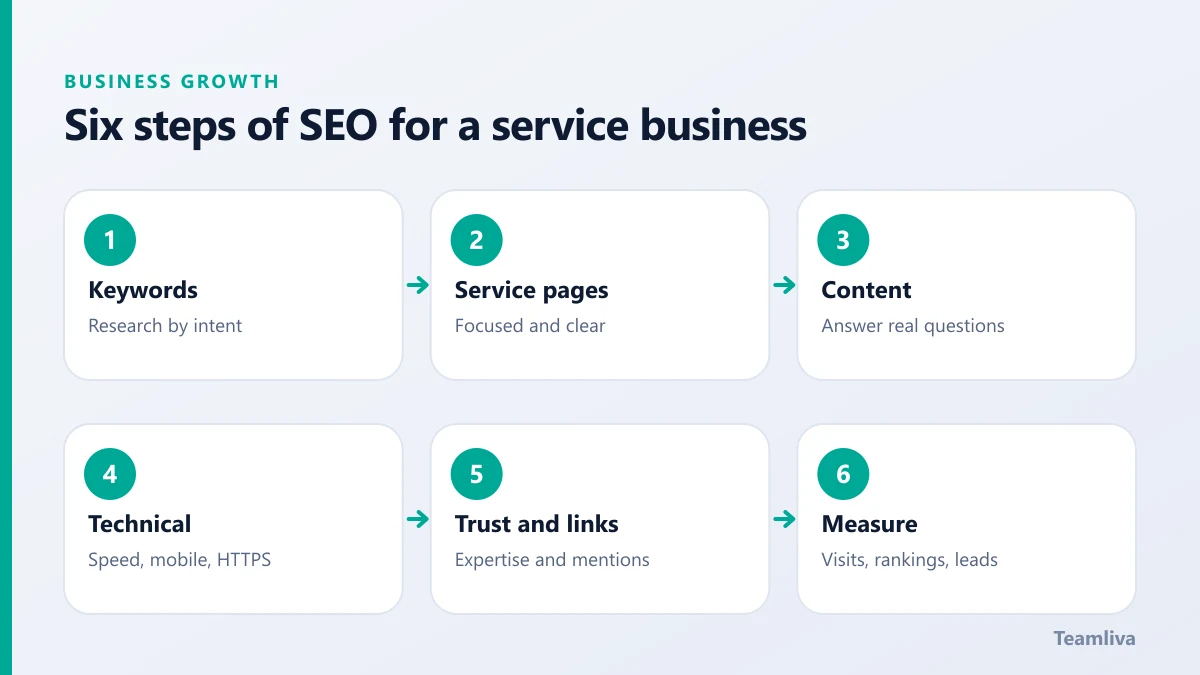
Step 1: Research keywords with intent
A keyword is the phrase a person types into a search engine. Rather than chase the biggest numbers, look for phrases that show intent.
- Service keywords, such as "customer support outsourcing."
- Problem keywords, such as "how to reduce claim denials."
- Comparison keywords, such as "in-house versus outsourced."
Group related phrases together. One page should target one main topic and its close variants.
Step 2: Build strong service pages
Your service pages are where visitors become leads. Each one should:
- Say clearly what you offer and who it is for.
- Use the words your customers use in the headline and opening.
- Explain your process so buyers know what happens next.
- Answer common questions in a short FAQ.
- Offer one clear action, such as a contact form or a call.
Cover related services on the same site, and link them together. Teamliva's own digital marketing and growth services page is built this way, as a cluster of related topics rather than a thin single page.
Step 3: Publish helpful content
Articles let you reach people earlier in their search. Each one should answer a real question thoroughly.
- Match the search intent. If people want a checklist, give a checklist.
- Be specific and accurate. Depth beats padding.
- Use clear headings, so readers and search engines can scan the page.
- Link to related pages, including your services, so readers can take the next step.
For example, our article on BPO versus in-house teams links naturally to the matching service page.
Step 4: Fix the technical basics
Search engines need to crawl and understand your site.
- Speed. Compress images and avoid heavy scripts.
- Mobile friendliness. Most searches happen on phones.
- Clean structure. Use logical URLs and a sitemap.
- Secure connection. Serve the site over HTTPS.
- Structured data. Mark up articles, FAQs and your organisation so results can show extra detail.
Google publishes a helpful SEO starter guide that explains these basics directly.
Step 5: Earn trust and links
Search engines look for signs that a site is credible. You can build them by:
- Showing real expertise and named authors.
- Listing genuine case details, credentials and contact information.
- Earning links from reputable sites in your field.
- Keeping your business profile consistent across the web.
Step 6: Measure and improve
Track a few numbers monthly:
- Organic visits to the site.
- Rankings for your target phrases.
- Leads from search, such as form submissions and calls.
- Top landing pages and how visitors behave on them.
Update pages that slip, expand those that show promise and retire content that does not help anyone.
Mistakes to avoid
- Stuffing keywords until the writing sounds unnatural.
- Publishing thin pages just to have more pages.
- Ignoring mobile and speed.
- Expecting overnight results.
Where to go next
Once your foundations are in place, connect SEO with lead generation so that traffic becomes conversations. Consider how a better site and a stronger brand help conversion as well, and read about custom web application development if your site needs more than a brochure.
A simple 90-day plan
If you are starting from scratch, this order works well.
Days 1 to 30: foundations. Audit your site for speed, mobile layout and broken pages. Choose one main keyword for each service page and rewrite headings and introductions to match.
Days 31 to 60: content. Publish two to four helpful articles that answer the top questions buyers ask. Link each article to the relevant service page and to related articles.
Days 61 to 90: trust and measurement. Add case details, credentials and clear contact options. Set up tracking for form submissions and calls, then review which pages bring leads.
After the first 90 days, keep a steady rhythm: publish, update, measure. SEO rewards consistency far more than bursts of effort.
Local and industry signals
If you serve a specific region or industry, say so plainly on the page. Mention the sectors you work with, the regulations you understand and the systems you support. This helps the right buyers recognise you, and it helps search engines connect your pages to the right searches.
The takeaway
SEO for service businesses rewards patience and clarity. Research the phrases buyers use, build focused service pages, publish genuinely helpful articles and keep the technical side healthy. If you want a partner for the work, contact Teamliva.
Frequently asked questions
How long does SEO take to show results?
It varies with competition and your starting point. Many businesses see early movement within a few months, but steady growth usually builds over six to twelve months of consistent work.
Do I need a blog for SEO?
A blog is not mandatory, but helpful articles let you target the questions buyers ask before they contact anyone. They also support your service pages through internal links.
Is SEO better than paid advertising?
They serve different goals. Ads bring traffic quickly while you pay for it. SEO takes longer but compounds over time. Many businesses use both.
- #seo
- #digital marketing
- #lead generation
- #service business