Insurance Eligibility Verification: A Step-by-Step Guide
Insurance eligibility verification step by step: what to check before each visit, when to verify, common mistakes that cause denials, and how to outsource it.
In this article
Insurance eligibility verification is the check that a patient’s coverage is active and covers the planned service before the visit takes place. Done consistently, it prevents a large share of avoidable denials and surprises at the front desk.
Why insurance eligibility verification matters
Eligibility errors are among the most common reasons claims are denied. A patient may have changed plans, lost coverage, reached a benefit limit or need an authorisation nobody requested. Each of these is easy to catch before the visit and expensive to fix afterwards. Front-end checks also let you tell patients what they will owe, which improves collections at the time of service.
For the bigger picture, see how the front end connects to collections in our guide to revenue cycle management.
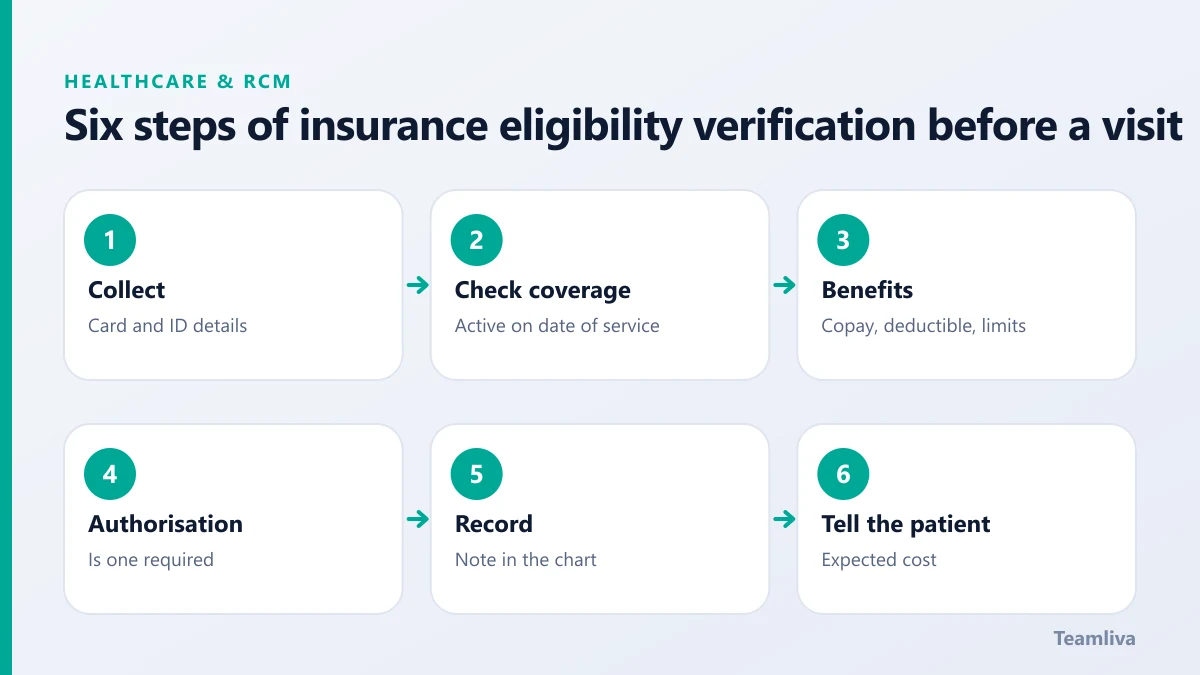
What to verify before every visit
A complete insurance eligibility verification covers:
- Active coverage on the exact date of service, not just today.
- Plan type and network status of your provider.
- Copay, coinsurance and deductible, including how much of the deductible is met.
- Covered services and limits, such as visit caps for therapy.
- Authorisation or referral requirements for the planned service.
- Primary and secondary insurance, and coordination of benefits.

Step-by-step eligibility verification process
- Collect accurate details. Take a clear image of the insurance card and photo ID, and confirm the subscriber’s name and date of birth.
- Check coverage electronically. Use your practice management system’s real-time eligibility check or the payer portal.
- Confirm benefits for the service. A plan can be active but exclude the service you plan to provide.
- Identify authorisations. If one is needed, start the request immediately. Our prior authorization guide covers this in detail.
- Record the result. Note what you checked, the date, the reference number and the person or portal that confirmed it.
- Tell the patient what to expect. Share the estimated copay or balance before the visit.
When to verify eligibility
- Two to three days before each scheduled visit, so there is time to fix problems.
- At check-in for walk-ins, new patients and anyone with a recent change.
- At the start of each year, when many plans and deductibles reset.
- Before high-cost services, such as procedures and imaging.
Common mistakes that lead to denials
- Checking that a plan is active but not checking the specific service.
- Misspelled names or wrong dates of birth on the claim.
- Missing secondary insurance or getting the order of payers wrong.
- Not repeating the check for patients seen regularly.
- No record of what was verified, so disputes cannot be supported.
Our guide to medical claim denials shows how these errors appear later as denial codes.
Measuring how well you verify
Track the share of denials caused by eligibility, the share of visits verified before the day of service and the share of patient balances collected at check-in. If eligibility denials fall, the process is working.
Outsourcing insurance eligibility verification
Verification is repetitive, rule-based and schedule-driven, which makes it well suited to a trained remote team. The team works your upcoming schedule each day, verifies coverage and benefits, starts authorisations and flags problems to your front desk before patients arrive. Patient data must be handled under a business associate agreement and HIPAA-aligned controls, as explained in our article on HIPAA compliance for remote teams.

A daily verification routine that works
Most practices get the best results from a fixed daily rhythm rather than checking patients one by one at the desk:
- Morning: pull the schedule for two or three days ahead.
- Work the list: verify coverage and benefits for every visit, newest bookings first.
- Flag problems: inactive coverage, missing authorisations or unknown secondary plans go to a shared list.
- Contact patients: call or text anyone whose coverage needs updating before their visit.
- Afternoon: recheck same-day additions and walk-ins.
- End of day: confirm every visit for tomorrow shows a verified status.
Documentation that protects you
Record the date, time, method, payer reference number and the name of the person who confirmed benefits. If a claim is later denied for eligibility, that record is what supports your appeal. Keep the note in the same place for every patient, so anyone on the team can find it.
Training new staff on verification
New team members learn fastest with a short checklist per payer, screenshots of each portal and a few practice cases reviewed with a supervisor. Spot-check a sample of their work every week until accuracy is consistently high.
Key takeaways: insurance eligibility verification
- Insurance eligibility verification confirms active coverage and benefits for the planned service before the visit.
- Verify two to three days ahead, again at check-in for higher-risk visits, and at the start of each plan year.
- Check the specific service, authorisation needs and secondary coverage, not just whether a plan is active.
- Record the date, method and reference number so you can support an appeal later.
- Schedule-driven verification is well suited to a trained remote team working under a business associate agreement.

How Teamliva helps
Teamliva (Team Liva) provides remote eligibility and benefits verification specialists for US practices, working in your systems on your schedule. See our healthcare staffing services or talk to us about your volume.
For official background on eligibility transactions, the Centers for Medicare & Medicaid Services publishes guidance on standard electronic transactions used by payers and providers.
Frequently asked questions
What is insurance eligibility verification?
It is the check, before a visit, that a patient’s insurance is active on the date of service and covers the planned care, along with the patient’s copay, deductible and any authorisation requirements.
When should eligibility be verified?
Verify two to three days before a scheduled visit, again at check-in for high-risk cases, and every time a patient reports a change in coverage.
Can eligibility verification be outsourced?
Yes. A trained remote team can work your schedule ahead of time in your practice management system and payer portals, and flag problems before the patient arrives.
- #Teamliva
- #TeamLiva
- #MedicalBilling
- #RCM
- #HealthcareBPO
- #InsuranceEligibilityVerification
- #BenefitsVerification
- #PatientEligibility
- #FrontEndRevenueCycle