Virtual Assistant Red Flags and Scams: How to Protect Yourself
Learn the warning signs of a bad virtual assistant provider or a hiring scam, from unrealistic promises to payment requests, and how to verify before you commit.
In this article
The most common virtual assistant red flags are unrealistic promises, pressure to pay or sign quickly, vague security answers and no written agreement. Verify identity, ask for references and start with a small paid trial before you share any access.
Most virtual assistant providers and freelancers are honest, and remote work is a legitimate, useful way to grow a business. But hiring online has real risks: fake profiles, providers who overpromise and vanish, and even fraud aimed at both buyers and job seekers. This guide lists the warning signs and the simple checks that protect you.
Red flags when hiring a provider
Promises that are too good
"Guaranteed 10x productivity", "the best in the world" or prices far below every competitor should make you ask how. Quality support has real costs. Ask what is included at that price.
No clear answer on who supervises the work
If you cannot find out who manages the assistant daily, the answer is usually "you". That may be fine, but you should know before you sign. See best virtual assistant companies: how to compare.
Pressure to sign or pay quickly
Legitimate providers give you time. "Offer ends today" pressure is a sales tactic at best and a scam at worst.
Vague or missing security answers
If a provider cannot explain device controls, access rules and how confidential data is handled, do not give them access to your systems.
Unusual payment requests
Be cautious about requests to pay by gift cards, cryptocurrency or personal accounts, or for large payments before any agreement. Use traceable methods and a written invoice.
No contract
A provider who avoids putting terms in writing is one you cannot hold to anything. Use our contract and NDA checklist.
Reviews that look manufactured
Many identical five-star reviews, or reviews with no detail, are suspicious. Ask for a client you can speak to.
Red flags in an individual candidate
- Evasive answers about past work or references.
- A portfolio that does not match their claimed skills.
- Refusal to do a small paid test task.
- Reluctance to sign a confidentiality agreement.
- Insisting on communicating only through unusual channels.
- Poor written communication in the application itself, when the role depends on it.

Scams aimed at job seekers
Fake "virtual assistant jobs" that ask candidates to pay for training, buy equipment from a specified seller or cash cheques are common fraud. If you are an assistant looking for work, never pay to get hired. Never cash a cheque and send money on. The US Federal Trade Commission publishes guidance on job scams at consumer.ftc.gov.
Six checks that verify a provider
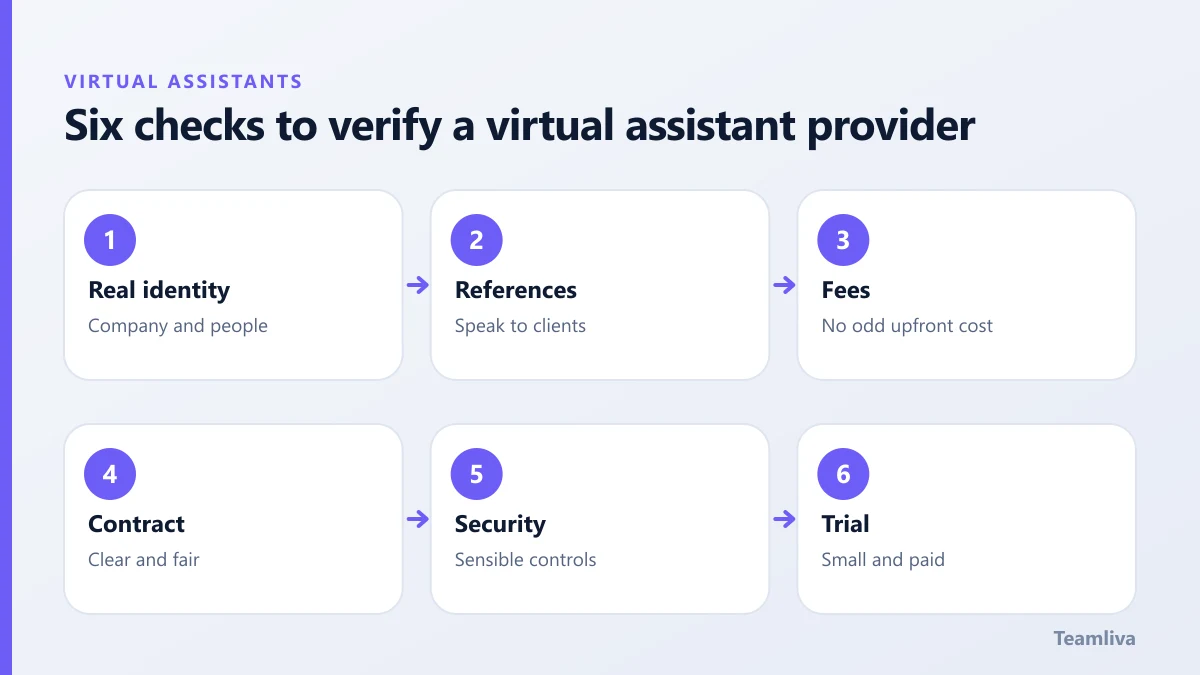
- Real identity: a registered business name, a physical location, named people and a working email domain.
- References: speak to at least one current client.
- Fees: every fee itemised in writing.
- Contract: clear scope, confidentiality, notice and ownership terms.
- Security: sensible answers on devices and access. See virtual assistant data security.
- Trial: a small, paid test before any larger commitment.
Protect yourself day to day
- Give access in small steps, not everything on day one.
- Use unique accounts and multi-factor authentication.
- Keep sensitive financial actions, such as approving payments, with you.
- Review activity logs occasionally.
- Trust your instincts. If something feels wrong, pause.
A short verification routine for any virtual assistant red flags
Spend thirty minutes before you commit:
- Search the company name with words such as "reviews" and "complaints".
- Check the domain and email: a professional email on the company’s own domain is a basic sign of legitimacy.
- Ask for two references and actually speak to them.
- Request the contract and read it before any payment.
- Video call the candidate, ideally with a short live task.

What to do if something goes wrong
- Stop sharing access and change passwords for anything the person could reach.
- Review recent activity in your email, storage and accounting tools.
- Notify your bank if payments were involved.
- Report the incident to the platform you used and, if money or data was lost, to the relevant authority in your country.
- Document everything with dates and screenshots.
Building good habits from the start
Most problems can be prevented by giving access in small steps, keeping approvals for payments with you, using unique accounts for every person and writing down what each person can and cannot do. Combine this with the contract and NDA checklist and the guidance on comparing providers.
Key takeaways: virtual assistant red flags
- The clearest virtual assistant red flags are pressure to pay or sign fast, vague security answers and reluctance to put terms in writing.
- Verify the company, speak to a reference and read the contract before any payment.
- Give access in small steps and keep payment approvals with you.
- If you are a job seeker, never pay to be hired and never cash a cheque and send money on.
- If something goes wrong, stop access, change passwords, review activity and document everything.

What a trustworthy provider looks like
A trustworthy provider explains their process openly, welcomes a trial, puts terms in writing, lets you talk to clients and is happy for you to compare them with others. Teamliva is a BPO and staffing company based in Dhaka, and we are glad for you to check us against this list. Read about our virtual assistant services or ask us anything before you decide.
Frequently asked questions
How do I know if a virtual assistant provider is legitimate?
Check the company’s identity, ask for client references, review a written agreement, confirm how payment works, and start with a small paid trial. Be wary of pressure and vague answers.
Is asking for an upfront fee always a scam?
Not always. Reasonable setup or trial fees can be legitimate. Be cautious of large, unexplained payments requested by unusual methods before any work or agreement.
- #Teamliva
- #TeamLiva
- #VirtualAssistant
- #VirtualAssistantServices
- #HireAVirtualAssistant
- #VirtualAssistantScams
- #RedFlags
- #HiringSafely