BPO vs KPO vs LPO: What Is the Difference?
BPO, KPO and LPO describe different kinds of outsourcing. Learn what each covers, how they differ in skill level and risk, and which one suits your work.
In this article
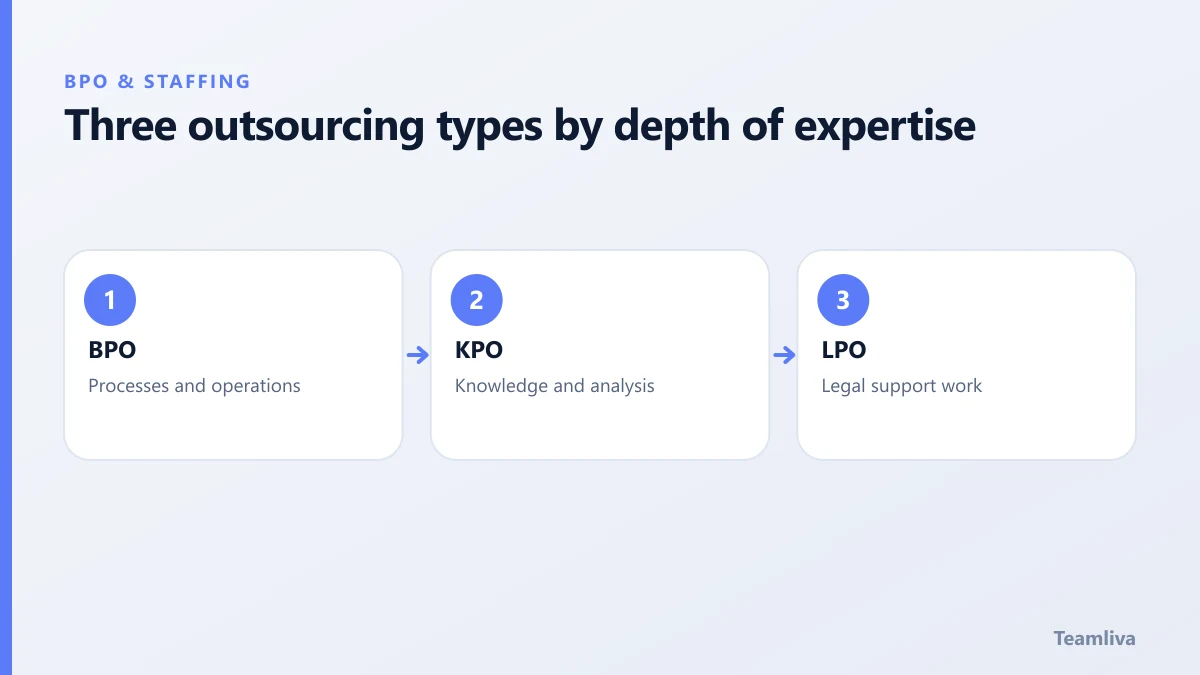
BPO vs KPO vs LPO describes three levels of outsourcing: business process outsourcing for operational tasks, knowledge process outsourcing for expert analysis and legal process outsourcing for legal support. The right choice depends on how much judgement the work needs.
The outsourcing world is full of acronyms. BPO is the best known, but you will also see KPO and LPO. They are related, and they are not the same. Knowing the difference helps you ask for the right service and judge a provider’s claims.
BPO: business process outsourcing
BPO covers operational processes that follow defined steps: customer support, data entry, billing, order processing, payroll administration and records upkeep. The emphasis is on efficiency, consistency and volume. If you are new to it, start with what BPO is.
Typical skills: communication, accuracy, following procedures and tool use.
KPO: knowledge process outsourcing
KPO covers work that needs analysis, judgement and domain knowledge: market research, financial analysis, data analytics, medical content, engineering support and similar tasks. The emphasis is on quality of thinking rather than volume.
Typical skills: subject expertise, analysis and reporting, often with advanced degrees or professional training.

LPO: legal process outsourcing
LPO covers legal support work: document review, contract administration, legal research and paralegal-style tasks. It is normally supervised by qualified lawyers because legal advice must come from a licensed professional. See our note on virtual assistants for lawyers for how supervision works.
Side by side
| Factor | BPO | KPO | LPO |
|---|---|---|---|
| Nature of work | Process-driven | Knowledge-driven | Legal support |
| Skill level | Trained operators | Subject specialists | Legal-trained staff |
| Volume | High | Lower | Medium |
| Pricing basis | Hours, seats or volume | Project or hourly | Hourly or per document |
| Main risk | Quality drift | Judgement errors | Confidentiality and ethics |
Which one do you need?
- If the work follows a repeatable script, you need BPO.
- If the work depends on expert interpretation, you need KPO.
- If the work is legal support, you need LPO and a lawyer’s oversight.
Many projects mix them. For example, a healthcare practice may need BPO for claim submission and KPO-level analysis of denial trends. See medical billing KPIs.
How the models are priced
BPO is often priced by hours, seats, transactions or a monthly fee, and KPO by project or expert hours. See BPO pricing models explained.
Questions to ask a provider
- What type of work do you do day to day?
- How are your staff trained and qualified for it?
- Who reviews quality and how?
- How do you protect confidential data?
- Can we speak to a client with similar work?
Use the BPO checklist to compare providers.

Examples to make BPO vs KPO vs LPO concrete
- BPO: processing 2,000 insurance claims a month, answering customer emails, entering invoice data.
- KPO: analysing market trends and preparing a research report, building financial models, analysing clinical data.
- LPO: reviewing a batch of contracts for specified terms, preparing first drafts of routine legal documents for lawyer review, organising discovery documents.
Risks specific to each type
- BPO: quality drift as volume grows, and dependence on training.
- KPO: errors in judgement that are harder to detect, so review by an expert is important.
- LPO: confidentiality, privilege and professional ethics obligations.
How to buy each type well
- Define outputs, not just tasks. "A 10-page report on X with cited sources" is better than "do research".
- Set review points. Especially for KPO and LPO, plan a review of drafts.
- Check credentials. Ask who does the work and what training they have.
- Protect information. Confidentiality agreements and secure systems are essential.
- Start small. Run a paid pilot on one project.
For a broader introduction, read what BPO is and Wikipedia’s summary of business process outsourcing.
Key takeaways: BPO vs KPO vs LPO
- BPO vs KPO vs LPO is a question of judgement: operational tasks, expert analysis or legal support.
- Define outputs rather than tasks, especially for KPO and LPO, where the quality of thinking matters most.
- Plan review points for drafts of expert or legal work, because errors in judgement are harder to spot than errors in data entry.
- Legal support must be supervised by a qualified lawyer, and confidentiality obligations apply.
- Many projects mix all three, so buy each layer with the right oversight.

What Teamliva offers
Teamliva (Team Liva) focuses on BPO and staffing: customer support, back-office, healthcare administration and virtual assistants, plus web and design services. See our BPO and staffing solutions and contact us if you are unsure which category your work falls in.
Frequently asked questions
What is the main difference between BPO and KPO?
BPO covers operational, process-driven tasks, while KPO covers knowledge-intensive work that needs analysis, judgement and domain expertise, such as research or analytics.
What does LPO cover?
Legal process outsourcing covers legal support tasks such as document review, contract administration and research, done under the supervision of qualified lawyers.
- #Teamliva
- #TeamLiva
- #BPO
- #Outsourcing
- #RemoteStaffing
- #BpoVsKpo
- #Lpo
- #Kpo
- #OutsourcingTypes