
Virtual Assistant for Startup Founders: What to Delegate First
Startup founders wear every hat. Learn what to delegate to a virtual assistant first, how to stay lean, and how to avoid common mistakes in the first 90 days.

In this article
A virtual assistant for startups is a remote helper who takes recurring admin, research and operations work off a founder’s plate so they can focus on product, customers and funding. Start with inbox and calendar, then add research, support and reporting over the first 90 days.
Early-stage founders do everything: product, sales, hiring, support and admin. The trap is treating every task as equally important. Your time has a very different value depending on what you spend it on, and a virtual assistant lets you buy back hours without the cost or commitment of a full-time hire.
Signs you are ready
- You spend an hour or more a day on email and scheduling.
- Small admin tasks pile up and slow real work.
- You have processes you can describe but no one to run them.
- Customers wait because you are busy.
If two or more apply, delegation will pay off. Our guide to virtual assistants for small business covers the wider case.
What to delegate first
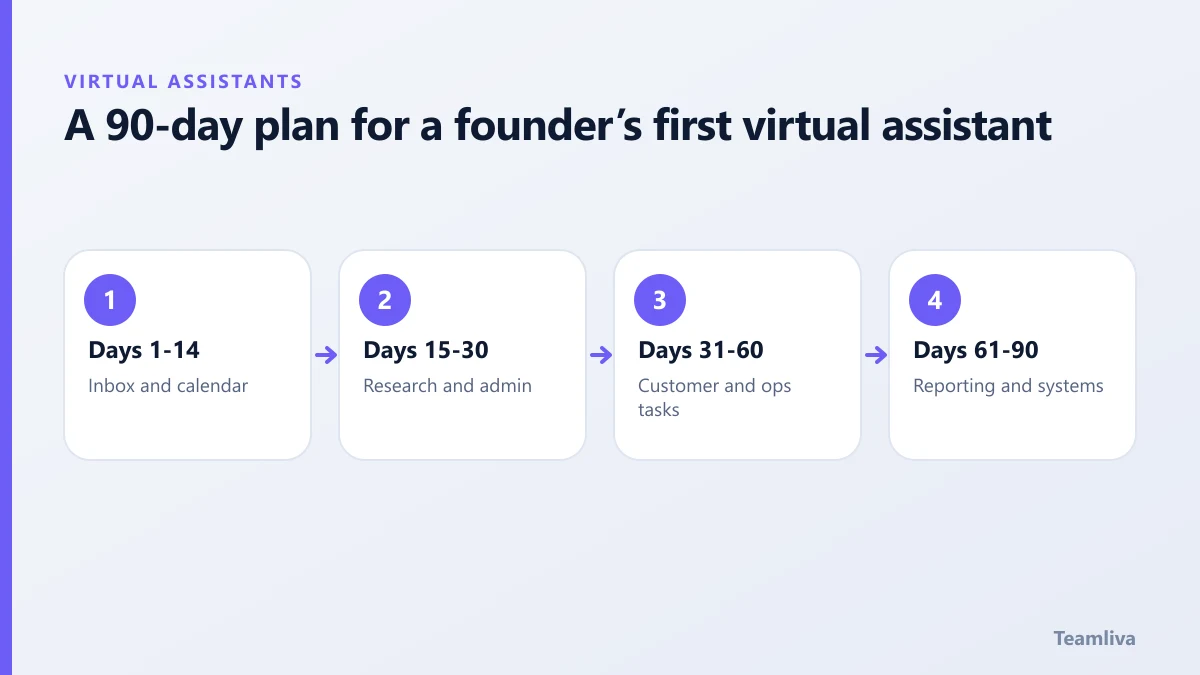
Days 1 to 14: inbox and calendar
Give delegate access to email and calendar with clear rules: what to answer, what to draft for you, what to flag. This delivers instant relief and builds trust.
Days 15 to 30: research and admin
Investor lists, competitor summaries, travel booking, expense reports and document formatting. Keep instructions written and reusable.
Days 31 to 60: customer and operations tasks
Support inbox triage, onboarding emails, data entry, CRM updates and simple order processing. See customer service virtual assistant.
Days 61 to 90: reporting and systems
Weekly reports from your tools, updating dashboards and documenting processes so the business can scale beyond you.

What not to delegate yet
- Fundraising strategy and investor relationships.
- Product decisions and hiring decisions.
- Anything requiring authority you have not defined.
You can move these later, once your assistant has proven judgement.
Keep the structure lean
- One assistant, clear scope. Resist the urge to add roles before you have documented the first.
- Trial first. A one to two week paid trial reveals fit quickly.
- Written instructions. Every task you explain twice becomes a guide.
- A simple cadence. A short daily update and a weekly review.
Use our onboarding plan and management guide.
Budget considerations
Start with a part-time arrangement, such as 10 to 20 hours a week, and scale up when the workload justifies it. Compare models in virtual assistant cost and pricing models. The US Small Business Administration offers general guidance for new businesses at sba.gov.
Common mistakes
- Hiring before you know what to delegate.
- Giving full access to everything on day one.
- Vague instructions and no feedback.
- Expecting strategic thinking from a junior assistant.
- Choosing on price alone.

What a virtual assistant for startups can free up in a week
A founder who spends ten hours a week on email, scheduling, expense reports and data entry can often hand most of it over within a month. The hours returned can go to customer conversations, hiring or product work, which is where early-stage value is created.
Try this exercise for one week: keep a simple log of everything you do in 30-minute blocks. At the end, mark each block "only I can do this", "someone could do this with instructions" or "should not be done at all". The second group is your delegation list. The third group is your fastest saving.
Signs your delegation is working
- You spend fewer evenings clearing your inbox.
- Meetings are scheduled without back-and-forth from you.
- Customers get replies more quickly.
- You can describe your assistant’s work in a few lines.
- You have written at least three guides for recurring tasks.
When to move from one assistant to a small team
If your assistant is consistently full and tasks are waiting, consider adding a second person with a different skill, such as support or bookkeeping, or moving a process to a managed pod. Our guide to scaling with a remote team explains the options, and virtual assistant vs BPO helps you choose.
Key takeaways: virtual assistant for startups
- A virtual assistant for startups pays off fastest on inbox, calendar and admin, which frees founder hours for customers and product.
- Log a week of your time in 30-minute blocks to find what to delegate and what to stop doing.
- Start part-time, run a paid trial and write a guide for every task you explain twice.
- Hold back fundraising, product and hiring decisions until the assistant has proven judgement.
- Add a second person or a managed pod only when the first assistant is consistently full.

Get set up
Teamliva (Team Liva) supplies managed virtual assistants for start-ups and small teams, working US hours from Dhaka. Explore our virtual assistant services or contact us with the first three tasks you want off your plate.
Frequently asked questions
When should a startup hire a virtual assistant?
When you regularly spend time on tasks below your pay grade and those tasks are repeatable. Many founders start once admin consumes several hours a week.
What is the first thing a founder should delegate?
Inbox and calendar management is a common first step because it is easy to define, low risk with the right access rules and frees time immediately.
- #Teamliva
- #TeamLiva
- #VirtualAssistant
- #VirtualAssistantServices
- #HireAVirtualAssistant
- #VirtualAssistantForStartups
- #StartupFounders
- #Delegation
- #LeanTeam